Quick Guide to Growing Bottlebrush Buckeye
USDA Hardiness Zones: 4–8
Best Soil: Moist, well-drained, organically rich soil
Sunlight: Shade to part shade or morning sun
Watering: Deeply once a week; more often in hot, dry spells
Bloom Time: Early summer (June–July)
Native: The Southeastern United States
Wildlife Benefit: Attracts a wide variety of pollinating insects, hummingbirds, and eastern swallowtail butterflies
Why Bottlebrush Buckeye Belongs in Every Shade Garden
Bottlebrush buckeye (Aesculus parviflora) is an excellent native plant choice for a large space in a shade garden. It can form colonies over time due to the suckering growth habit.
It is a multi-stemmed, deciduous shrub with a naturally rounded shape that matures to 8 to 12 feet tall and 8 to 15 feet wide.
Note: Provide plenty of space for it to spread, as it will form a large colony over time.
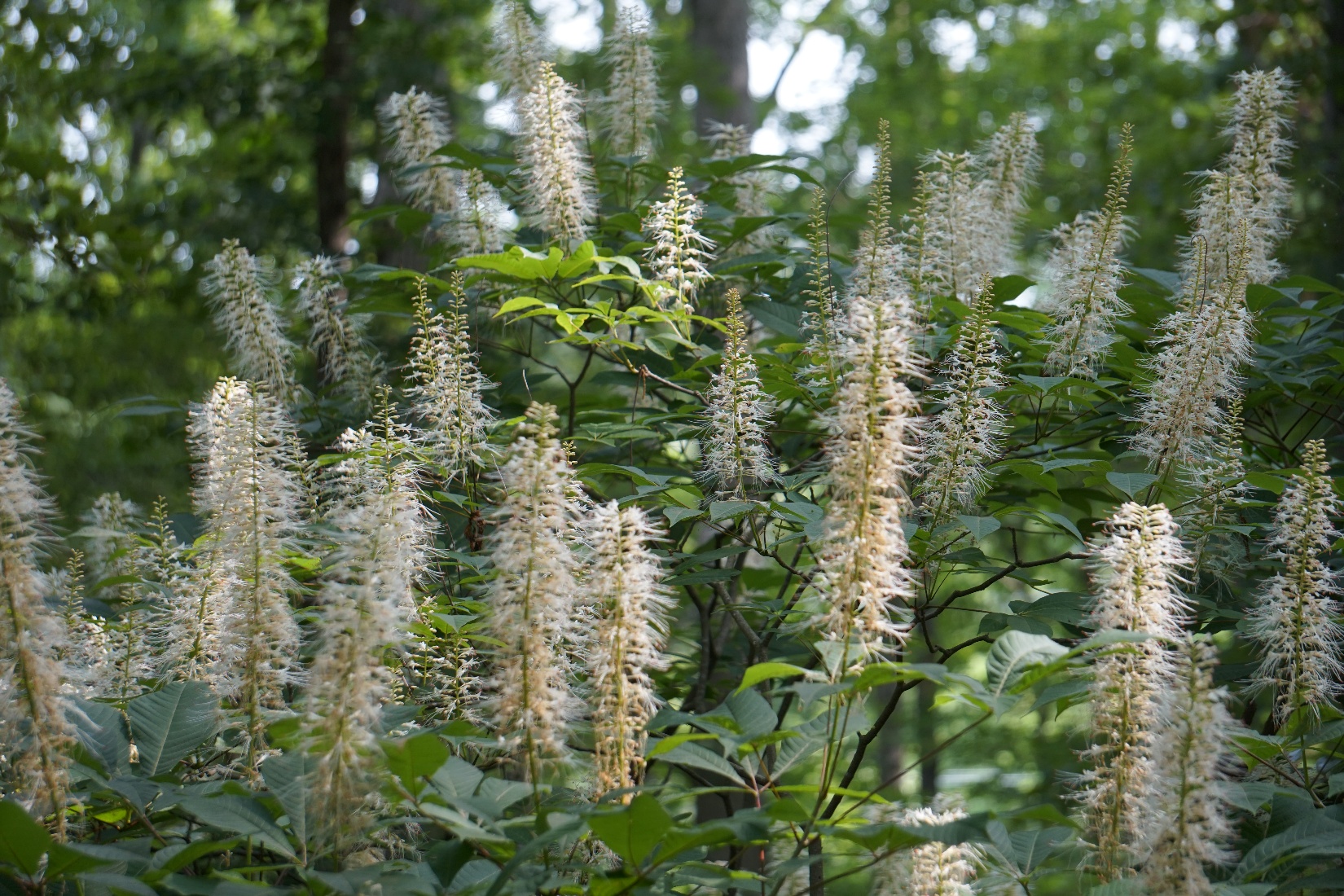
Bottlebrush buckeye (Aesculus parviflora) is an excellent native plant choice for a large space in a shade garden.
Barbara H. Smith, ©2025 HGIC, Clemson Extension
Bottlebrush Buckeye Leaf Characteristics and Seasonal Color
The palmately compound dark green leaves with 5 to 7 leaflets emerge in the spring and turn a vibrant greenish-gold in the fall. They are arranged opposite each other on the branch, with serrated leaf margins.

Bottlebrush buckeye (Aesculus parviflora) is an excellent native plant choice for a large space in a shade garden.
Barbara H. Smith, ©2025 HGIC, Clemson Extension

The foliage turns a vibrant, greenish-gold in the fall.
Barbara H. Smith, ©2025 HGIC, Clemson Extension
When Bottlebrush Buckeye Blooms: Showy Summer Flowers
In the early summer, after other buckeye species have finished blooming, bottlebrush buckeyes are covered with tall, 6- to 12-inch white, spidery panicle flowers with slender stamens (male reproductive organs) and reddish-pink anthers (the part of the stamen that produces pollen). The long, white, feathery panicles resemble a bottlebrush, thus giving the plant its common name.
Bees and other pollinating insects will exhibit red pollen sacs when gathering pollen from bottlebrush buckeyes.
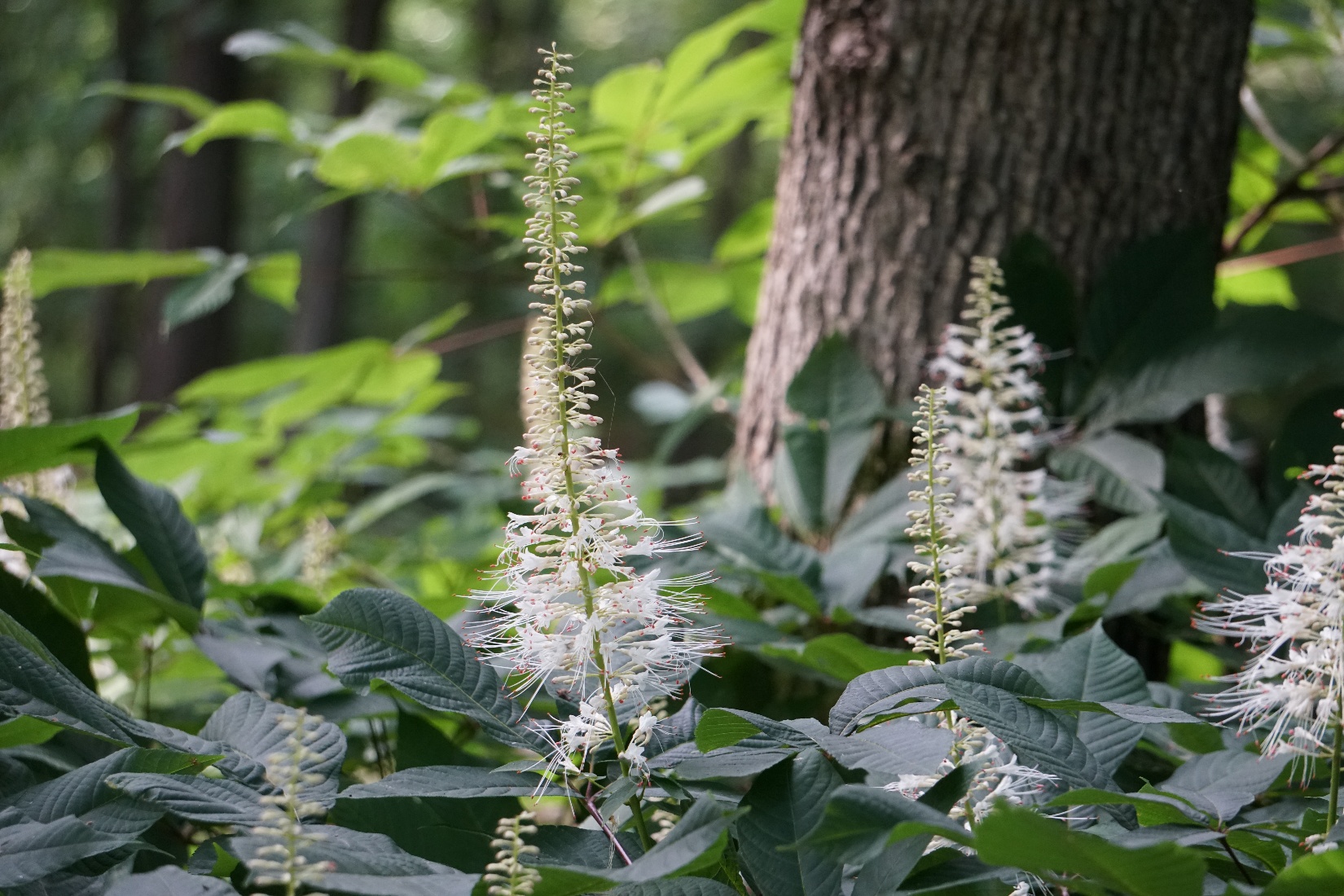
Bottlebrush buckeyes will bloom in June and July after other buckeye species have finished blooming.
Barbara H. Smith, ©2025 HGIC, Clemson Extension

The anthers at the end of the stamens have bright reddish-pink pollen.
Barbara H. Smith, ©2025 HGIC, Clemson Extension

Honey bees and other pollen-gathering insects will have red pollen sacs after gathering pollen from a bottlebrush buckeye.
Barbara H. Smith, ©2025 HGIC, Clemson Extension
Bottlebrush Buckeye Seeds and Fall Fruit
Bottlebrush buckeyes produce a smooth, yellow seed that soon turns to a bright copper in late September or early October. The seeds will have a pale “buck eye” scar, which gives buckeyes the common name, as the scar resembles a buck’s eye.
Caution: Don’t be tempted to eat the seed as they are poisonous to people and pets.

Mature bottlebrush buckeye seeds will turn a copper color when mature.
Barbara H. Smith, ©2025 HGIC, Clemson Extension
How to Propagate Bottlebrush Buckeye
Bottlebrush buckeye is easily propagated by seed or rooted cuttings.
Propagation by Seed
The seed should be planted in the fall as soon as they are gathered and not allowed to dry out, as they will shrivel quickly.
They can be planted in a soil mix in containers or planted directly in moist, organically rich soil in a wooded area.
Propagation by Rooted Cuttings
Root cuttings can be taken when the plant is dormant, typically in late fall or winter.
Carefully dig up a sucker with the roots attached and transplant it to a desirable spot.
Insect and Disease Tolerance of Bottlebrush Buckeye
Bottlebrush buckeye is the most insect- and disease-tolerant of all the buckeye species. It is susceptible to leaf scorch, but it will still retain its foliage in good condition well into the fall.
Best Landscape Uses for Bottlebrush Buckeye
If enough space is allowed for the shrubs to spread, they make an excellent addition to borders, as a specimen, or when naturalizing in a wooded area.

Bottlebrush buckeyes make an excellent addition to a woodland garden, provided they are given sufficient space for the shrubs to spread.
Barbara H. Smith, ©2025 HGIC, Clemson Extension