
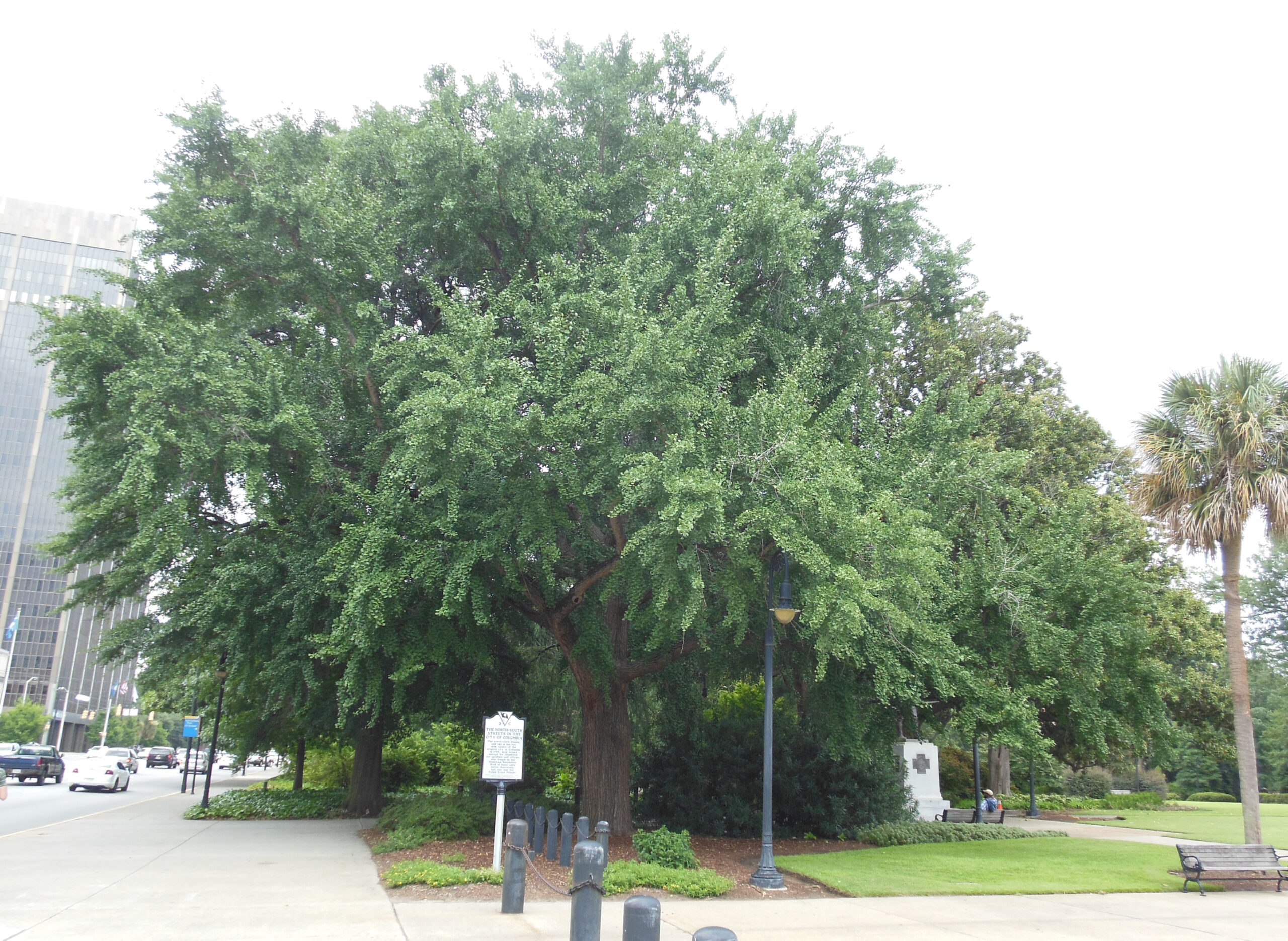
Located on the state grounds in Columbia, South Carolina, ginkgo (Gingko biloba) tolerates the challenging conditions of the built environment.
Robert F. Polomski ©2025, Clemson Extension
Quick Guide to Growing Ginkgo
USDA Hardiness Zones: 4 to 8b
Best Soil: Tolerant of a range of soil conditions; prefers well-drained soil.
Sunlight: Full sun to partial shade
Watering: Drought-tolerant once established
Care Tips: Avoid poorly drained or waterlogged sites; choose male cultivars to avoid messy, foul-smelling fruit.
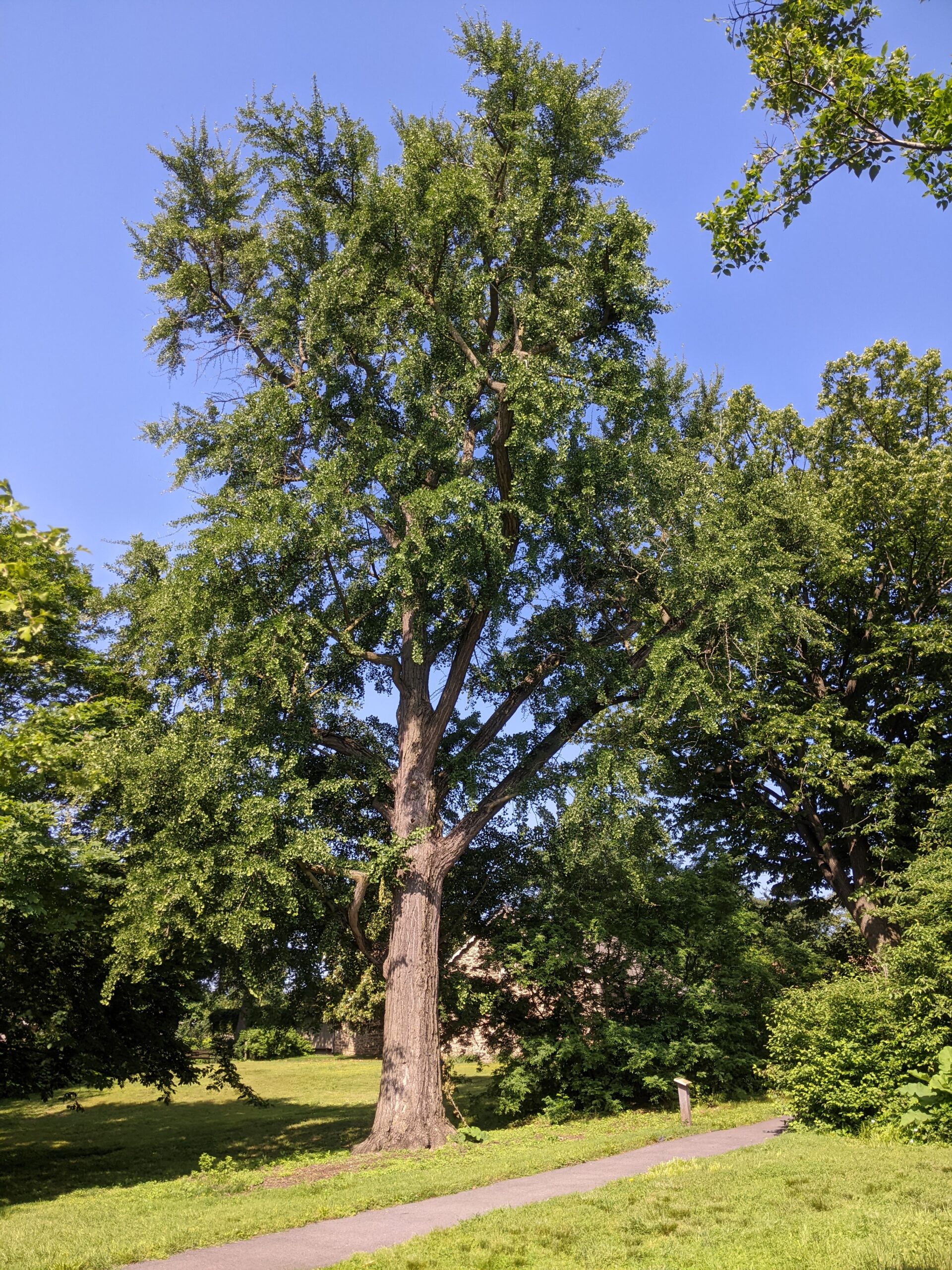
The oldest ginkgo in North America in Bartram’s Garden in Philadelphia in 2023. It has a diameter at breast height (measured 4.5 feet from the ground) or dbh of 46 inches.
Copyright ©2025 by Mandy Katz. Used with permission.
Ancient Origins of the Ginkgo Tree
Ginkgo or maidenhair tree (Ginkgo biloba) is an ancient “living fossil” considered one of the oldest plants on earth. Based on fossil evidence, it has remained essentially unchanged since its debut 180 million years ago during the early Jurassic period.
For centuries, ginkgo has been cultivated in China, Japan and Korea, where trees exceed 100 feet in height and live for more than 1,000 years.
History of Ginkgo in North America
According to the fossil record, ginkgo was last found in the northwestern U.S. 7 million years ago. It eventually returned to North America in 1784 from Japan 30 years before when William Hamilton, a botanist and plant collector, acquired three ginkgo plants from London.
Hamilton planted two at his Woodlands country estate south of Philadelphia, Pennsylvania. He gave the last one, a male ginkgo, to his friend and botanist, William Bartram, who planted it in his garden near Philadelphia. The two in Hamilton’s garden no longer exist, but the one planted by Bartram in the present day, Bartram’s Garden in Philadelphia, is currently the oldest ginkgo in North America.
In 1787 André Michaux, a diplomat and botanist to the King of France, transported ginkgos to his French Botanical Garden in Charleston, South Carolina. In 1841 nurseryman and horticulturist Andrew Jackson Downing promoted ginkgo’s ornamental merits and importance as a landscape tree:
“The Ginko (sic) tree is so great a botanical curiosity, and is so singularly beautiful when clad with its fern-like foliage, that it is strikingly adapted to add ornament and interest to the pleasure-ground. As the foliage is of that kind which must be viewed near by to understand its peculiarity, and as the form and outline of the tree are pleasing, and harmonize well with buildings, we would recommend that it be planted near the house, where its unique character can be readily seen and appreciated.”
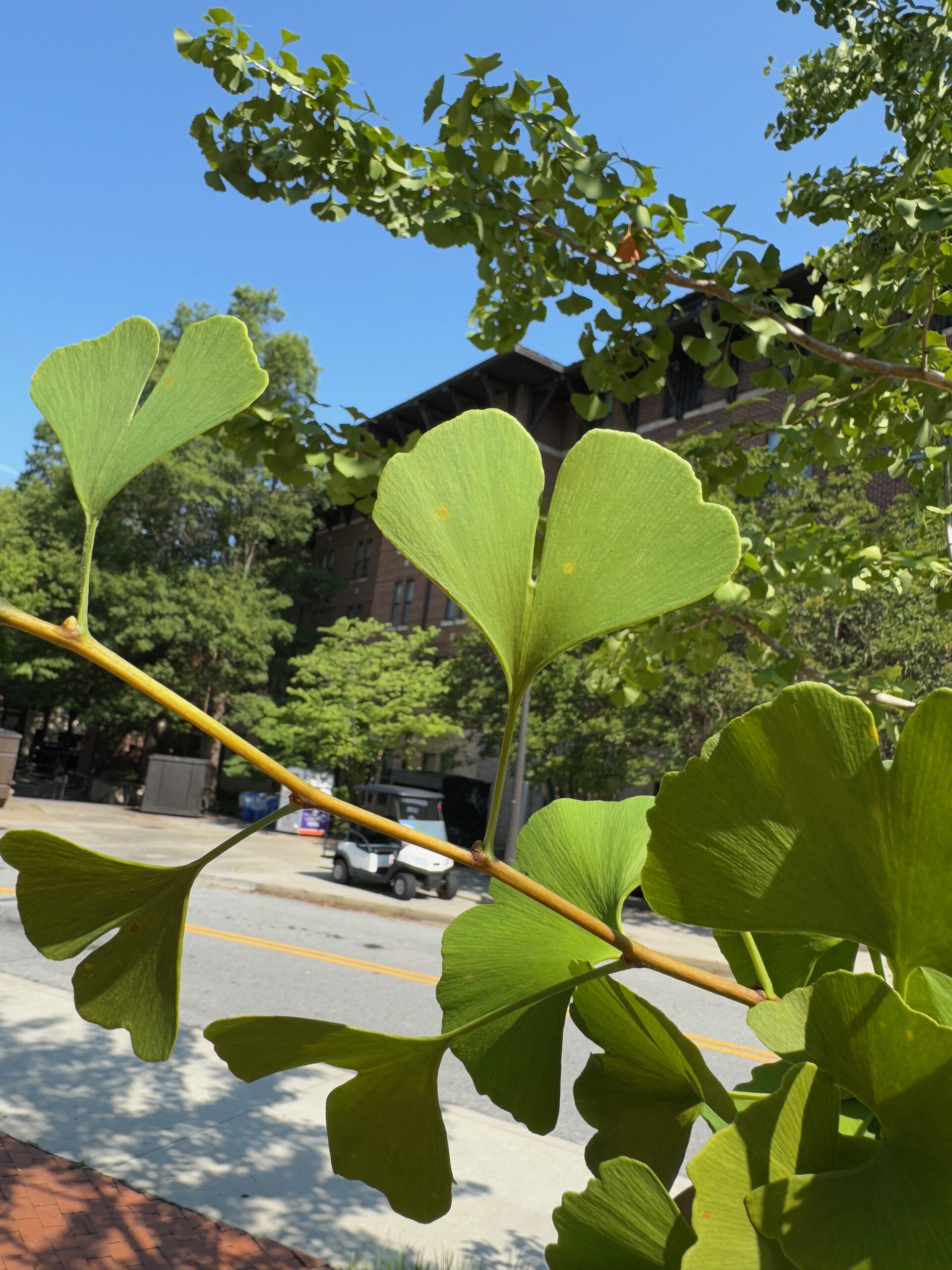
The unique, fan-shaped leaves of ginkgo (Ginkgo biloba) are sometimes notched at the tip into two lobes, which refers to its specific epithet of biloba.
Robert F. Polomski, ©2025 Clemson Extension
Botanical Description
Ginkgo is a large, deciduous shade tree with 2- to 3-inch long and wide, emerald-green, fan-shaped leaves with a pair of rounded lobes (hence the specific epithet “biloba”). They resemble the leaflets of maidenhair fern (Adiantum spp.), which gives it its common name.
In the fall, the leaves turn brilliant golden yellow, then almost all at once, are shed to create a golden carpet beneath the tree.
Male & Female Ginkgo Trees
Ginkgos are dioecious (derived from the Greek meaning “two houses”), with male and female reproductive parts on separate trees. Their primitive seed production process requires water for fertilization to occur.
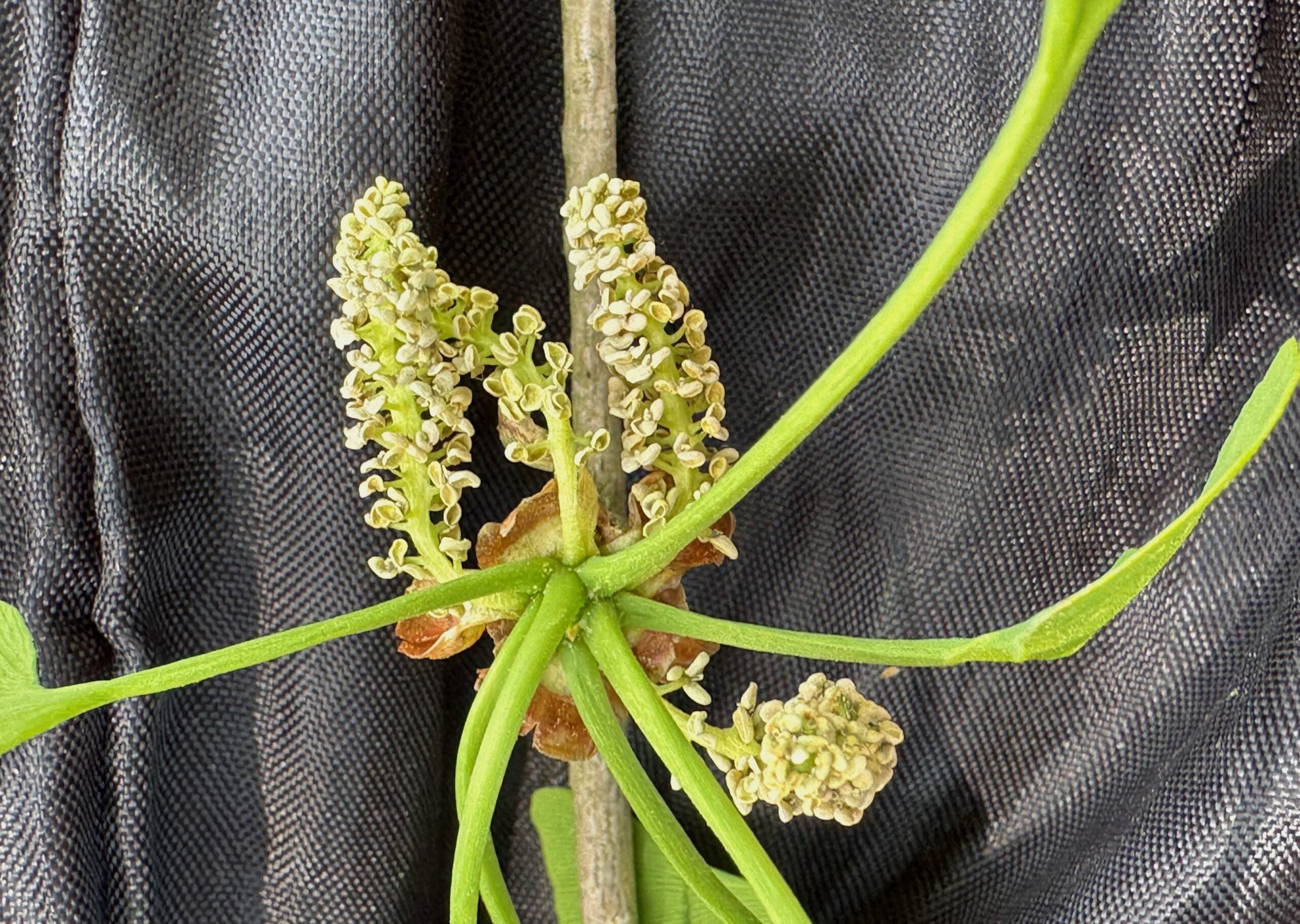
- Male Trees: Produce pollen-bearing catkins in March–April.
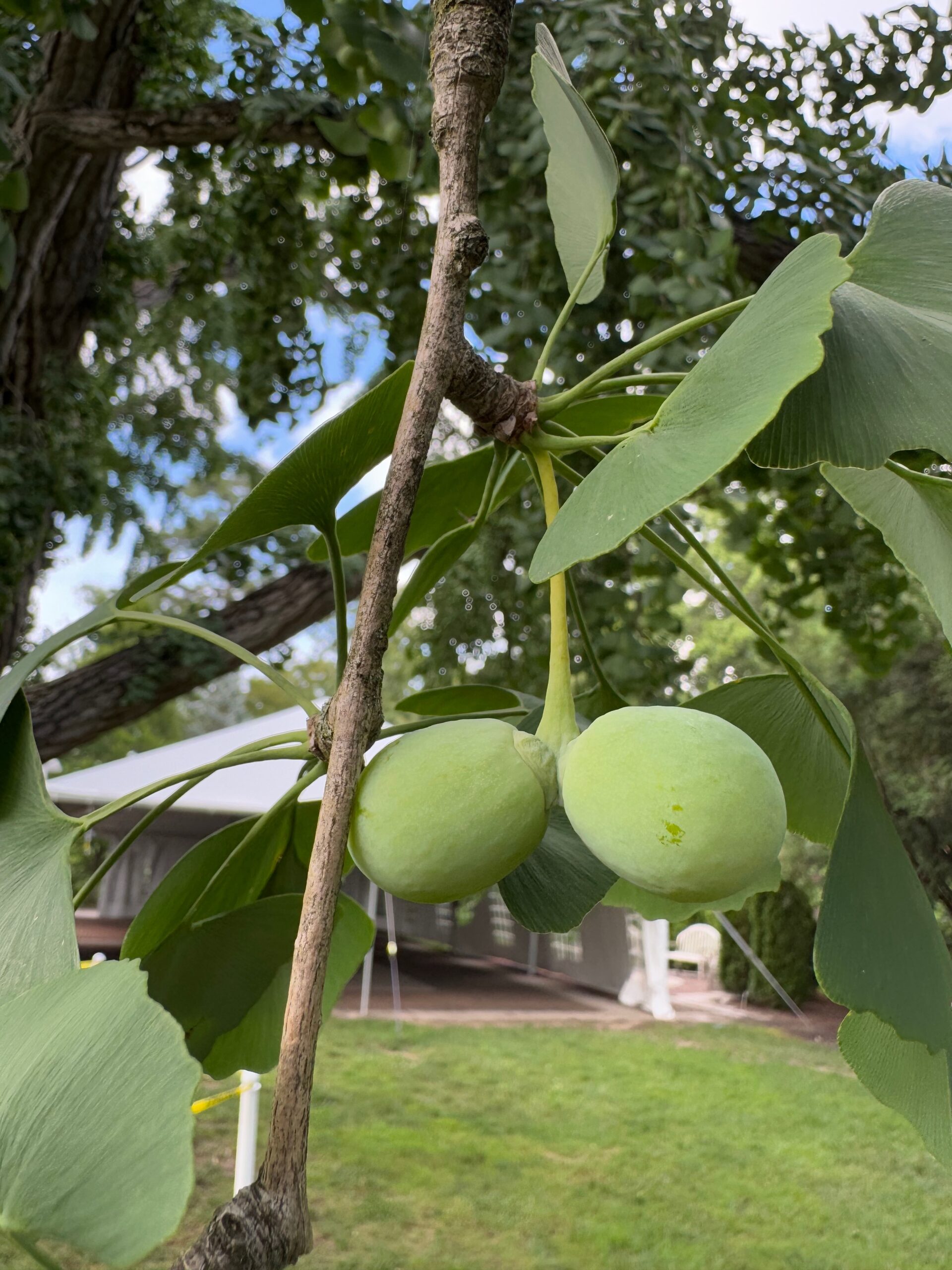
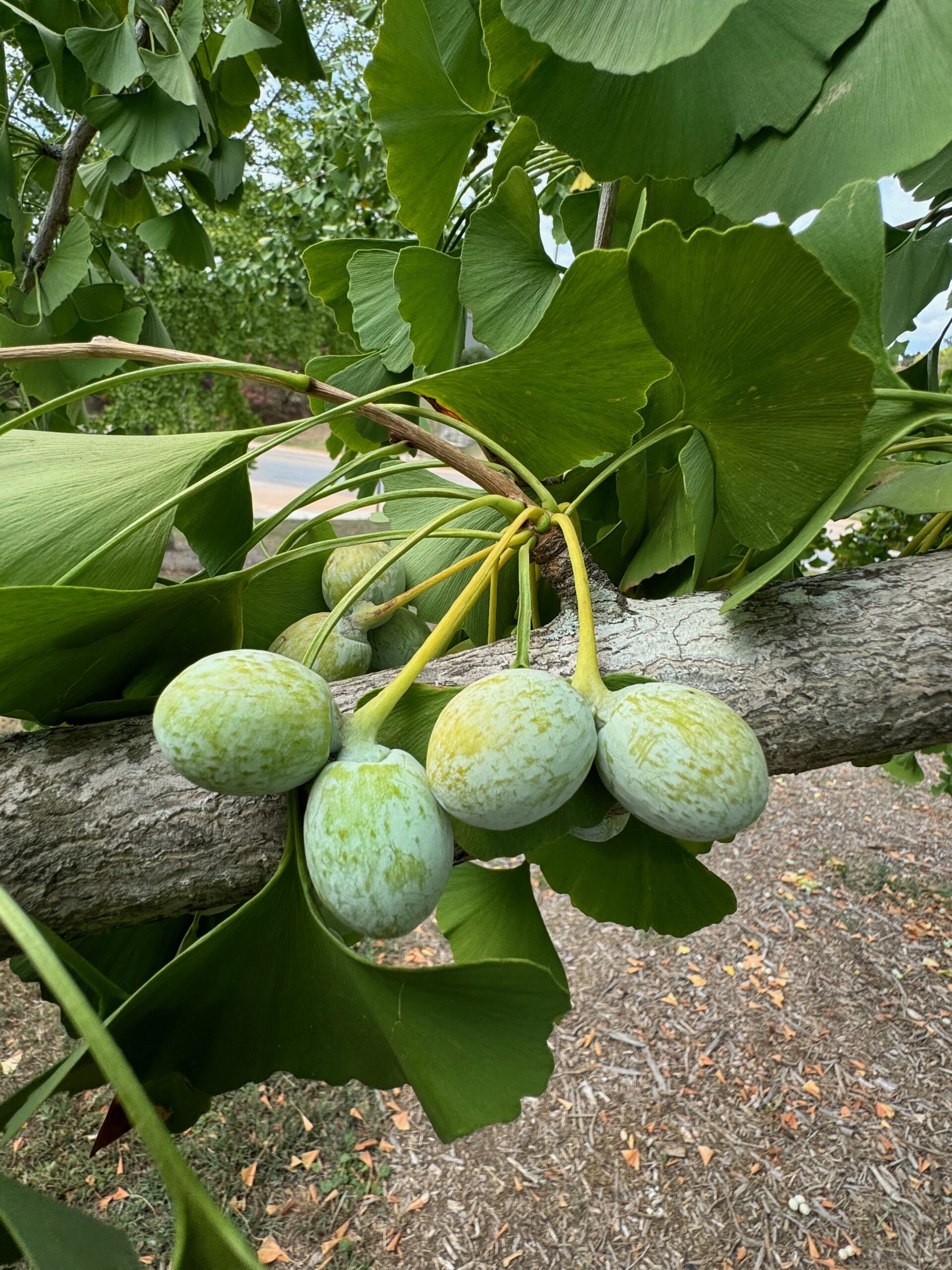
- Female Trees: Bear pairs of ovules or female cones attached to the tip of a long stalk called a peduncle.
When the male cones release their windborne pollen, the ovule captures it and pulls it inside.
As the ovule matures, it eventually releases a pair of motile sperm cells in August or September. Each sperm cell is powered by nearly a thousand tails called flagella as it swims to the egg where only one of them will fertilize the egg.
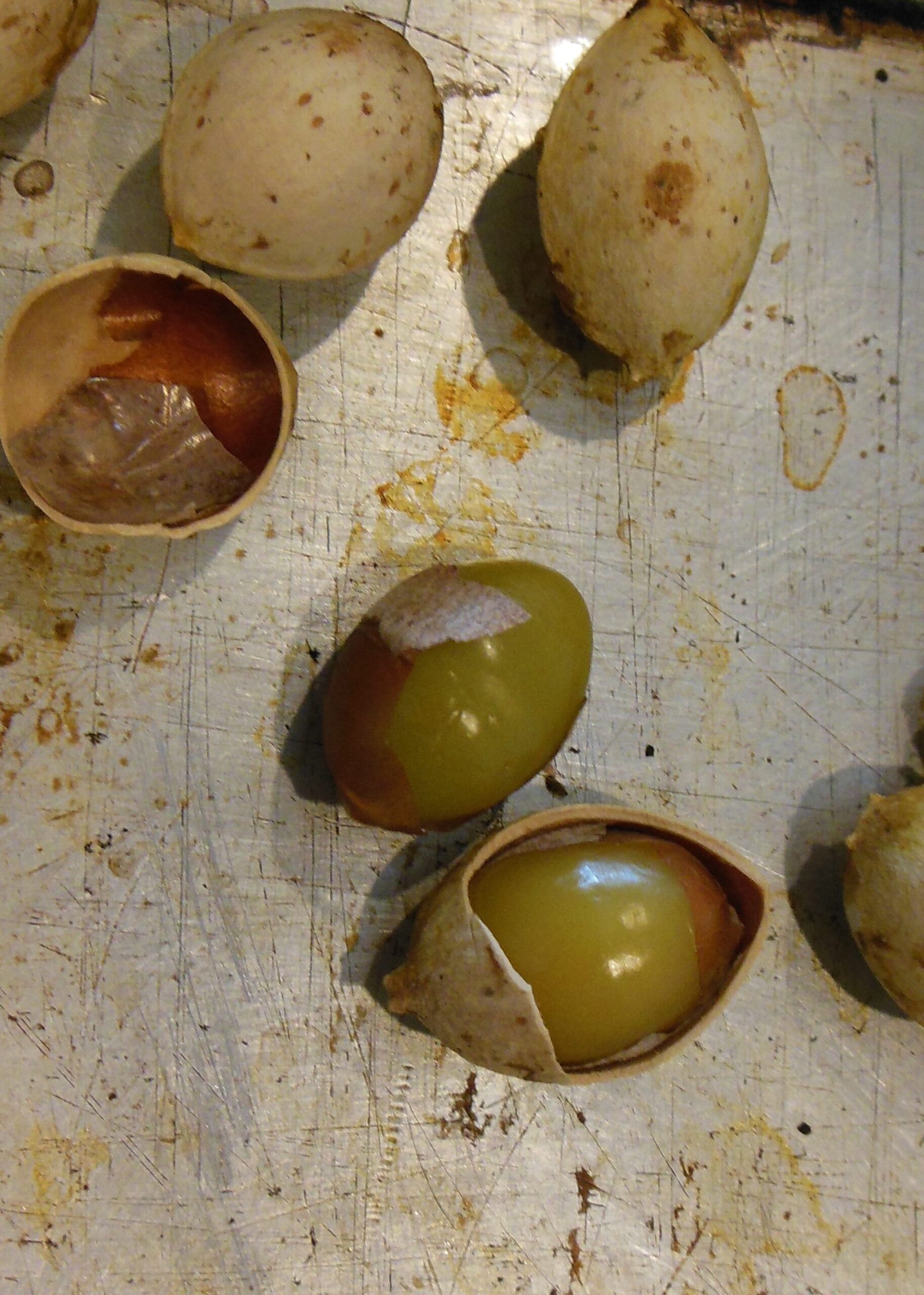
As the embryo develops inside, the soft fleshy, pulplike outer layer of the seed called a sarcotesta turns orange-brown and it eventually drops. The mature ovules or seeds produce a foul-smelling aroma when the pulp decays or is crushed underfoot.
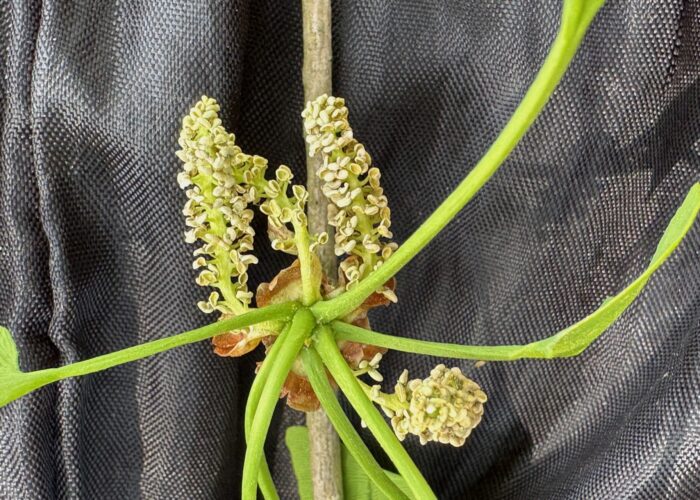 As the male, catkin-like pollen cones of ginkgo ripen, the individual pollen sacs open to shed their pollen grains. Robert F. Polomski, ©2025 Clemson Extension

Mature Size & Growth Habit
- Height: 50-80 feet
- Spread: 30-40 feet
Young ginkgo trees tend to look gangly with irregularly shaped canopies.
With selective pruning, they become more picturesque with age as they grow 50 to 80 feet high and 30 to 40 feet wide and develop full, round to pyramidal crowns.
Ornamental & Seasonal Features
The unusual, emerald fan-shaped leaves contribute to the ginkgo’s allure in the landscape. Ginkgo is one of the earliest trees to turn color in the fall with vibrant yellow leaves.
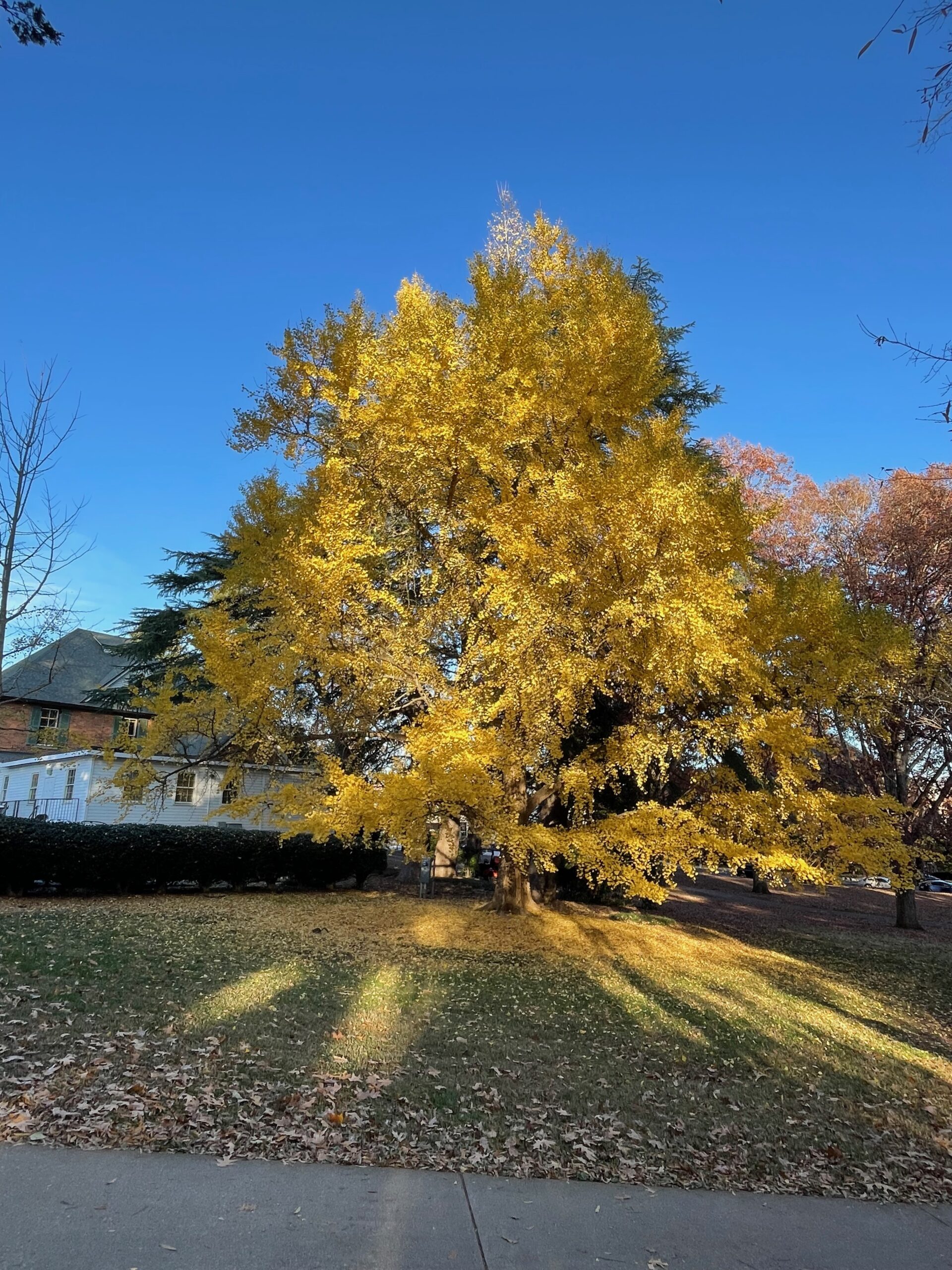
This ginkgo on the Clemson University campus produces spectacular bright golden yellow fall color.
Robert F. Polomski, ©2025 Clemson Extension
Landscape Uses for Ginkgo
Ginkgo combines urban toughness with beauty.
Common Uses Include:
- Street plantings
- Parking lot landscapes
- Parks and golf courses
In residential landscapes, consider smaller-statured cultivars for specimens, accents, or shade trees.
Best Growing Conditions:
- Well-drained soil
- Full sun to partial shade
- Once established: Moderate heat and drought tolerance
For more information on planting trees, refer to HGIC 1001, Planting Trees Correctly.
Pruning & Maintenance
Young trees require structural or formative pruning to maintain a pyramidal form with a central leader or topmost vertically oriented branch. To maintain a central leader, reduce the length of any wayward branches and any competing vertically oriented limbs.
Occasionally, the understock of a grafted cultivar will produce suckers that have to be removed. After their young formative years, mature trees require little pruning except to remove dead, broken, or weak limbs.
For more information on pruning, refer to HGIC 1003, Pruning Trees.
Common Problems
Ginkgo is an outstanding landscape and street tree, and with proper siting, planting and pruning, it can be expected to thrive.
- Leaf scorch on street tree caused by high heat and drought stress.
- Bacterial leaf scorch (Xylella fastidiosa) is a pathogen that infects ginkgo, resulting in the tree’s decline and may lead to its eventual death. Leafhopper and treehopper insects transmit this disease. Because bacterial leaf scorch produces similar symptoms to leaf scorch, samples must be submitted to Clemson’s Plant and Pest Diagnostic Clinic or a similar laboratory for analysis.
- Unpleasant-smelling pulp of ginkgo cones produced by female trees
- Skin irritation from ginkgolic acid in the pulp.
Since it takes 20 to 30 years for a seed-grown ginkgo to reach reproductive maturity and reveal its sex, select male cultivars instead of seed-propagated trees.
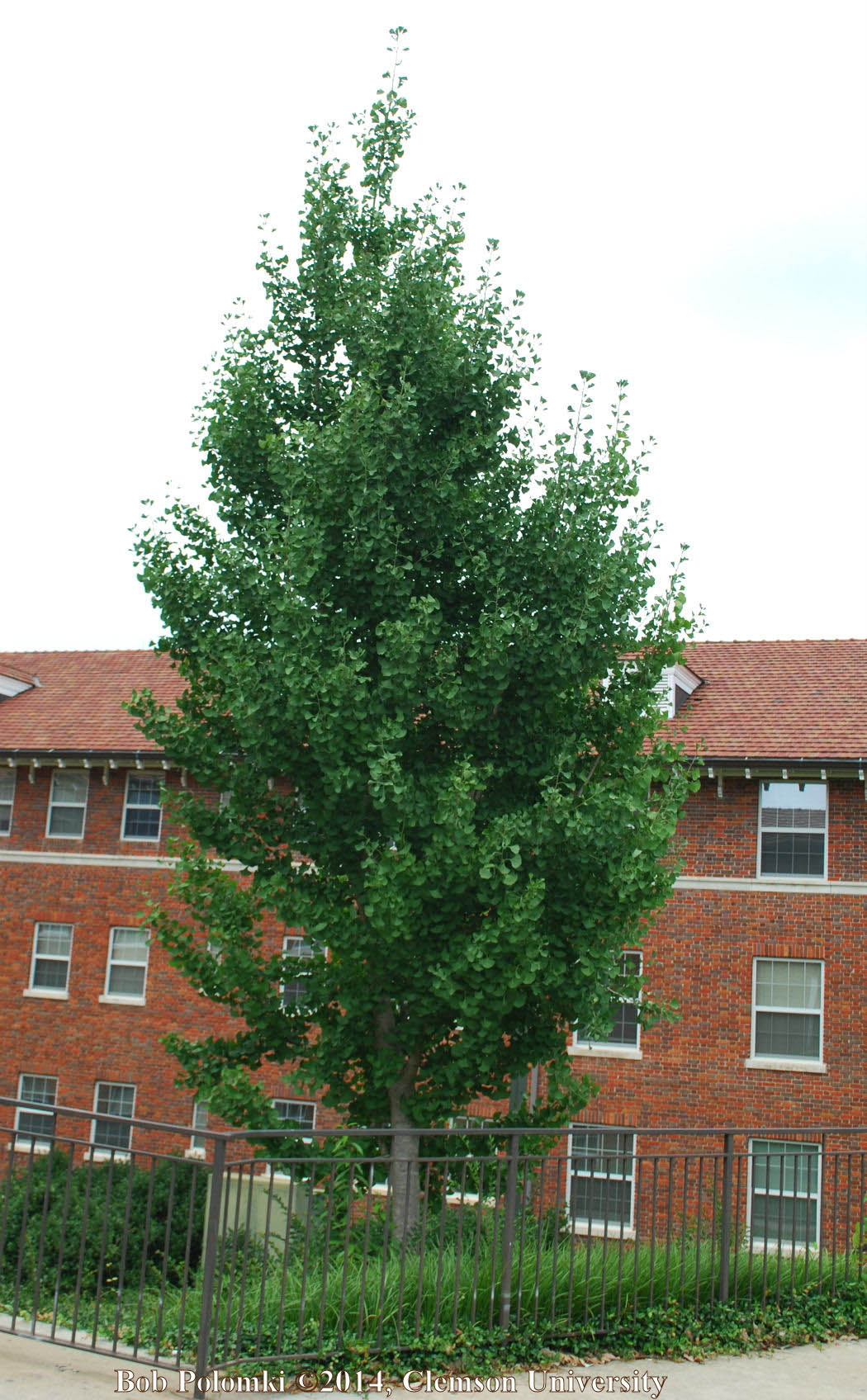
Regular structural pruning as a young tree results in a pyramidal shape with a dominant, central leader at the top and strongly attached side branches below.
Robert F. Polomski, ©2025 Clemson Extension
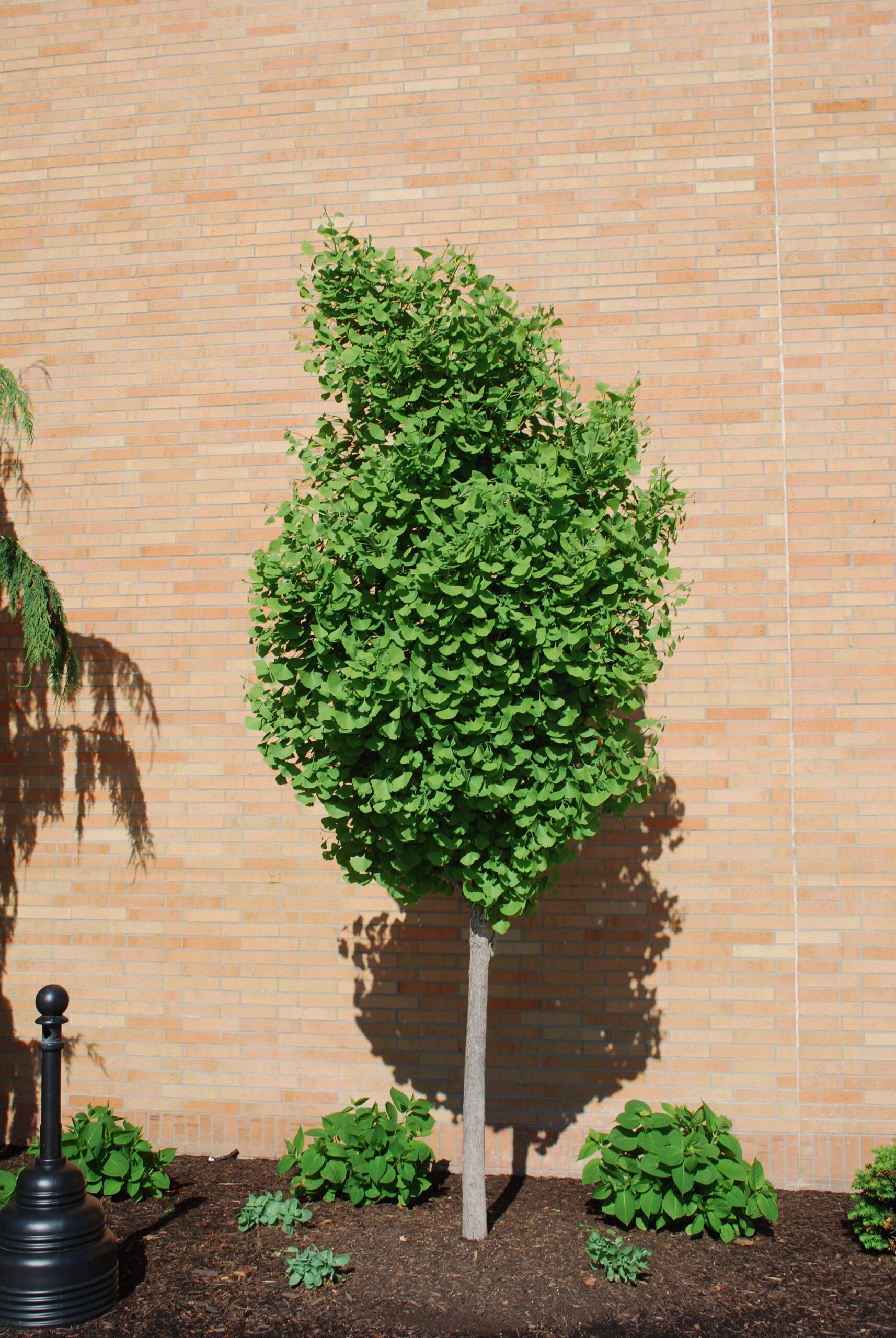
Columnar ginkgo cultivars with dense canopies are well-suited for narrow growing spaces.
Robert F. Polomski, ©2025 Clemson Extension
Notable Ginkgo Cultivars
More than 300 ginkgo cultivars have been documented. They range in size from dwarf to large trees, narrow and upright to broad and wide-spreading forms.
Other cultivars have variegated leaves or a weeping, pendulous habit. Many dwarf cultivars have been selected from witches’ brooms.
‘Jehoshaphat’, ‘Munchkin’, and ‘Troll’ have become collectors’ items and conversation pieces because of their bunched, bushy leaves and compact habits.
Ginkgo Cultivars for South Carolina Landscapes
The following ginkgo cultivars comprise a short list of desirable trees that merit planting in South Carolina landscapes.
- ‘Autumn Gold’: Male selected for bright golden yellow fall color. It matures to a height and spread of 50 feet and 30 feet, respectively, and develops a broadly conical, symmetrical crown.
- ‘Blagon’, Gold Spire™: Considered one of the best of the narrow cultivars for its dense, very slender pyramidal crown. Originally from France, it was introduced by Commercial Nursery Co., Inc., Decherd, Tennessee.
- ‘Chase Manhattan’, also ‘Bon’s Dwarf’: This shrubby, very slow-growing dwarf cultivar has smaller leaves than the species and a compact growth habit. Leaves turn bright yellow in the fall. Expect a mature height of 6 feet.
- ‘Fairmount’: This male clone was propagated from a tree planted during the Centennial Exposition in Philadelphia at Horticultural Hall in Fairmount Park in 1876. Matures into a dense, columnar tree, 50 to 75 feet high and 10 to 15 feet wide.
- ‘Gnome’: This dwarf cultivar occurred as a chance seedling in Tennessee. Forms a dense crown and grows slowy, 10 feet tall after 14 years.
- ‘Golden Globe’: Reportedly a fast-grower, this male tends to produce a full, dense crown when young, quite unlike typical immature ginkgoes, and eventually develops a broad, round crown with bright yellow fall color.
- ‘Halka’: A male that develops a uniform, broad pyramidal crown that eventually becomes oval with age. Expect a mature height of 45 feet with a 40-foot spread.
- ‘Jade Butterflies’: A slow-growing male that develops into a small tree, perhaps 10 to 12 feet high after 10 years. Introduced by Duncan & Davies Nurseries in New Plymouth, New Zealand.
- Golden Colonnade®, ‘JFS-UGA2’: An upright cultivar with a narrow oval canopy, expect it to grow 45 feet tall by 25 feet wide with bright gold fall color. Selected by the Univ. of Georgia, Athens.
- ‘King of Dongting Mountain’, also ‘King of Dongtingshan Mountain’: This female cultivar produces the largest seeds that are a culinary delicacy in Asian cultures. A 500-year-old tree measured 52 feet in height.
- ‘Magyar’: A male columnar form with uniform, symmetrical branching habit and a narrow, upright pyramidal form. Expect it to grow 60 feet tall and half as wide.
- ‘Majestic Butterfly’: A variegated cultivar with green leaves streaked with yellow, it maintains the variegation over the entire growing season. Grow this cultivar in afternoon shade. Expect a mature height of 10 feet. Discovered as a “sport” or mutation on ‘Jade Butterflies.’
- Princeton Sentry®, ‘PNI 2720’: This upright, dense, narrow-growing male matures to a height of 60 feet and a spread of 25 feet.
- ‘Shangri-la’: This fast-growing male develops a compact, pyramidal shape with an expected mature height of 40 feet.

Gnome is a dwarf, slow-growing ginkgo cultivar that produces a dense, compact crown.
Robert F. Polomski, ©2025 Clemson Extension

The unique incised or split leaves of Jade Butterflies ginkgo turn an attractive gold in the fall.
Robert F. Polomski, ©2025 Clemson Extension
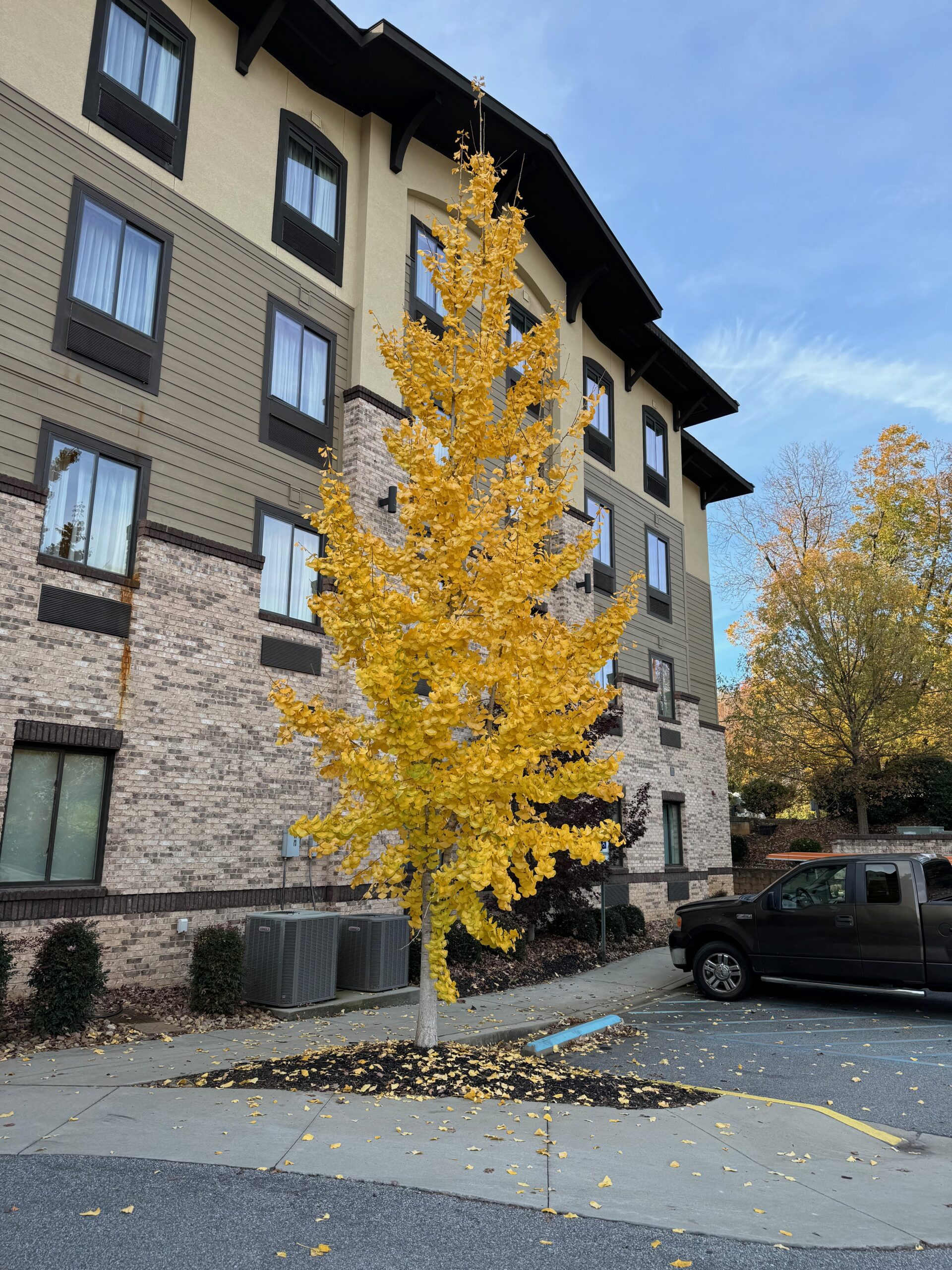
The narrow, columnar ginkgo cultivar, PNI 2720, Princeton Sentry®, is widely used in harsh urban environments and treasured for its spectacular fall color.
Robert F. Polomski, ©2025, Clemson Extension
References and Additional Reading
- Author unknown. Ginkgo biloba ‘Gnome.’ JC Raulston Arboretum Plant Search
- https://jcra.ncsu.edu/horticulture/our-plants/results-by-name-serial-number.php?serial=117416. [accessed 27 June 2025].
- Barker CS, Elston DM. 2022. Botanical Briefs: Ginkgo (Ginkgo biloba) Cutis. 110(1):30-33. https://cdn.mdedge.com/files/s3fs-public/CT110001030.PDF. [accessed 27 June 2025].
- Chaudhuri S. 2024. The story of Ginkgo Biloba (sic) should be a great lesson of why not to fall in despair during this challenging time. Medium: Human stories & ideas. https://tschaudhuri.medium.com/the-story-of-gingko-biloba-should-be-a-great-lesson-of-why-not-to-fall-in-despair-during-this-3c9ffac3a1f8. [accessed 27 June 2025].
- Cox TJ, Ruter JM. 2013. Landscaping with conifers and ginkgo for the Southeast. University Press of Florida, Gainesville, FL.
- Crane P. 2015. Ginkgo: the tree that time forgot. Yale University Press, New Haven.
- Del Tredici P. 1981. The ginkgo in America. Arnoldia 51(2):150-161.
- Del Tredici P. 1991. Ginkgo and people – a thousand years of interaction. Arnoldia 51(2): 2-15.
- Del Tredici P. 2000. The evolution, ecology, and cultivation of Ginkgo biloba, pp. 7-23. In: TA Van Beek (ed.). Ginkgo biloba. Edition 1. Harwood Academic Publishers, Amsterdam.
- Dirr MA, Warren KS. 2019.The tree book: superior selections for landscapes, streetscapes, and gardens. Timber Press, Portland, OR.
- Downing AJ. 1844. A treatise on the theory and practice of landscape gardening : adapted to North America, with a view to the improvement of country residences treatise on the theory and practice of landscape gardening. 2nd ed. Wiley & Putnam, NY. https://archive.org/details/treatiseontheor00down/page/n7/mode/2up. [accessed 27 June 2025].
- Gauthier N. 2021. Bacterial leaf scorch of shade trees. Plant Pathology Fact Sheet PPFS-OR-W-12. Extension Plant Pathology. University of Kentucky. https://plantpathology.ca.uky.edu/files/ppfs-or-w-12.pdf. [accessed 27 June 2025].
- Gibbens S. 2023. “Ginkgo trees nearly went extinct. Here’s how we saved these ‘living fossils.’” National Geographic Magazine. https://www.nationalgeographic.com/environment/article/ginkgo-trees-nearly-went-extinct-how-we-saved-these-living-fossils. [accessed 25 June 2025].
- Stanković MS. 2016. Biology and ecology of Ginkgo biloba L. (Ginkgoaceae), p 1-27. In: Fisher E (ed). Ginkgo biloba: biology, uses, and health benefits. Nova Science Publishers, Inc. NY.
- Starr Herr-Cardillo. 2018. “Introducing the two Williams.” The Woodlands Blog, 16 January 2018. https://www.woodlandsphila.org/blog/2018/1/16/introducing-the-two-williams. [accessed 27 June 2025].
Document last revised on 11/25 by Robert F. Polomski.
Published 07/14


