American Sycamore Seed Pods That Look Like Winter Ornaments
With Christmas and the holiday season now in the rearview mirror, these seed pods felt like a gentle echo of the festivities. Outlined against the bluest sky, they were a beautiful sight on a cold January morning.

Sycamore fruit on a cold January day.
Sue Watts, ©2026 SC Botanical Garden, Clemson University
These natural baubles are the fruits of the American sycamore (Platanus occidentalis), sometimes called the buttonwood tree because of its distinctive seed balls.
Where American Sycamore Trees Grow Best
American sycamore is a bottomland tree, happiest on floodplains and in other moist environments.
On our long holiday journeys back and forth between Clemson and Halifax, Nova Scotia, sycamores were easy to spot along the highway. Their ghostly white trunks stood out clearly against other, less vibrant trees.
Spotting them became a family road-trip game and once we saw them, we knew water was nearby.
How Large American Sycamore Trees Can Grow
Under ideal conditions, sycamores grow quickly and reach impressive proportions. A typical large specimen grows between 70 and 100 feet tall, with a canopy spread of 60 to 80 feet.
President George Washington, during his early career as a land surveyor, encountered three enormous sycamores while surveying for a canal in Virginia. He reported that the largest had a circumference of nearly 45 feet at chest height.
Record-Breaking and Historic American Sycamores
Today’s national champion sycamore, growing in Ashland, Ohio, boasts a trunk circumference of 36 feet, stands 124 feet tall, and has a crown spread of 88 feet.
Sycamores are also long-lived trees; the oldest recorded specimen, the Bonsall Buttonwood, is estimated to be more than 400 years old.
Wildlife Supported by American Sycamore Trees
Sycamore trees contribute significantly to ecological biodiversity by providing food for a wide range of animals.
In winter, when food is scarce, small birds and mammals feast on the high-protein seeds that persist through the cold months.
Sycamore sap is favored by sapsuckers who create distinctive wells in the bark. These wells trap insects in the sticky sap, attracting other animals, from hummingbirds to porcupines, to the sap-and-insect buffet.
Pollinator and Caterpillar Value of American Sycamore
In summer, pollinators are drawn to the tree’s sweet nectar, and the leaves provide food for many species.
More than 40 species of Lepidoptera larvae feed on sycamore foliage, and these soft, squishy caterpillars are an important food source for nestling birds.
Porcupines, beavers, and deer also browse on the bark, twigs, and leaves.
How American Sycamores Provide Shelter for Wildlife
Many animals find shelter in sycamores, including humans.
The broad canopy is favored by several heron species, which perch near water sources while hunting fish and amphibians. In turn, the dense foliage shades waterways, helping regulate temperatures for aquatic species.
The tree’s peeling bark supports a variety of small insects, feeding animals higher up the food chain.
Hollow Sycamores and Human History
Over a sycamore’s long lifetime, many cavities form in the heartwood. These spaces can shelter everything from cavity-nesting birds, including owls, ducks, and woodpeckers, to mammals, large and small.
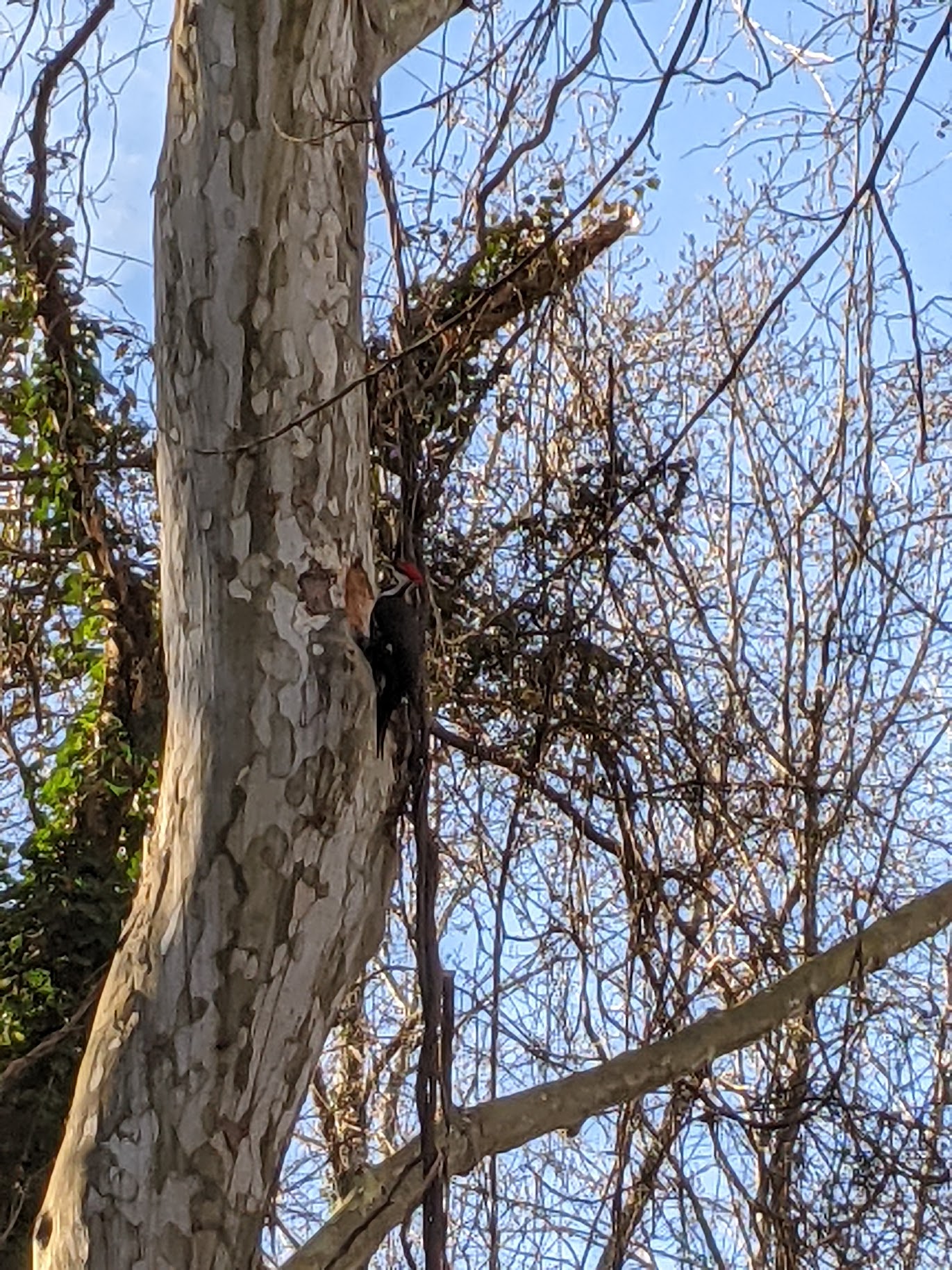
Piliated woodpecker feeding on the peeling bark of a sycamore’
Sue Watts, ©2026 SC Botanical Garden, Clemson University
There are even historical accounts of people sheltering inside sycamores or living in them for extended periods.
From 1764 to 1767, two brothers reportedly lived inside a large sycamore after deserting the British army during the French and Indian War. Botanist Donald Peattie wrote in his 1950 book A Natural History of Trees that “…pioneers often stabled a horse, cow, or pig in a hollow sycamore, and sometimes a whole family took shelter in such a hospitable giant, until the log cabin could be raised.”
Appreciating the American Sycamore Today
If you have a sycamore on your land or in your neighborhood, you probably can’t live in it—but you can certainly appreciate it for its beauty, history, and remarkable ecological value.
References
- Sullivan, Janet. 1994. Platanus occidentalis. In: Fire Effects Information System, [Online]. U.S. Department of Agriculture, Forest Service, Rocky Mountain Research Station, Fire Sciences Laboratory (Producer).
- Wildlife of the James – The Ghostly Sycamore
- Majestic Giant: Sycamore is Ohio’s Biggest Recorded Tree, ABC News
- Monumental Trees: American Sycamore ‘Bonsall Buttonwood’
- Monumental Trees: The thickest, tallest, and oldest American Sycamores (Platanus occidentalis)
- UFL IFAS Campus Tree Tour: American sycamore –Platanus occidentalis
- American Sycamore (Platanus occidentalis L.), bplant.org
- Smithsonian’s National Zoo: The Master Sap Tapper, Yellow-bellied Sapsucker
- Native Plant Finder
- Tree Notes: Hollow Sycamore Trees