
Quick Guide to Growing Periwinkle in South Carolina
Scientific names: Vinca minor (periwinkle); Vinca major (large periwinkle)
Common names: Periwinkle, Vinca, Myrtle
Plant type: Evergreen groundcover
Height:
- Vinca minor: ~6 inches
- Vinca major: Mounds up to 2 feet
Spread: Rapid, spreading by trailing/rooting stems
Light: Partial shade preferred; tolerant of full sun
Soil: Moist, well-drained, rich in organic matter; adaptable to various soils
Bloom time: Mostly March–April; sometimes again in fall
Flower colors: Purple, blue, or white (varies by cultivar)
Best landscape uses: Groundcover, erosion control, shaded slopes, under trees, containers
Not the same as: Bedding plant Catharanthus roseus (Madagascar periwinkle)
What Is Periwinkle (Vinca)?
Periwinkle is also called vinca or myrtle. Of the 12 species of periwinkle, two, Vinca minor and Vinca major, are popular groundcovers.
All species have opposite leaves and single flowers.
The perennial periwinkle should not be confused with the bedding plant, Madagascar periwinkle (Catharanthus roseus).
Periwinkle (Vinca) is a widely used evergreen groundcover in South Carolina gardens.
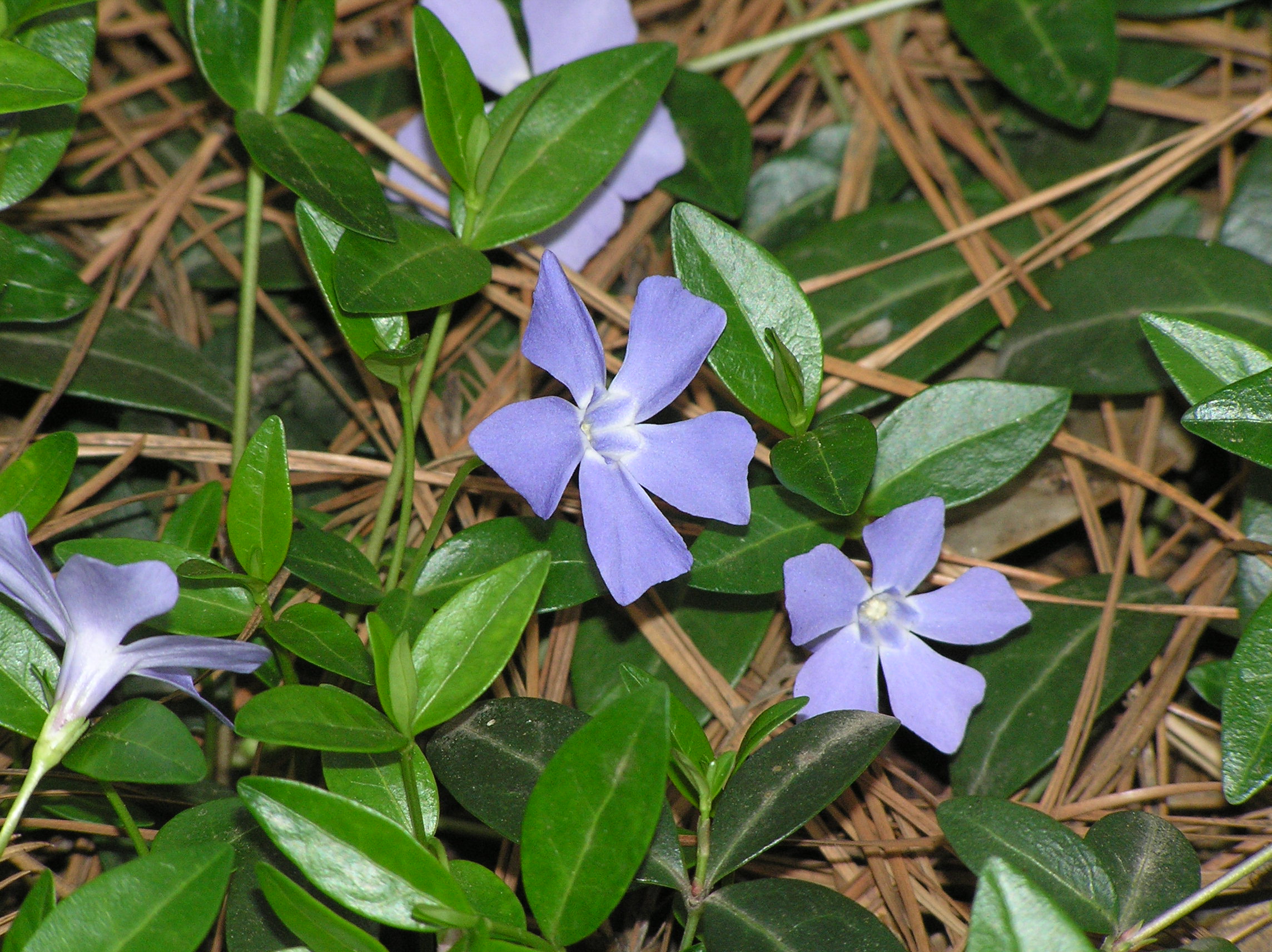
Periwinkle flowers in early spring.
Karen Russ, ©2007 HGIC, Clemson Extension
Description of Periwinkle (Vinca minor)
Growth Habit
Vinca minor grows about 6 inches tall, spreading in all directions by sending out long, trailing and rooting shoots, which make new plants.
Flowers & Bloom Time
Flowers are purple, blue or white depending on the cultivar. Plants bloom in March or April and sometimes again in the fall.
Foliage Characteristics
Periwinkle (Vinca minor) is an excellent evergreen groundcover with dark green foliage.
Oblong to ovate leaves are opposite, simple, ½ to 2 inches long, glossy, with a short petiole. They exude a milky juice when broken.

New growth of variegated large periwinkle emerges in spring.
Karen Russ, ©2007 HGIC, Clemson Extension
Description of Large Periwinkle (Vinca major)
Growth Habit
Vinca major, or large periwinkle, is a larger and more aggressive species than Vinca minor. It spreads rapidly and will mound up to 2 feet. Non-flowering stems root at the tips where they touch the ground.
Flowers & Bloom Time
The blue, funnel-shaped flowers are 1 to 2 inches in diameter. They are borne in abundance in early spring and sporadically throughout the summer.
Foliage Characteristics
Leaves are up to 3 inches long.
Landscape Uses for Periwinkle Groundcovers
The trailing, arching, evergreen stems of periwinkle root where they touch the soil.
Best Landscape Uses for Periwinkle (Vinca)
Periwinkle can be used in the landscape in the following ways:
- Groundcovers
- Erosion control on shaded slopes
- Understory areas beneath trees and shrubs
- Cascading from window boxes or planters
- Shaded foundations and north-side plantings
Spring-flowering bulbs interplanted with periwinkle will lend color and interest to the groundcover planting. Daffodils are particularly well-suited since they bloom with periwinkle and do not require frequent division.
Periwinkle’s ability to root at stem nodes makes it especially effective for erosion-prone areas.
How to Grow Periwinkle (Vinca): Site, Soil & Planting
Periwinkle prefers shade but will grow well in full sun. The foliage color is richer green in partial shade, but more flowers are produced in the sun.
Rooted cuttings or established plants are normally spaced from 12 to 18 inches apart.
How to Plant Periwinkle (Vinca) in South Carolina
- At a 6-inch spacing, periwinkle will completely cover an area in one year.
- Plant whenever the soil is workable.
- Provide sufficient water, especially when planting in summer.
Best Soil for Periwinkle (Vinca)
Periwinkle prefers moist, well-drained soil that is rich in organic matter. However, it is tolerant of a wide range of soil conditions.
Early Care and Maintenance for Periwinkle (Vinca)
Weeding and mulching are required on a regular basis until the groundcover fills in the planted area.
How to Care for Periwinkle (Vinca): Fertilizing, Pruning & Propagation
Periwinkle (Vinca) Fertilizer Guide
Fertilize only when necessary, preferably in the spring, with a complete fertilizer such as 10-10-10 at a rate of 6 to 8 pounds per 1,000 square feet.
How to Prune Periwinkle (Vinca)
Occasionally, shear plants close to the ground to encourage new growth.
How to Propagate Periwinkle (Vinca)
Periwinkle can be propagated in two primary ways:
- Taking tip cuttings of non-flowering stems in late spring
- Dividing throughout the season
Periwinkle (Vinca minor) Cultivars
The following cultivars of Vinca minor are commonly grown in South Carolina:
- ‘Alba’ – white flowers
- ‘Atropurpurea’ – purple flowers
- ‘Bowles Variety’ – blue flowers; grows vigorously in clumps
- ‘Variegata’ – blue flowers; and rich, yellow-variegated leaves
- ‘Flore Pleno’ – double purple flowers
- ‘Alboplena’ – double white flowers
- ‘Jekyll’s White’ – single, pure white flowers; more floriferous than ‘Alba’
- ‘Sterling Silver’ – dark blue flowers and white-margined foliage
Large Periwinkle (Vinca major) Cultivars
The following cultivars of Vinca major are commonly grown in South Carolina:
- ‘Alba’ – white flowers
- ‘Pubescens’ – pubescent leaves; red-purple flowers with narrow petals
- ‘Reticulata’ – foliage netted with yellow lines
- ‘Variegata’ (‘Elegantissima’) – creamy white leaf blotches; blue flowers
Common Periwinkle Problems & Diseases
Periwinkle is susceptible to dieback (plants wilt and “die back” to the ground), caused by fungal diseases.
Cankers, which are sunken, wound-like lesions, may be visible on the stem near the ground line.
Fungal leaf spots occasionally occur and look like brown circular-to-oval spots on the leaves.
Management Tips
- Shear off and discard infected leaves.
- Avoid overhead irrigation to reduce fungal infection.
- Chemical control is seldom necessary.
Healthy cultural practices, such as proper spacing and avoiding overhead irrigation, remain the most effective long-term strategies for managing periwinkle diseases.
For more information, see the section on Rhizoctonia Stem & Root Rot in HGIC 2108, Vinca Diseases.
Document last updated 11/25 by N. Jordan Franklin.
Originally published 06/99


