
Quick Guide / At-a-Glance
Affected Plants:
- American sycamore (Platanus occidentalis)
- London plane tree (Platanus x acerifolia)
Primary Disease Types:
- Anthracnose
- Powdery mildew
- Bacterial leaf scorch
Primary Insect Pests:
- Sycamore lace bug
Primary Causes:
- Fungal pathogens
- Bacterial infection
- Sap-feeding insect pests
Most Important Prevention Strategy:
- Maintain tree vigor through proper cultural care, sanitation, and removal of infected leaves and twigs
Chemical Control:
- Fungicides may protect small trees from anthracnose and powdery mildew
- Insecticides may control sycamore lace bug when needed
- Antibiotic root flare injections may suppress bacterial leaf scorch symptoms
Of the 10 species of sycamore (Platanus species), one species, American sycamore (Platanus occidentalis), and one hybrid, London plane tree (Platanus x acerifolia), are common in South Carolina. Both trees are well adapted to all areas of the state; however, they are susceptible to a few diseases and insect pests.
As always, the first line of defense against pest problems is to follow recommended cultural practices to maintain healthy plants. The healthier a plant is, the better it can withstand disease and insect pests.
For information on cultural practices that favor the growth of healthy sycamores, see HGIC 1022, Sycamore.
Sycamore Diseases: Anthracnose on Sycamore
Anthracnose is the most serious fungal disease affecting American sycamore trees in South Carolina.
Cause
Anthracnose is caused by the fungus Apiognomonia veneta (asexual stage – Discula platani).
Symptoms
Symptoms of anthracnose on sycamore include:
- Twig blight occurs in the spring before leaf emergence, killing tips of small, 1-year-old twigs
- Bud blight occurs in April and May, where expanding buds die due to girdling cankers on branches
- Shoot blight causes the sudden death of new shoots and immature leaves on infected branches
- Leaf blight resulting in crinkling, browning, and premature leaf drop
- Repeated defoliation during cool, wet spring weather (temperatures under 60°F)
- “Witches’ broom” growth caused by branch girdling and shoot proliferation
- Fungal spores spread by rain and wind to leaves, buds, and twigs
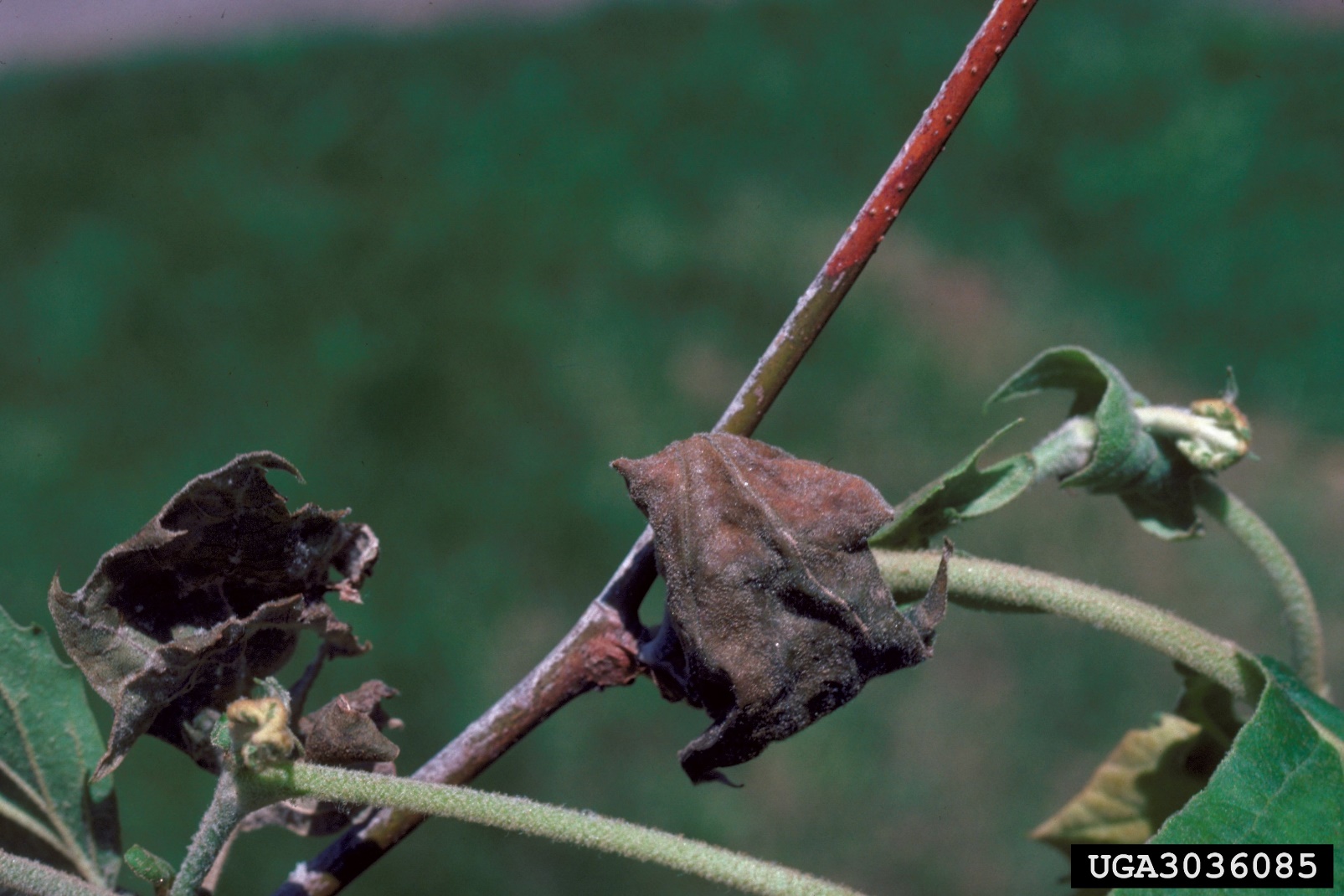
Sycamore anthracnose symptoms on leaves and twigs.
Robert L. Anderson, USDA Forest Service, Bugwood.org
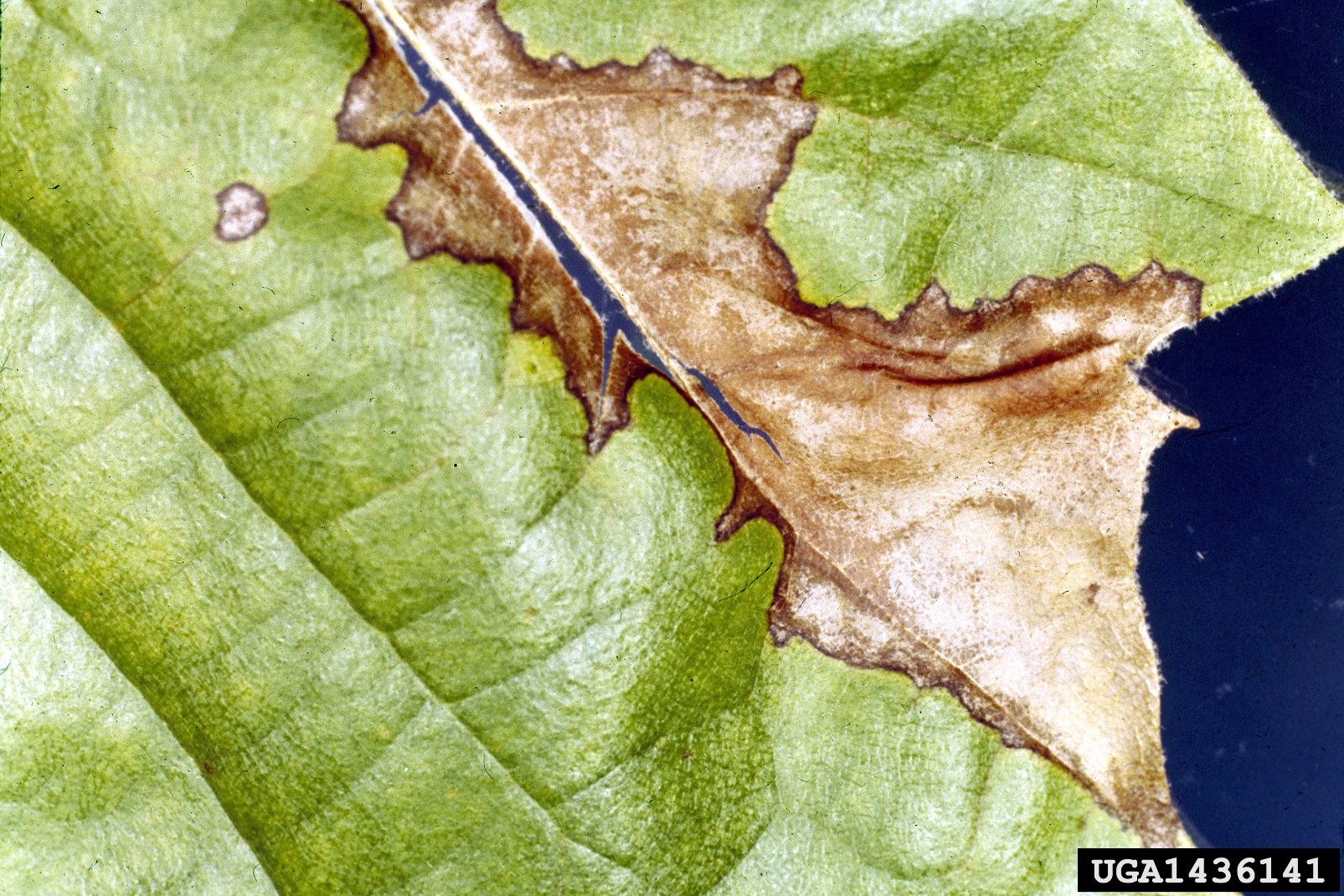
Sycamore anthracnose symptoms on a leaf.
Clemson University – USDA Cooperative Extension Slide Series, Bugwood.org
Prevention & Treatment
Cultural Controls
- Maintain tree vigor through proper fertilization and irrigation
- Remove and destroy fallen leaves and infected twigs (reduces pathogenic spores)
- Prune out diseased branches
- Disinfect pruning shears between cuts using rubbing alcohol or 10% bleach solution
- Select moderately-resistant London plane tree cultivars, such as:
- ‘Bloodgood’
- ‘Columbia’
- ‘Liberty’
For more information about fertilization and irrigation, visit HGIC 1000, Fertilizing Trees and Shrubs. HGIC 1056, Watering Trees and Shrubs.
Chemical Control
For small trees, fungicides may include:
- Chlorothalonil
- Thiophanate-methyl
- Copper
Certified arborists may perform root flare injections using thiabendazole (Arbortect Macro-Infusion Fungicide) for multi-year protection of valuable trees.
Always read and follow all pesticide label directions.
Sycamore Diseases: Powdery Mildew on Sycamore
Powdery mildew is a common fungal disease that affects sycamore foliage, particularly in humid or shaded environments in South Carolina.
Cause
Powdery mildew on sycamores is caused by the fungus Erysiphe platani.
Symptoms
- Circular or irregular patches of white to gray powdery fungal growth on leaves and twigs
- Patches may expand and merge to form a thin, powdery coating on plant surfaces
- Distortion of young leaves and shoots
- Yellow foliage and premature leaf drop
- Stunted new growth
- Small black overwintering structures form in late summer on infected tissue
Prevention & Treatment
Cultural Controls
- Powdery mildew is often not severe enough to require treatment on large trees
- Improve air circulation and reduce excessive shade when possible
- Maintain general plant vigor through proper cultural care
Chemical Control
When spraying is necessary and practical, fungicides labeled for powdery mildew control include:
- Myclobutanil
- Thiophanate-methyl
- Propiconazole
- Chlorothalonil
- Sulfur
- Copper fungicides
- Horticultural oil
Note: Powdery mildew fungi may develop resistance if the same fungicide is used repeatedly.
Always read and follow all pesticide label directions.
Sycamore Diseases in South Carolina: Bacterial Leaf Scorch on Sycamore
Bacterial leaf scorch is a chronic vascular disease that affects sycamore trees and can lead to gradual decline over several years in South Carolina landscapes.
Cause
Bacterial leaf scorch (BLS) is caused by the bacterium Xylella fastidiosa, which colonizes the xylem (water-conducting tissue) of sycamore trees.
The bacterium is transmitted primarily by xylem-feeding insects, such as:
- Leafhoppers
- Sharpshooters
- Spittlebugs
Spread may also occur through root grafts between adjacent trees.

Sycamore leaves showing the scorched appearance and upward curling characteristic of BLS.
Edward L. Barnard, Florida Department of Agriculture and Consumer Services
Symptoms
Symptoms of bacterial leaf scorch on sycamore include:
- Irregular marginal leaf scorch (brown and dry along leaf edges)
- Browning between leaf veins
- Reddish band separating scorched tissue from healthy green tissue
- Upward curling of affected leaves, which often remain on the tree
- Symptoms appearing late summer or early fall
- Initial symptoms confined to individual branches
- Progressive branch dieback over multiple seasons
- Symptoms begin with older leaves, then spread to younger leaves
- Healthy-appearing young leaves at shoot tips despite older leaf symptoms
Prevention & Treatment
Cultural Controls
- Prune infected limbs early in disease development
- Make pruning cuts well below symptomatic tissue
- Provide irrigation during drought
- Apply mulch to reduce stress
- Maintain proper fertilization to prolong tree health
- Remove severely affected trees when decline becomes extensive
Chemical Control
Currently, no effective spray treatments are available.
Certified arborists can perform annual root flare injections of the antibiotic, oxytetracycline (such as Bacastat), to suppress symptom development.
Antibiotic treatments reduce symptom severity but do not eliminate the pathogen.
Sycamore Insect Pests: Sycamore Lace Bug on Sycamore
Sycamore lace bug is the primary insect pest of sycamore trees, feeding on leaf tissue and causing visible stippling damage during the growing season in South Carolina.
Identification & Life Cycle
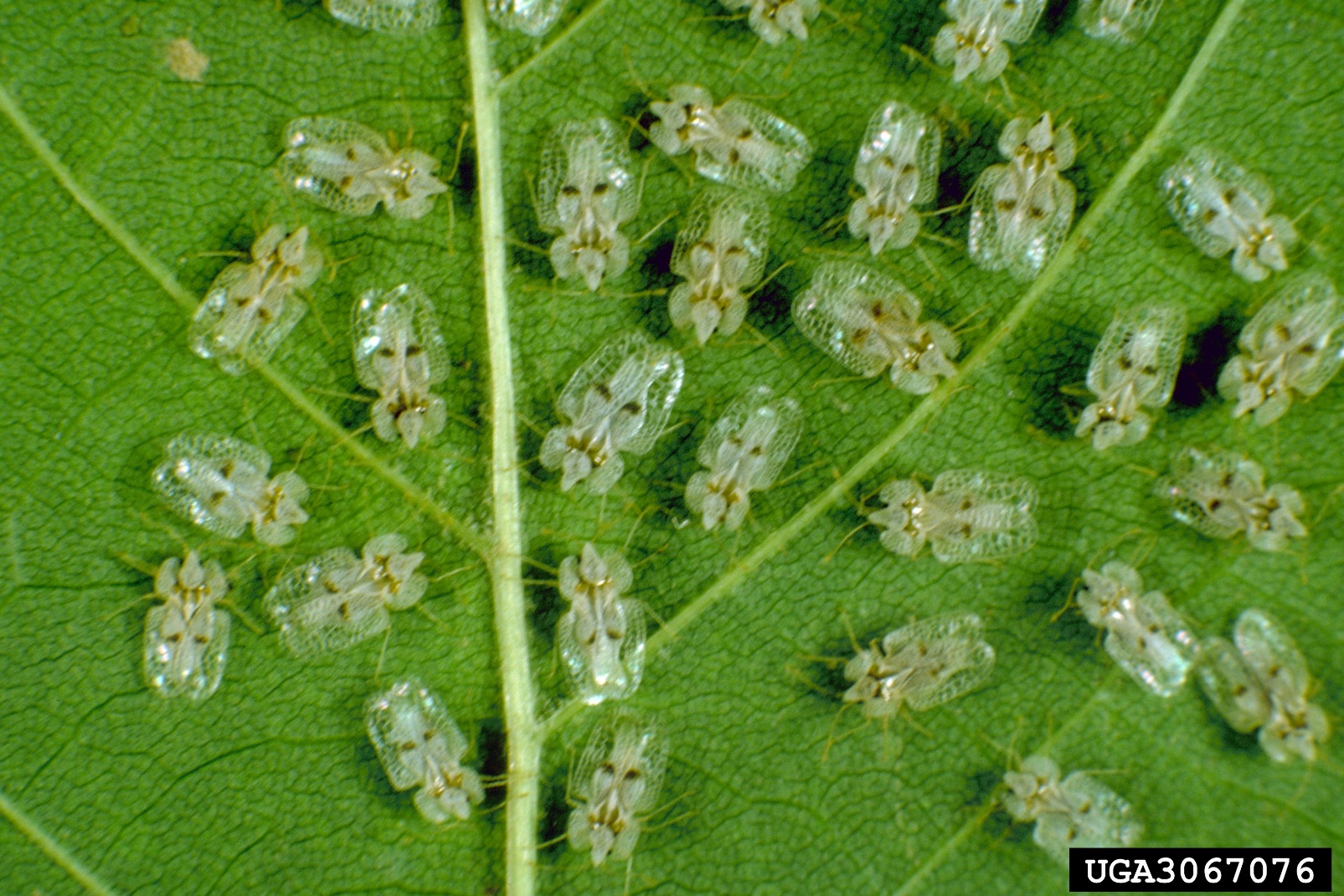
Sycamore lace bugs.
James Solomon, USDA Service, Bugwood.org
Sycamore lace bug (Corythucha ciliata) is a small sap-feeding insect recognized by the lacy appearance of the adult’s wings, head, and thorax (chest region).
Key identifying characteristics include:
- Adults approximately 1/8-inch long
- Whitish coloration with dark brown spots
- Distinct lacy wing pattern
- Adults overwinter under peeling sycamore bark
- Eggs deposited on leaf underside and coated with brown sticky material
- Spiny, wingless nymphs are darker in color than the adults
Sycamore lace bugs become active in the spring as leaves emerge. Both adults and nymphs feed on the undersides of leaves.
Symptoms (Damage)
Symptoms of sycamore lace bug feeding include:
- Yellow stippling or flecking on upper leaf surfaces
- Sap removal from lower leaf surfaces using piercing/sucking mouthparts
- Dark spots of insect waste on leaf undersides
- Presence of shed skins (castings) from immature insects
- Reduced tree vigor with heavy infestations
- Late-season accumulation of insect debris on lower leaf surfaces
Prevention & Treatment
Cultural & Biological Controls
Encourage natural predators of the sycamore lace bug, such as:
- Assassin bugs
- Minute pirate bugs
- Lacewings
- Spiders
- Predaceous mites
- Inspect leaves regularly for signs of the insects
- Spraying with a strong stream of water can control light infestations on small trees
- Tolerate minor infestations since damage is often not severe
Chemical Control
When treatment is warranted and practical:
- Direct insecticidal soap spray to lower leaf surfaces
- Acephate sprays
- Imidacloprid soil drenches
Chemical treatment of large trees is expensive and often not practical. Tolerate some damage, since little serious damage results from lace bug infestation.
Always read and follow all pesticide label directions.
Fungicides and Insecticides for Sycamore Pest and Disease Control
The following fungicides and insecticides are labeled for the management of common sycamore diseases and insect pests in South Carolina when treatment is necessary.
Fungicides for Sycamore Disease Management (Table 1)
Active Ingredient |
Example Product Names |
| Chlorothalonil | Bonide Fung-onil Multi-purpose Fungicide Concentrate Bonide Fung-onil Multi-purpose Fungicide Ready to Use Ferti-lome Broad Spectrum Landscape & Garden Fungicide GardenTech Daconil Fungicide Concentrate GardenTech Daconil Fungicide Ready-to-Use Hi-Yield Vegetable, Flower, Fruit And Ornamental Fungicide Ortho MAX Garden Disease Control Concentrate Southern Ag Liquid Ornamental and Vegetable Flowable Fungicide Tiger Brand Daconil |
| Copper | Bonide Captain Jack’s Liquid Copper Fungicide Bonide Copper Fungicide Spray or Dust Ready to Use Camelot O Fungicide/Bactericide Monterey Copper Fungicide Garden Spray Liqui-Cop Natural Guard by ferti-lome Copper Soap Fungicide Concentrate Natural Guard by ferti-lome Copper Soap Fungicide Ready to Use Southern Ag Liquid Copper Fungicide |
| Horticultural oil | Bonide All Seasons Horticulture Spray Oil Ready-to-Use Bonide All Seasons Horticulture & Dormant Spray Oil Ready-to-Spray Ferti-lome Horticultural Oil Spray Monterey Horticultural Oil Concentrate Monterey Horticultural Oil RTU Safer Brand Horticultural & Dormant Spray Oil Concentrate Southern Ag Parafine Horticultural Oil Summit Year-Round Spray Oil |
| Propiconazole | Banner Maxx II Fungicide Bonide Infuse Systemic Disease Control Bonide Infuse Systemic Disease Control Lawn & Landscape Ready to Spray Ferti-lome Liquid Systemic Fungicide II Quali-Pro Propiconazole 14.3 Fungicide |
| Sulfur | Bonide Sulfur Plant Fungicide Micronized Spray or Dust Ready to Use Hi-Yield Snake Eyes Brand Dusting Wettable Sulfur Safer Brand Garden Fungicide for Flowers, Fruit and Vegetables Concentrate Safer Brand Garden Fungicide II for Flowers, Fruit and Vegetables Southern Ag Wettable or Dusting Sulfur |
| Thiophanate-methyl | Southern Ag Thiomyl Systemic Fungicide |
| Abbreviations RTS = Ready-to-Spray (hose-end applicator) RTU = Ready-to-Use Drench = dilute in water and apply to soil around the base of the plantImportant Use Precautions Do not apply horticultural oil within 2 weeks of a sulfur application Do not apply horticultural oils or sulfur when temperatures exceed 90°F Do not apply to drought-stressed plants Always read and follow all pesticide label directions. |
|
Insecticides for Sycamore Lace Bug Management (Table 1)
Active Ingredient |
Example Product Names |
| Acephate | BioAdvanced Science-Based Solutions 2-in-1 Systemic Rose & Flower Care Granules with 6-9-6 Fertilizer Bonide Systemic Insect Control II |
| Dinotefuran | Gordon’s Zylam Liquid Systemic Insecticide Valent Safari 20 SG Insecticide |
| Horticultural oil | Bonide All Seasons Horticulture Spray Oil Ready-to-Use Bonide All Seasons Horticulture & Dormant Spray Oil Ready-to-Spray Ferti-lome Horticultural Oil Spray Monterey Horticultural Oil Concentrate Monterey Horticultural Oil RTU Safer Brand Horticultural & Dormant Spray Oil Concentrate Southern Ag Parafine Horticultural Oil Summit Year-Round Spray Oil |
| Imidacloprid | BioAdvanced Science-Based Solutions 12 Month Tree & Shrub Insect Control Concentrate Landscape Formula BioAdvanced Science-Based Solutions 12 Month Tree & Shrub Protect & Feed Concentrate 2-1-1 BioAdvanced Science-Based Solutions 12 Month Tree & Shrub Protect & Feed II Concentrate 2-1-1 BioAdvanced Science-Based Solutions 12 Month Tree & Shrub Protect & Feed II Ready to Use Granules 2-1-1 BioAdvanced Science-Based Solutions 12 Month Tree & Shrub Protect & Feed Ready to Use Granules 2-1-1 BioAdvanced Science-Based Solutions 2 in 1 Systemic Rose & Flower Care Ready-to-Use Granules II Bonide Annual Tree & Shrub Insect Control w/ Systemaxx Bonide Systemic Granules Insect Control Bonide Systemic Insect Spray w/ Systemaxx Ready to Spray Ferti-lome Tree & Shrub Drench Hi-Yield Systemic Insect Granules Hi-Yield Systemic Insect Spray Ready-to-Spray Martin’s Dominion Tree & Shrub Insecticide Concentrate Monterey Once A Year Insect Control II |
| Insecticidal Soap | Bonide Insecticidal Soap Multi-purpose Insect Control Ready to Use Garden Safe Brand Insecticidal Soap Insect Killer Miracle-Gro Nature’s Care Insecticidal Soap Natria Insecticidal Soap Ready-to-Use Natural Guard by ferti-lome Insecticidal Soap Concentrate Safer Brand Insect Killing Soap Concentrate II Whitney Farms Insecticidal Soap 1 |
| Abbreviations RTS = Ready-to-Spray (hose-end applicator) RTU = Ready-to-Use Drench = dilute in water and apply to soil around base of plantImportant Use Precautions Do not apply horticultural oil within 2 weeks of a sulfur application Do not apply horticultural oils or sulfur when temperatures exceed 90°F Do not apply to drought-stressed plants Always read and follow all pesticide label directions. |
|
Pesticides are updated annually. The last updates were made on 4/26 by N. Jordan Franklin.
Originally published 01/01


