Tropical Pitcher Plants Facts at a Glance
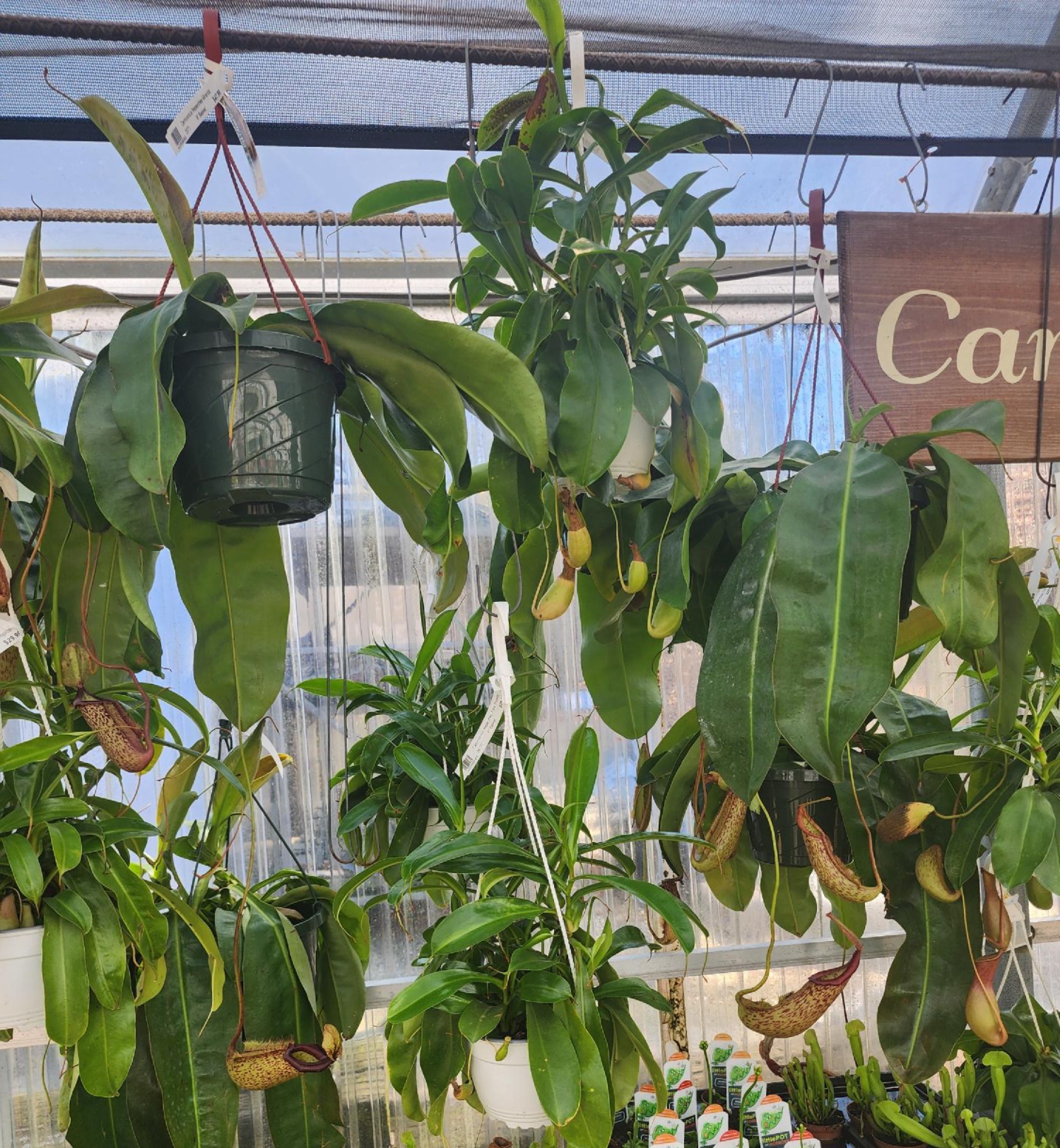
A group of tropical pitcher plants growing in hanging baskets in a greenhouse.
Jackie Jordan, ©2026, Clemson Extension
Botanical Name: Nepenthes spp.
Common Name: Tropical pitcher plant
Plant Type: Indoor; carnivorous perennial
Mature Size: Typically, 2 to 3 feet tall and 1 to 2 feet wide
Best Soil: 60% sphagnum moss, 20% perlite, 20% orchid bark
Light Level: Bright indirect light
Humidity: above 60%
Watering: Keep moist; do not allow plants to dry out
Temperatures:
- Lowland species 70°F to 95°F
- Highland species 70°F and 80°F, with a drop to 50°F to 60°F at night
Pet Safe: Yes
Indoor Plant Difficulty Level: Novice to experienced grower
Tropical Pitcher Plant Height and Spread
Height and spread vary significantly depending on species and growing conditions.
- Slow growing
- Average height of 2 to 3 feet
- Average spread of 1 to 2 feet
- The smallest species can reach a diameter of 3 inches
- The largest can reach over 1 meter wide
Tropical Pitcher Plant Overview
Tropical pitcher plants are carnivorous, evergreen, herbaceous plants native to Madagascar, Northeastern India, and Southeast Asia. The plants feature vase-like pitchers attached to tendrils at the tips of long, strap-like leaves.
Pitchers can range from a few inches to 8 inches long, depending on the species.
How Tropical Pitcher Plants Catch Insects
Pitcher plants have adapted to limited nutrient availability by feeding on insects.
The pitchers lure insects in with fragrance, color, and an intoxicating nectar. Once an insect loses its foothold, it will fall into a pitcher that is divided into two zones.
- The upper zone is waxy and impossible to climb.
- The lower zone secretes digestive juices that dissolve the prey.
How Tropical Pitcher Plants Grow
In nature, most Nepenthes grow as scrambling or climbing vines, some species grow along the ground, and others grow epiphytically (on other plants).
Tropical pitcher plants can be grown in hanging baskets, terrariums, and containers.
Ornamental Features of Tropical Pitcher Plants

A close-up photo of a multicolored lower pitcher.
Jackie Jordan, ©2026, Clemson Extension
Tropical pitcher plants are grown for their unique pitchers that form at the tips of their leaves.
Two types of pitchers develop on the plant:
- Lower pitchers
- Upper pitchers
The two pitcher types can differ significantly in color, shape, and function.
Lower Pitchers
Lower pitchers grow lower on the plant and are more colorful.
They are the first to develop on young plants.
Upper Pitchers
A plant can take 5 to 10 years to develop a climbing stem that will produce upper pitchers.
The upper pitchers can vary from the lower pitchers in color and form, and can lure different prey.
Tropical Pitcher Plant Flowers
The plants are dioecious, meaning that male or female flowers are produced on separate plants. 70% of wild plants are male.
The flowers are produced on a stalk that grows above both sets of pitchers.
Flower Appearance and Pollination
Dozens to hundreds of densely packed small flowers are produced on a raceme inflorescence.
Some species produce colorful flowers, but the majority are pale green. The scent varies among the species as well.
Some flowers offer a sweet scent, while others smell like cat urine. Flower scents developed to attract different pollinators.
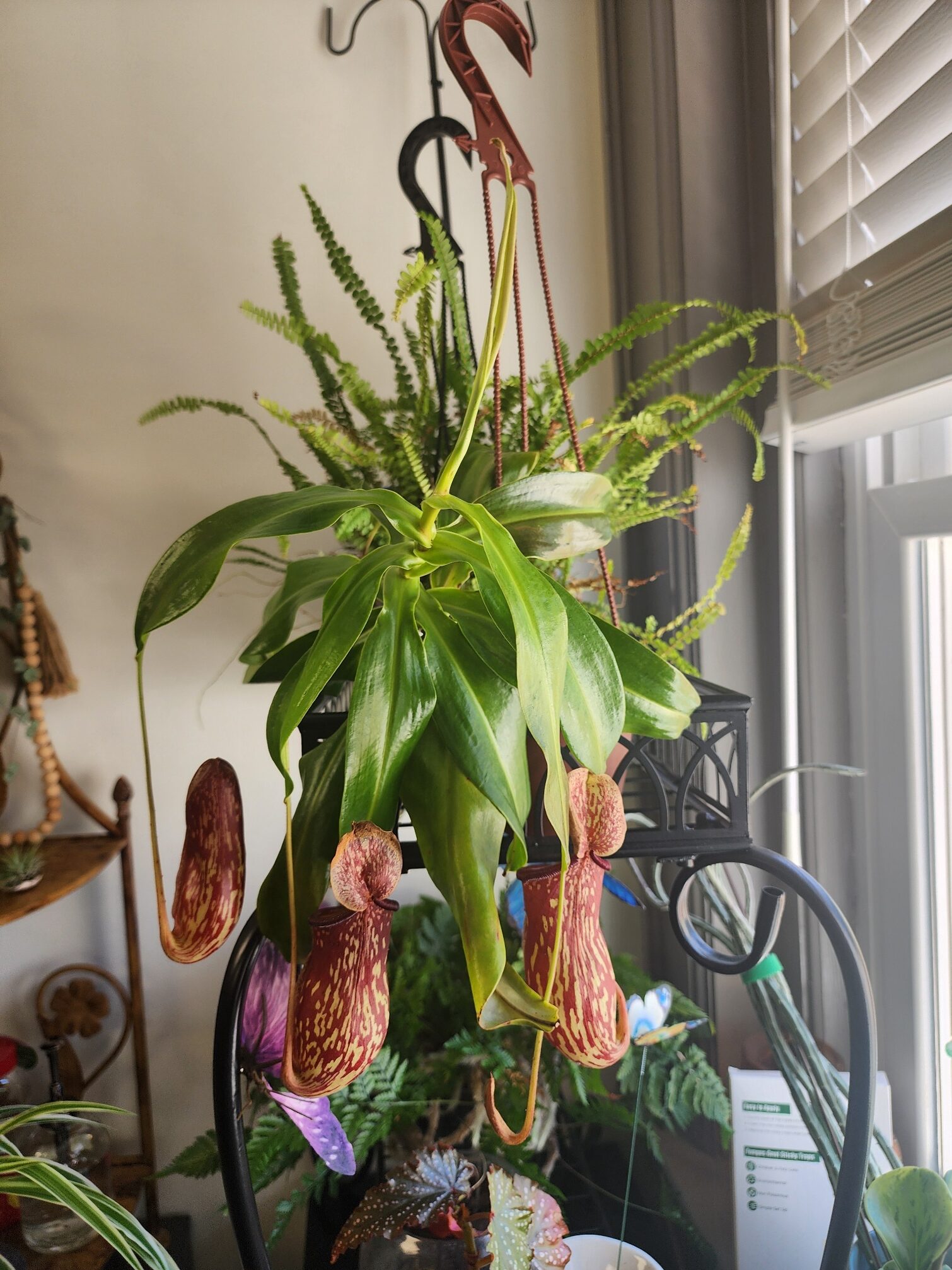
A tropical pitcher plant growing in bright indirect light.
Jackie Jordan, ©2026, Clemson Extension
How to Care for Tropical Pitcher Plants
Tropical Pitcher Plant Light Requirements
Most tropical pitcher plants like bright, diffused light and can tolerate a few hours of direct sun in the morning or late afternoon.
Locate near an east or west-facing window.
Tropical Pitcher Plant Watering and Humidity Needs
Keep plants moist.
Plants can be sensitive to tap water; it is better to use rainwater or distilled water when possible.
Provide plants with humidity levels above 60%.
For more information about watering indoor plants, visit Indoor Plants – Watering (HGIC 1459).
Why Isn’t My Tropical Pitcher Plant Making Pitchers?
If plants are not producing pitchers, low light and low humidity levels are usually the reason.
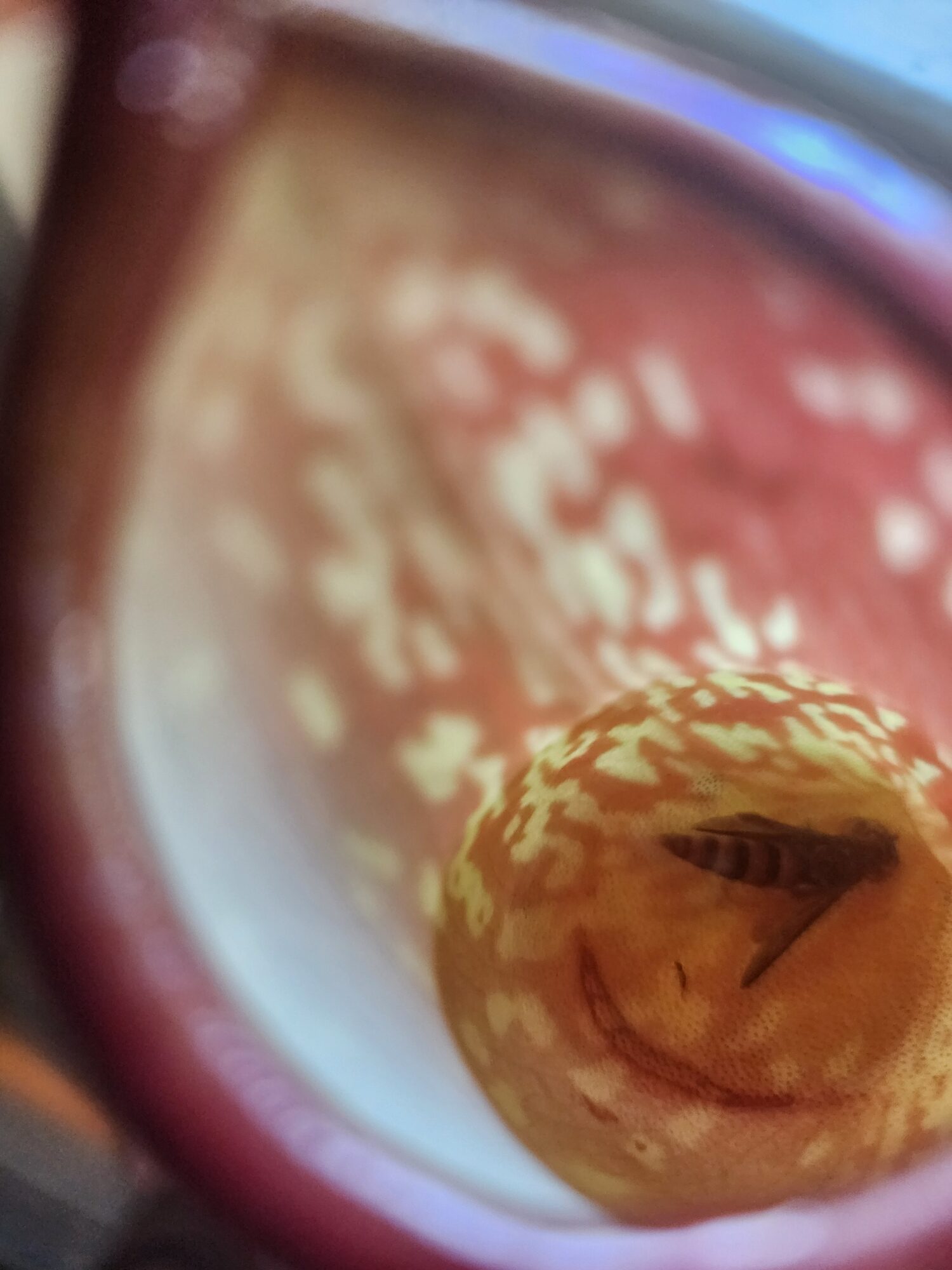
A lower pitcher dissolves a wasp in digestive fluid.
Jackie Jordan, ©2026, Clemson Extension
Tropical Pitcher Plant Temperature Requirements
Nepenthes are divided into two groups:
Lowland Species
Lowland species tolerate hot daytime temperatures and warm nighttime temperatures.
Highland Species
Highland species prefer warm daytime temperatures and cool nights.
When kept in terrariums, they may require reusable ice packs to cool the temperature at night.
Temperature-Tolerant Hybrids
Many commercially available hybrids are more tolerant of temperatures than the species.
Feeding Tropical Pitcher Plants
Tropical pitcher plants can be fed:
- Crickets
- Sow bugs
- Mealworms
- Various dried insects
Fertilizing Tropical Pitcher Plants
If insects are not provided, plants can be fertilized with an organic fertilizer twice a month during the growing season.
Use the following fertilizers:
- Fish emulsion
- Seaweed extract
- Kelp extract
How to Apply Fertilizer to Tropical Pitcher Plants
- Dilute the fertilizer to ¼ to of the recommended strength.
- Apply the fertilizer to the leaves and open pitchers.
Repotting Tropical Pitcher Plants
Repot plants every 2 to 3 years.
Repotting is necessary when:
- Plants outgrow their container
- Potting medium breaks down
How to Repot Tropical Pitcher Plants
- Remove old or brown pitchers.
- Moisten the plant.
- Remove the plant from the container.
- Gently remove old potting medium and minimize root disturbance.
- Use water to dislodge old potting medium, if necessary.
- Replant into a slightly larger container.
Best Soil for Tropical Pitcher Plants
Use a light, low-nutrient potting medium that retains moisture.
A mixture of:
- Long-fibered sphagnum moss or tree fern fiber
- Perlite or pumice rock
- Orchid bark
Common Problems with Tropical Pitcher Plants
Tropical Pitchers Turning Brown or Black
Individual pitchers can live for 2 to 3 months on faster-growing varieties and 6 to 12 months on slower-growing varieties.
An individual pitcher will turn brown or black as its lifespan comes to an end.
A sudden change in the environment can cause multiple older pitchers to dry out.
Check for changes in:
- Humidity
- Temperature
- Moisture levels
How to Remove Dead Tropical Pitcher Plant Pitchers
Dried pitchers can be pruned from the plant.
Remove spent pitchers from the leaf tip at the point the pitcher begins to develop.
Tropical Pitcher Plant Pests
Aphids, mealybugs, thrips, and scale insects can be problematic.
Common Tropical Pitcher Plant Insect Pests
Potential pests include:
- Aphids
- Mealybugs
- Thrips
- Scale insects
For more information on controlling common houseplant insects, see Common Houseplant Insects & Related Pests (HGIC 2252).
Tropical Pitcher Plant Diseases
Rust on Tropical Pitcher Plants
Rust can cause orange fungal leaf spots.
Managing Rust on Tropical Pitcher Plants
Fungicides can be used on Nepenthes.
Avoid copper-based fungicides, as they can kill tropical pitcher plants.
For more information about fungal leaf spots on indoor plants, visit Houseplant Diseases & Disorders (HGIC 2251).
Tropical Pitcher Plant Species and Cultivars
There are over 197 accepted species of Nepenthes.
Best Tropical Pitcher Plant Species for Beginners
Nepenthes alata
A widespread species that grows in the hills surrounding jungles.
This easy-to-grow species has a wide temperature tolerance from 54°F to 95°F.
Lower pitchers are slim and tinged red at the top.
Nepenthes maxima
Highly variable pitchers in color and form.
Upper and lower pitchers vary greatly in form.
Vigorous grower and very tolerant of conditions.
Nepenthes ventricose
Has tubby pitchers with variable colors that narrow at the mid-point.
Compact plant.
Grows well in terrariums and on windowsills.
Tropical Pitcher Plant Species for Advanced Collectors
Nepenthes veitchii
Stems, leaves, and pitchers are covered with coarse brown hair.
Has squat pitchers with a showy, wide, flat, often striped peristome (lip).
Adaptable to lower humidity.
Tropical Pitcher Plant Hybrid Cultivars
Nepenthes ‘Bloody Mary’ (N. ventricosa x N. ampullaria)
Has small scarlet pitchers and is well-suited for terrariums.
Nepenthes ‘Gaya’ (N. khasiana x N. ventricosa x N. maxima)
Has red pitchers with yellow spotting.
Tolerant of normal house conditions.
Nepenthes ‘Hookeriana’ (N. rafflesiana x N. ampullaria)
Large vigorous plant with squat green pitchers with red spotting.
Widely available for purchase and beginner friendly.
Frequently Asked Questions About Tropical Pitcher Plants
Why isn’t my tropical pitcher plant making pitchers?
Low light and low humidity are the most common causes.
Can tropical pitcher plants grow indoors?
Yes. Tropical pitcher plants can be grown in hanging baskets, terrariums, and containers indoors.
Do tropical pitcher plants need fertilizer?
Plants can be fed insects or fertilized with diluted organic fertilizer during the growing season.
References
- Plant of the Week: Nepenthes Pitcher Plant
- North Carolina Extension Gardener Plant Toolbox – Nepenthes
- D’Amato, Peter (2013). The Savage Garden, Revised. Berkley: Ten Speed Press.
Originally published 06/26