Why Ginger Is the Star of Gingerbread
Years ago, my family would make cookies for weeks leading up to Christmas. Of course, there were the old standbys, such as chocolate chip and sugar cookies.
Mom would break out the cookie press and make butter press cookies in various shapes and flavors like mint, anise, almond, and coconut. But no cookie made us laugh like the gingerbread men.
Our gingerbread men usually had raisins for eyes and buttons. My cheeky grandfather would derail our home-baked assembly line with raisins placed in wacky locations, causing grandma to giggle uncontrollably. And when grandma laughed, everyone laughed.
The star of gingerbread is ginger. The spice brings a heat that balances with the sweetness of molasses and sugar to produce that classic Christmas flavor.

Gingerbread cookies.
Stephanie Turner, ©2025, Clemson Extension
What Ginger Is: Understanding Zingiber officinale
It comes from the rhizome of Zingiber officinale, or true ginger, one of the oldest known spices.
A tropical perennial originating from Southeast Asia, it forms two-to four-foot-tall clumps of herbaceous foliage and cone-like, green flower spikes with creamy/yellow flowers.
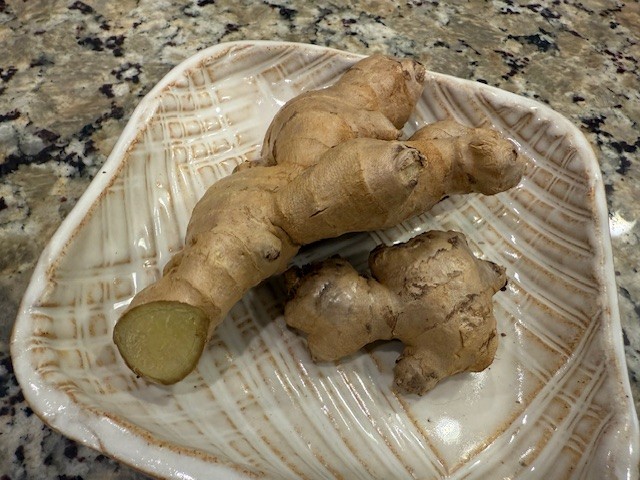
A ‘hand’ of true ginger (Zingiber officinale) is the knobby rhizome of the plant.
Stephanie Turner, ©2025, Clemson Extension
The underground stems, or rhizomes, are tan and knobby and are often referenced as a ‘hand’ due to the thick sections that branch off and look like fingers.
How to Grow Ginger (Containers or Garden Beds)
Best Growing Conditions for Ginger
Ginger is cold-hardy in zones 9-12, or it can be grown in containers and overwintered in a sheltered spot or as a houseplant.
The plants will thrive best in a location with afternoon shade and evenly moist, but not soggy, soil.
Where Ginger Comes From
Most of the ginger we import to the United States comes from Peru and China.
The rhizome is dried and powdered for uses like baking, or sliced or diced for fresh use in sautés, pickles, or stews, and even candied for use in desserts and treats. The new sprouts are also edible and impart a milder flavor than the rhizomes.
How to Use Fresh Ginger in the Kitchen
Fresh ginger is readily available in the produce section of most grocery stores. The knobby roots have yellow flesh covered in a golden skin.
Peel the thin skin of fresh ginger by sliding it off with a spoon so as not to waste any of the flavorful tissue below.
Make a simple tea by pouring hot water over thinly sliced ginger.
Fresh ginger is also fantastic in homemade teriyaki sauce. I usually combine:
- 1/3 cup brown sugar
- 1/3 cup soy sauce
- 2 tablespoons apple cider vinegar
- ½ teaspoon of minced garlic
- 1 teaspoon or more of diced ginger.
Ginger and Digestion: A Classic Remedy
Ginger is often consumed to aid in digestion and calm upset tummies.
That effect is negated when you have had one too many gingerbread men in one sitting. At least, that’s how I remember it.
Plants Called “Ginger” That Are Not True Ginger
Don’t confuse true ginger with:
- Wild ginger (Asarum and Hexastylis species)
- Heart-shaped leaves
- Staying less than 10 to 12 inches tall
- Ginger lily (Hedychium species)
- Related to true ginger
- Similar foliage
- Showy, fragrant flowers
- White ginger lily (Hedychium coronarium or butterfly lily) is a popular garden plant
For more information on growing wild ginger, see HGIC 1113, Wild Ginger.
For more information on growing ginger lily, see Ginger Lily.