What is Japanese stiltgrass?
Japanese stiltgrass (Microstegium vimineum) is an annual grassy weed that grows in shady areas in summer. It is an aggressive spreader.
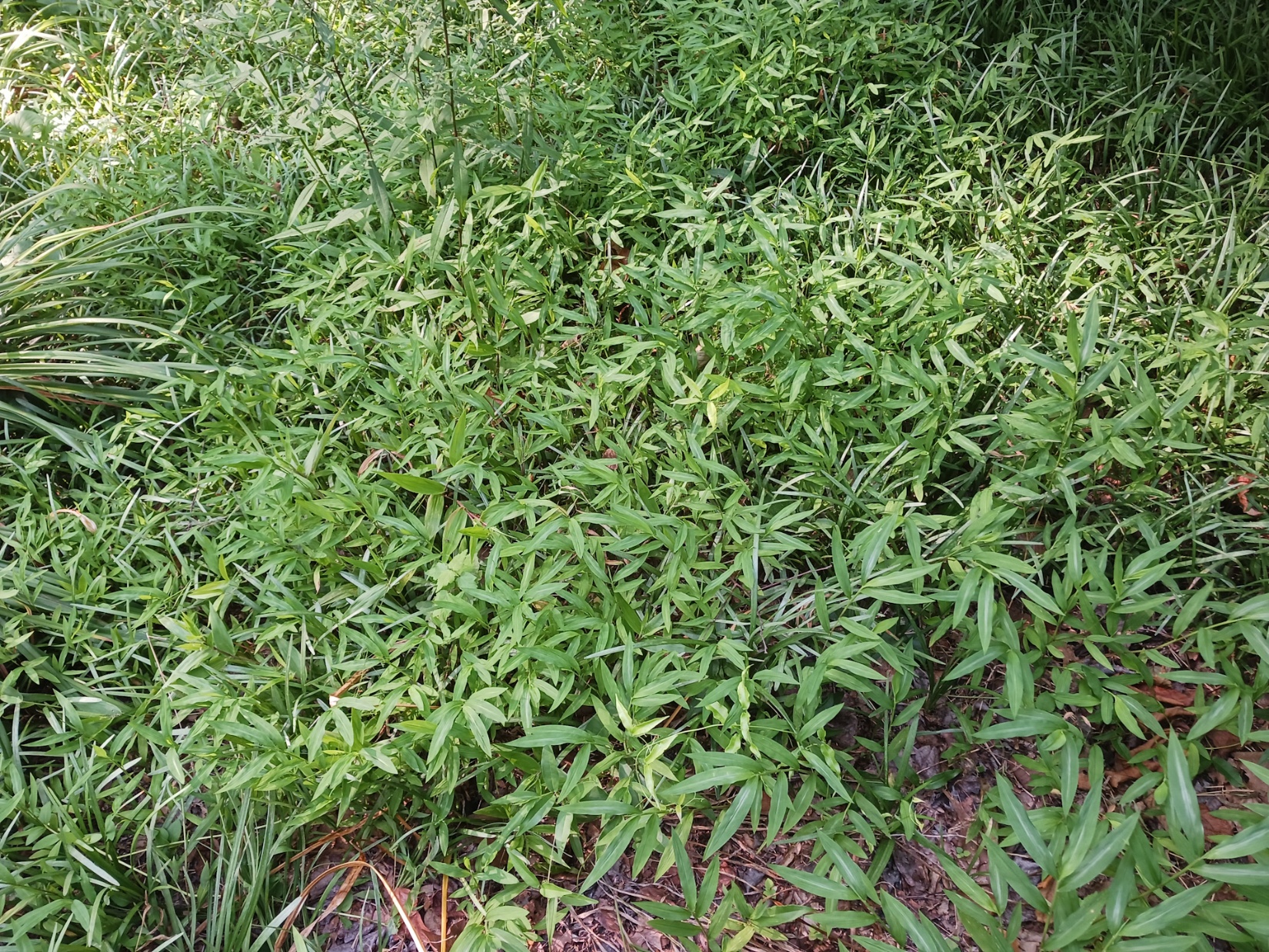
Japanese stiltgrass was introduced to the US in the early 1900s when it was used as packing material for breakable items from Asia.
Ginger E Long, ©2025 HGIC, Clemson University
Where is Japanese stiltgrass found?
Today, its range includes the eastern US, west to Texas, and north to New York. In many states, it is classified as invasive.
Japanese stiltgrass can be found in ditches, fields, roadsides, forests, shady gardens, and lawns.
It spreads quickly in forested areas. When stiltgrass dies in winter, the plants form brown mats of thatch, crowding out native species.
How to Identify Japanese Stiltgrass
Look for a light stripe down the center of the smooth, lance-shaped leaves.
The leaves are broader when compared to other grassy weeds.
It resembles bamboo leaves.

In the center of the leaf, there is a light, silvery stripe.
Ginger E Long, ©2025 HGIC, Clemson University
How does it spread?
Japanese stiltgrass roots at nodes that touch the ground, allowing it to cover a large area.
Each plant produces hundreds of seeds. They can remain in the seed bank for 5 years or more.
How to Control Japanese Stiltgrass
Timing Is Critical
It is imperative to control stiltgrass before it sets seed. It flowers in late summer to early fall, usually in September and October.
Mechanical Control (Hand pulling & Raking)
These are the best methods of control. The good news is that it is easy to pull up because of its fibrous roots.
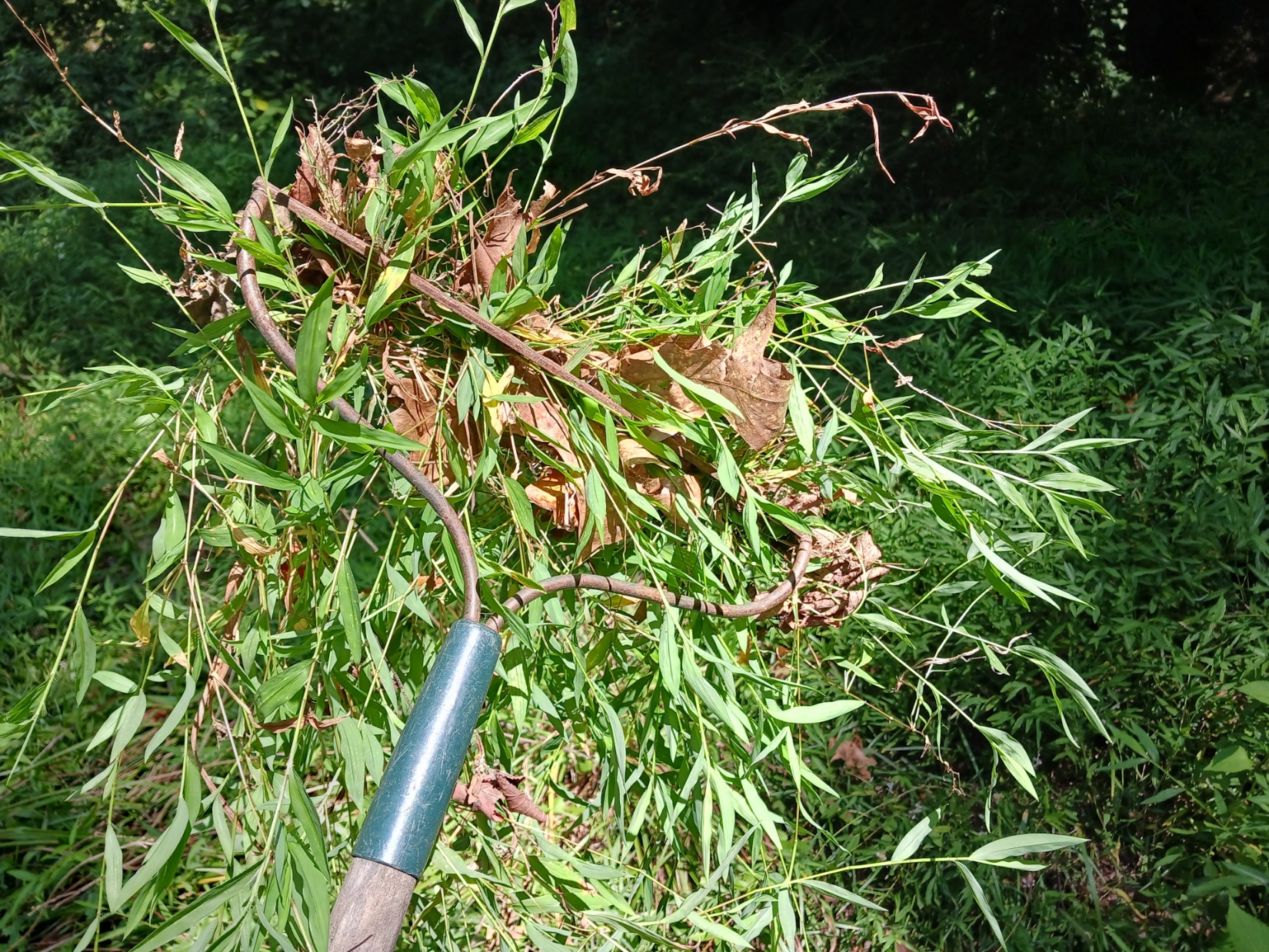
Use a sturdy garden rake to pull a lot of stiltgrass out, then hand-weed the rest.
Ginger E Long, ©2024 HGIC, Clemson University
String trimmers (weed eaters)
String trimmers may be used to scalp it down to the soil before it sets seed in late summer. The plants won’t have enough time to regrow and flower.
Mowing
Mowing can be done in late summer when the plants flower (before they go to seed). Getting the timing right can be tricky. Mowing it late in the season should prohibit it from growing back. Bag the clippings and throw them in the trash to be sure no seeds are left.
Chemical Control
Non-selective herbicides can be effective. These products will kill any plants on contact, so spray on a day without wind and only spray the stiltgrass.
For more information on non-selective herbicides that contain the active ingredient glyphosate, see HGIC 2301, Broadleaf Weeds.
For non-selective herbicide alternatives to the active ingredient glyphosate, see HGIC 2338, Controlling Weeds in Landscaped Beds Without Glyphosate.
If stiltgrass is in a fescue lawn, use products with the active ingredient fenoxaprop. See a list of products in Table 2 of the factsheet HGIC 2300 Grassy Weeds.
If stiltgrass is in a warm-season lawn, like Bermuda, centipede, zoysia, or St. Augustine, there is no product labeled and available to homeowners for control. In that case, hand weeding would be necessary.
Additional Resources
PennStats Extension: Japanese Stiltgrass
NC State Extension: Japanese Stiltgrass Identification and Management
US Forest Service Weed of the Week: Japanese Stiltgrass
Invasive Plant Atlas of the United States: Japanese Stiltgrass
Blue Ridge Partnership for Regional Invasive Species Management: Japanese Stiltgrass
Decreases Scenic, Timber, Agricultural, and Wildlife Value
Plant Conservation Alliance’s Alien Plant Working Group: Japanese Stiltgrass