The Southern Legacy of Muscadines
No other fruit can evoke more profound nostalgia for a multi-generational Southerner than muscadines. Even the name evokes memories of the sweet musky aroma emitted by the ripe grapes, deliciously sweet pulp, large seeds, and thick, tart skins that characterize the “berry grape”.
Muscadines are one of three species belonging to the subgenus Muscadinia within the genus Vitis, and they are the most unique member of the grape family. They are set apart from true grapes on a genetic level by their set of 2n=40 chromosomes, instead of the standard 38 possessed by true grapes (subgenus: Vitis). There are only a couple of varieties that have been crossbred between the two types due to the chromosome differences.
Where Muscadines Grow Best
Muscadines thrive in the hot, humid weather of the Southeast. Their home range extends from South Florida north to the Blue Ridge Mountains and west to Texas and Arkansas. They grow on stout, dioecious vines. Seventy-five percent of the wild-type vines are male pollinators, and the rest are fruit-bearing. Over the years, several muscadine varieties have been developed that have complete flowers that are self-fruiting.
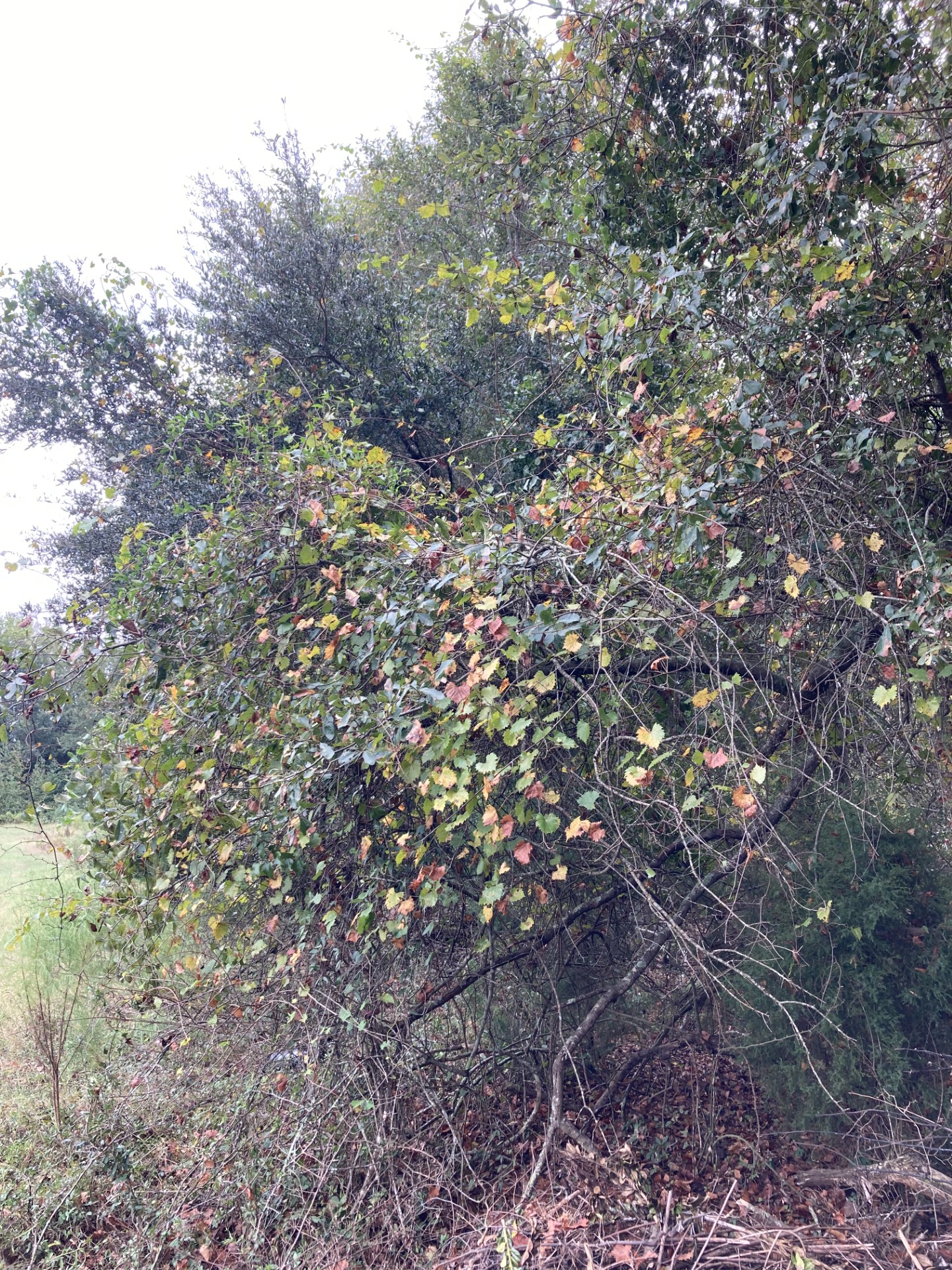
Muscadines are native to the Southeastern United States.
Anna Sarah Hill, ©2025, Clemson Extension
How to Identify Muscadine Grapes
Common Colors and Features
The majority of muscadines yield dark purple or “black” fruit. Some muscadines yield large, greenish-bronze fruit, which may have dark specks. The unbranched tendrils are reddish on vines bearing dark fruit and green on bronze-bearing vines.
Colloquial Names and Origins
There are many colloquial names for Muscadines, such as bull grapes, bullets, bullace, southern fox grape, and scuppernong, to name a few.
Wild muscadines are about the size of a bullet or a bullseye. Some sources maintain the popular name bullace is a corruption of the name bullet. Other sources say muscadines were dubbed bullaces in reference to a European plum of the same name, which is of similar size and appearance to muscadines. Southern fox grape is a misnomer that can easily be confused with fox grape, the common name for a species of bunch grape also native to North America.
The Story of the Scuppernong Variety
Misuse of the Scuppernong Name
Over the years, Scuppernong has become a general term to refer to all bronze-colored muscadines, and at times has been used interchangeably with muscadine. It is the most misused of the common names, partly due to the misconception that dark colored muscadines are a different type from the lighter bronze muscadine. The truth is that bronze muscadines are a genetic mutation of the dark form of muscadines.
Origin of the True Scuppernong
Scuppernong is the first named variety of bronze muscadine released by the University of Georgia. It was propagated from the “mother vine” located on Roanoke Island, but was named after the Scuppernong River in Tyree, NC, where the ancestors of the parental vine grew in significant quantities.
Since then, many bronze varieties as well as dark varieties have been developed and released over the years. Scuppernong should only be used to refer to the true variety and not to the group of bronze fruit.
The Mother Vine: America’s Oldest Cultivated Muscadine
Legends and Historical Accounts
The oldest known cultivated muscadine vine in the United States is located on Roanoke Island near the site where Sir Walter Raleigh’s expedition landed. The vine bears bronze grapes, historically referred to as “White Grapes” and later “Roanoke Grape”. The actual age of the vine is under hot debate, as well as its origins and who planted it. The grand old vine named the “Mother Vine” is thought to be over 400 years old.
Legend has it that the vine was transplanted based on Sir Walter Raleigh’s instructions for the colonists to transplant and cultivate the local “grapes,” which were plentiful. In his expedition narrative, Captain Arthur Burlowe (one of the two ship masters) described the land as “full of grapes” and stated, “in all the world the like abundance is not to be found”.
Many believe the Croatons transported the original muscadine vine from the mainland and transplanted it in Roanoke long before the first colonists landed.
Unsolved Mystery and DNA Debate
Another possible theory is that a member of the Baum family brought the original vine from Tyree County, NC. Peter Baum received a land grant for a section on Roanoke that later became known as the “Mother Vineyard” in the early 1700s.
Several multi-generational families connected with the “Mother Vine” and nearby Roanoke wineries have passed down their family legends about the vine, making great marketing stories. It is difficult to prove or disprove the stories without historical documentation. DNA testing has not been conducted because it has been deemed that taking a tissue sample from the vine’s core may damage it, so the debate continues.
How Muscadines Were Used Traditionally
Southern Culinary Traditions
Muscadines were used as a food and wine staple by both Native Americans and generations of southerners. Proper Southern etiquette dictates that the skin and seeds be spat out discreetly and the pulp savored and swallowed. Traditionally, the only time the skin or “hull” was eaten was in a baked “hull pie”.
Native American Uses
Native Americans routinely ate the skin as they preserved the fruit by sun-drying and ate the muscadine raisins during the long winters. Their version of hull pie was muscadine dumplings.
Health Benefits of Muscadines
Nutritional and Medicinal Properties
Despite being tough, the skin is edible and a good source of vitamins, nutrients, and other compounds, including Resveratrol. Studies show that Resveratrol can lower cholesterol and the risk of coronary heart disease and has anti-carcinogenic properties.
Modern Cultivar Improvements
Newer muscadine varieties have been selected for thinner skins, which makes the skin more palatable. Centuries before modern scientific revelations, Native Americans valued muscadines for their medicinal properties. They used all parts of the plant, including bark and leaves, to brew teas and make poultices to treat all illnesses and maladies.
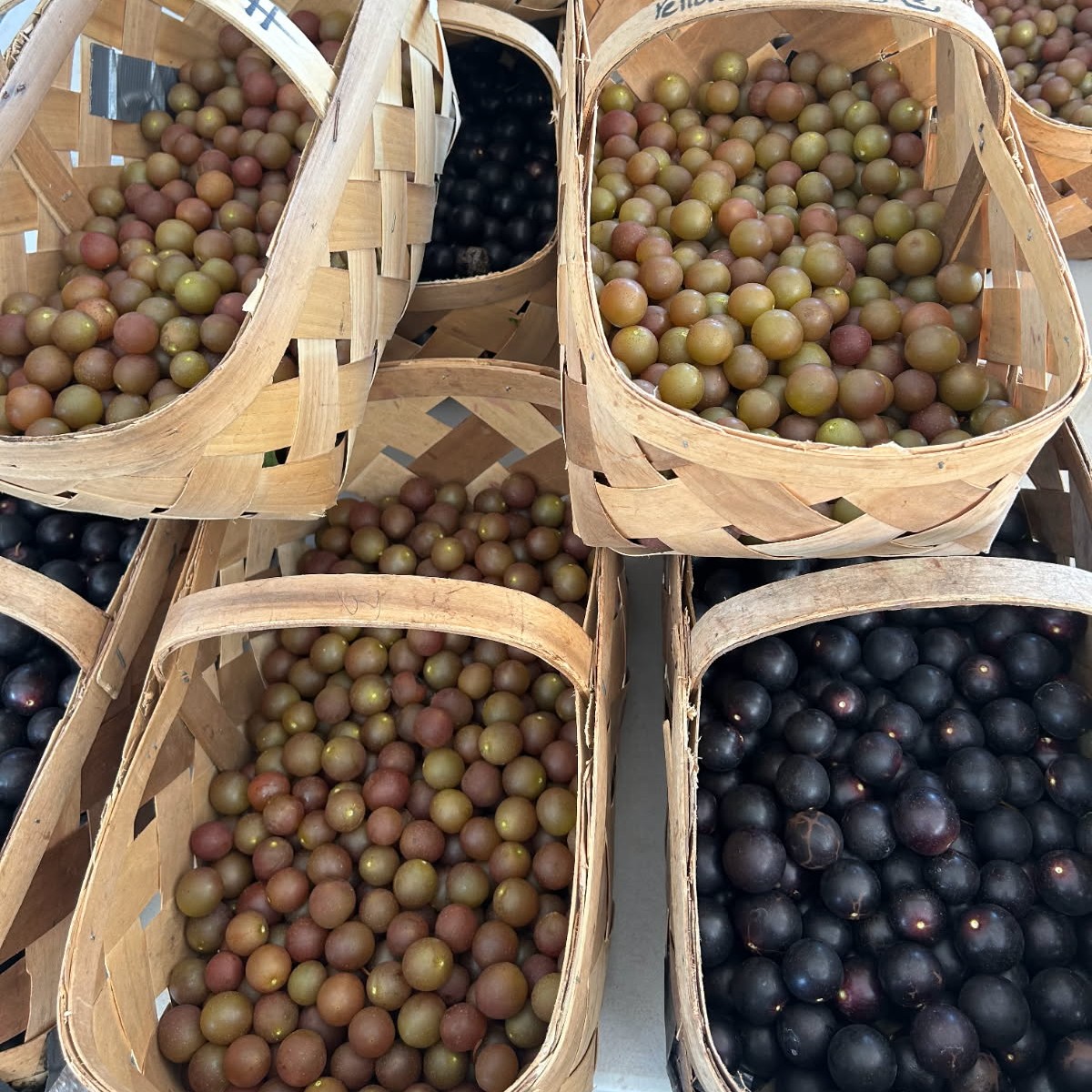
Many improved muscadine varieties, both bronze and dark colors, have been developed over the years.
Zack Snipes, ©2025, Clemson Extension
Modern Muscadine Varieties and Cultural Importance
Muscadines are a unique “berry grape” that have been romanticized, referred to as Southern cultural icons, called legendary, and described as an experience. It has even been touted that they rival the best wine grapes in France.
Eating them is the only way to appreciate their rich history and truly understand their uniqueness and extraordinary qualities!