
Quick Guide (At-a-Glance)
Affected Plants:
- Maple (Acer spp.), including: Japanese maple, red maple, silver maple, amur maple, and sugar maple
Primary Disease Types:
- Leaf scorch
- Anthracnose (Aureobasidium apocryptum)
- Bacterial leaf scorch (Xylella fastidiosa)
- Phyllosticta leaf spot (Phyllosticta minima)
- Tar spot (Rhytisma spp.)
Primary Insect Pests:
- Aphids (including woolly alder aphid, Paraprociphilus tessellatus)
- Scale insects (Pulvinaria spp., Melanaspis tenebricosa)
- Gall makers (Vasates spp., Acericecis ocellaris, Cecidomyia ocellaris)
- Asian ambrosia beetle (Xylosandrus crassiusculus)
Primary Causes:
- Fungal pathogens
- Bacterial infection
- Environmental stress (drought, heat, wind, soil contaminants)
- Sap-feeding insects
- Wood-boring beetles
Most Important Prevention Strategy:
- Promote tree vigor through:
- Proper watering
- Soil improvement
- Sanitation (leaf removal)
- Early detection
Chemical Control:
- Fungicides: copper-based products, mancozeb, chlorothalonil, thiophanate-methyl, triadimefon)
- Insecticides (pyrethroids, systemic drenches, horticultural oil)
This fact sheet describes common maple diseases and insect pests found in South Carolina landscapes and provides guidance for their management.
Maple Diseases: Leaf Scorch on Maple
Leaf scorch is a common physiological or stress-related disorder affecting maple (Acer spp.) trees.
Cause
Leaf scorch on maple (Acer spp.) may result from several different stress-related or pathological factors.
Physiological leaf scorch
- Most common type of scorch
- Caused by dry weather, combined with wind and high temperatures
- Occurs when trees do not get enough water
Response to an undesirable soil contaminant
- Salt (applied to roads for wintertime ice control)
- Fluoride accumulation in containerized soil mixes with perlite
- High phosphate fertilizer levels
- Fungal or bacterial vascular pathogen
Symptoms
- Light brown or tan dead areas between leaf veins and around the leaf margins
- Yellow or chlorotic leaf margins (occasionally)
- Symptoms on all parts of the tree or only on the sun- and wind-exposed side
Prevention & Treatment
Cultural Controls
- Water established trees with one inch of irrigation once per week during periods of heat and drought.
- Avoid salt accumulation and soil contaminants
- Improve soil moisture management
Chemical Control
Not applicable for physiological leaf scorch.
Maple Diseases: Anthracnose on Maple
Anthracnose is a fungal disease that affects maple leaves, twigs, and buds, particularly during periods of wet spring weather.
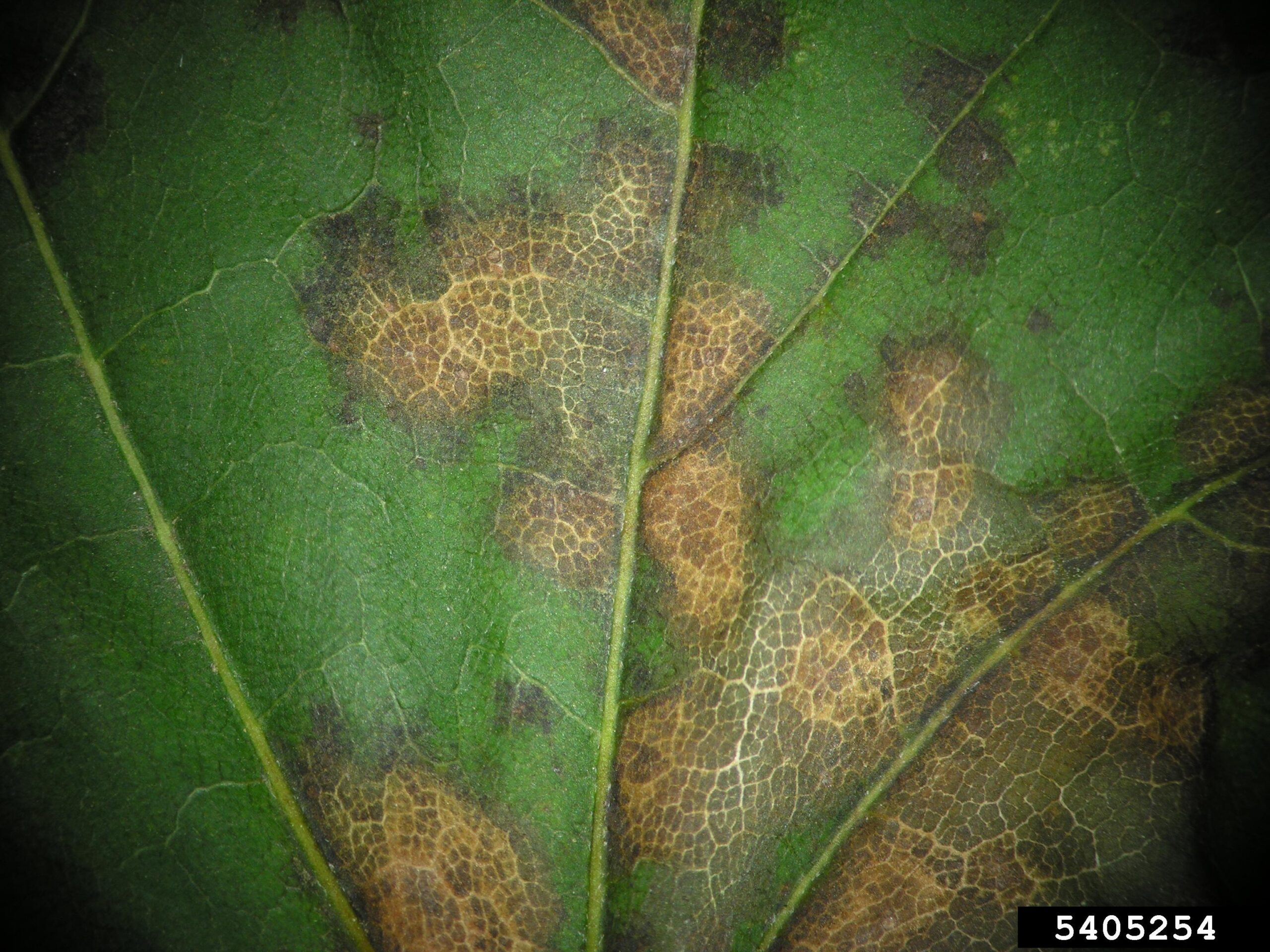
Anthracnose of maple (Aureobasidium apocryptum).
Photo by Paul Bachi, Bugwood.org
Cause
Anthracnose is a fungal disease caused by Aureobasidium apocryptum.
Symptoms
- Leaves and buds turn brown and die
- Twig and branch dieback
- Deformed, crooked, and angular branches
- Witches’ brooms (clusters of shoots)
- Most severe during wet weather
Prevention & Treatment
Cultural Controls
- Plant resistant trees
Chemical Control
Spray three times at two-week intervals starting when the leaves begin to unfurl in spring with:
- Copper-based fungicide
- Mancozeb, chlorothalonil
- Thiophanate methyl
See Table 1 for specific products.
Read and follow all directions on the label.
Maple Diseases: Bacterial Leaf Scorch on Maple
Bacterial leaf scorch is a vascular disease of maple caused by Xylella fastidiosa.
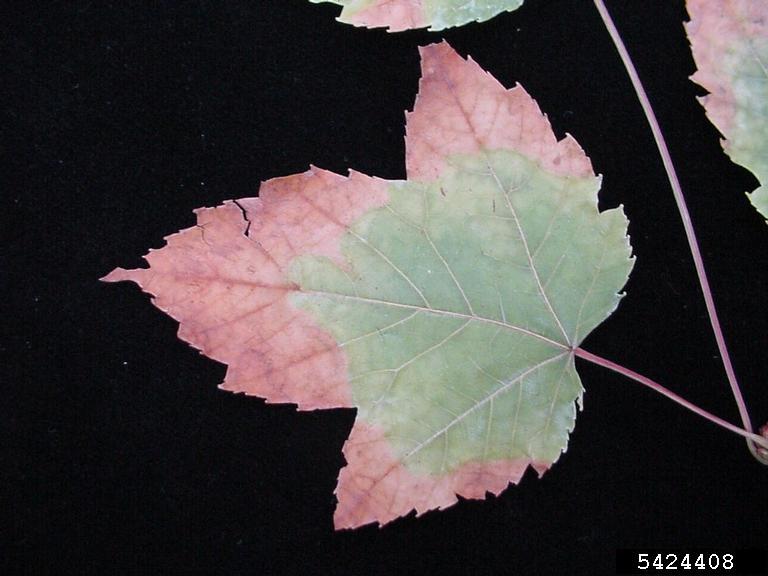
Bacterial leaf scorch of maple (Xylella fastidiosa).
Photo by John Hartman, Bugwood.org
Cause
- Caused by bacterium Xylella fastidiosa.
- Spread by leafhopper feeding, stem and root grafts, and cuttings.
Symptoms
- Marginal chlorosis (yellowing)
- Leaves fade to a drab green or brown color
- Reduced vigor
- Branch dieback
- Symptoms are most noticeable late summer to early fall
- Often follows extended periods of drought
Prevention & Treatment
Cultural Controls
- Practices that encourage root development and root function
- Incorporate organic soil amendments to improve aeration and drainage (clay soils) or water-holding capacity (sandy soils)
- Irrigate during drought
Chemical Control
- Oxytetracycline injections may suppress symptoms (not cure).
- Consult a certified arborist if chemical control is needed.
Maple Diseases: Phyllosticta Leaf Spot on Maple
Phyllosticta leaf spot is a common fungal leaf disease that produces distinctive purple-bordered spots on maple leaves.
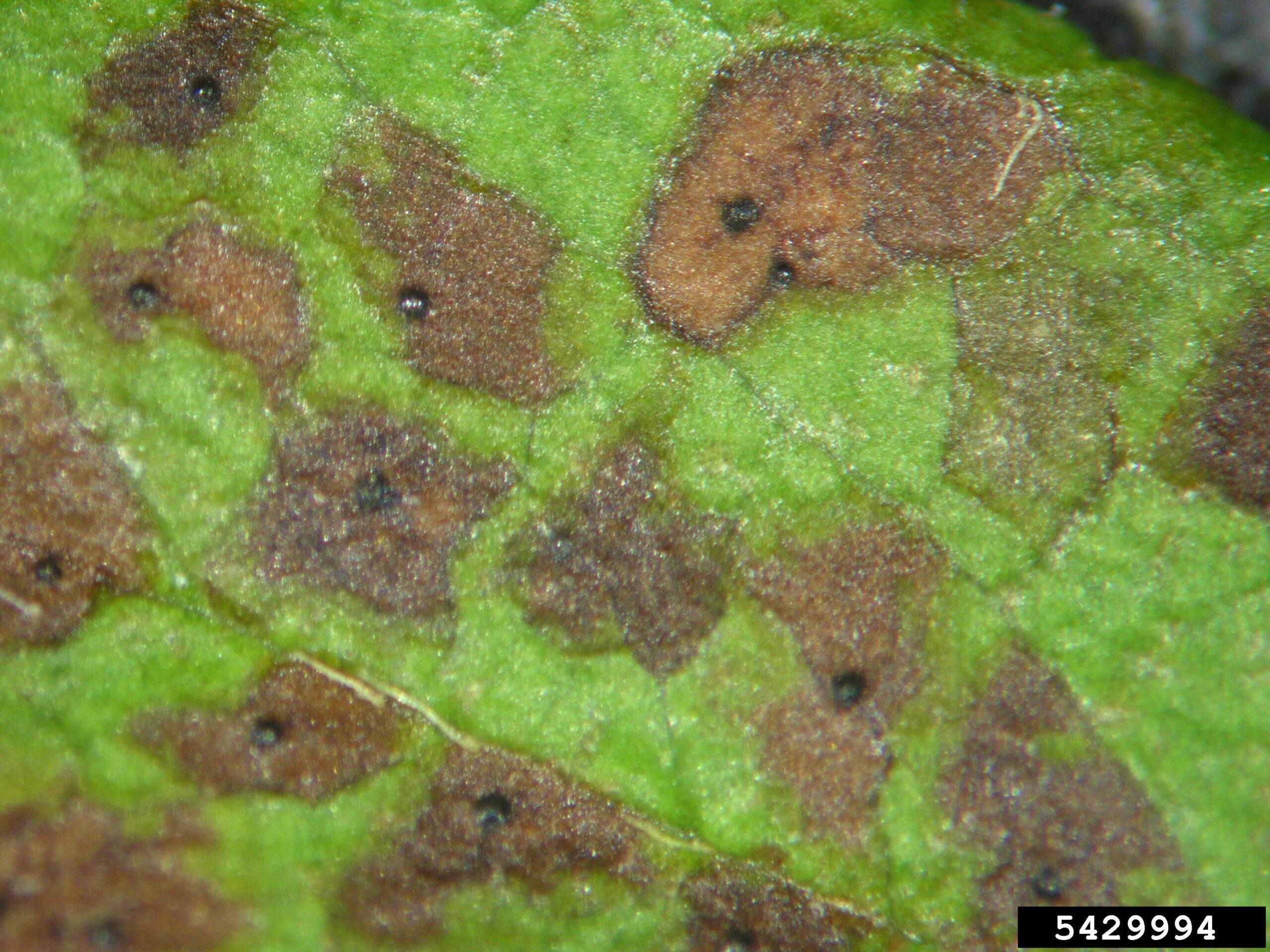
Tar spot of maple (Rhytisma species).
Photo by Andrej Kunca, Bugwood.org
Cause
Caused by the fungus Phyllosticta minima.
Symptoms
- Pale yellow centers with purple-bordered leaf spots
- Irregularly round (¼ inch diameter) spots
- Black fruiting bodies spot centers
- Fruiting bodies occur primarily on the upper leaf surface
- Partial defoliation in severe infection
- Leaf accumulation under infected trees
Prevention & Treatment
Cultural Controls
- Rake up fallen leaves, as the fungus survives the winter in fallen leaves
- Fertilize and water to maintain tree vigor
Resistant Red Maple Varieties
- ‘Autumn Flame’
- ‘Tilford’
- ‘Gerling’
Chemical Control
Spraying three times at two-week intervals beginning at leaf unfurl in spring with:
- Copper-based fungicide
- Mancozeb
- Chlorothalonil
- Thiophanate methyl
- Triadimefon
See Table 1 for specific products.
Read and follow all directions on the label.
Maple Diseases: Tar Spot on Maple
Tar spot is a recognizable fungal leaf disease of maple that produces raised black lesions on the upper leaf surface.
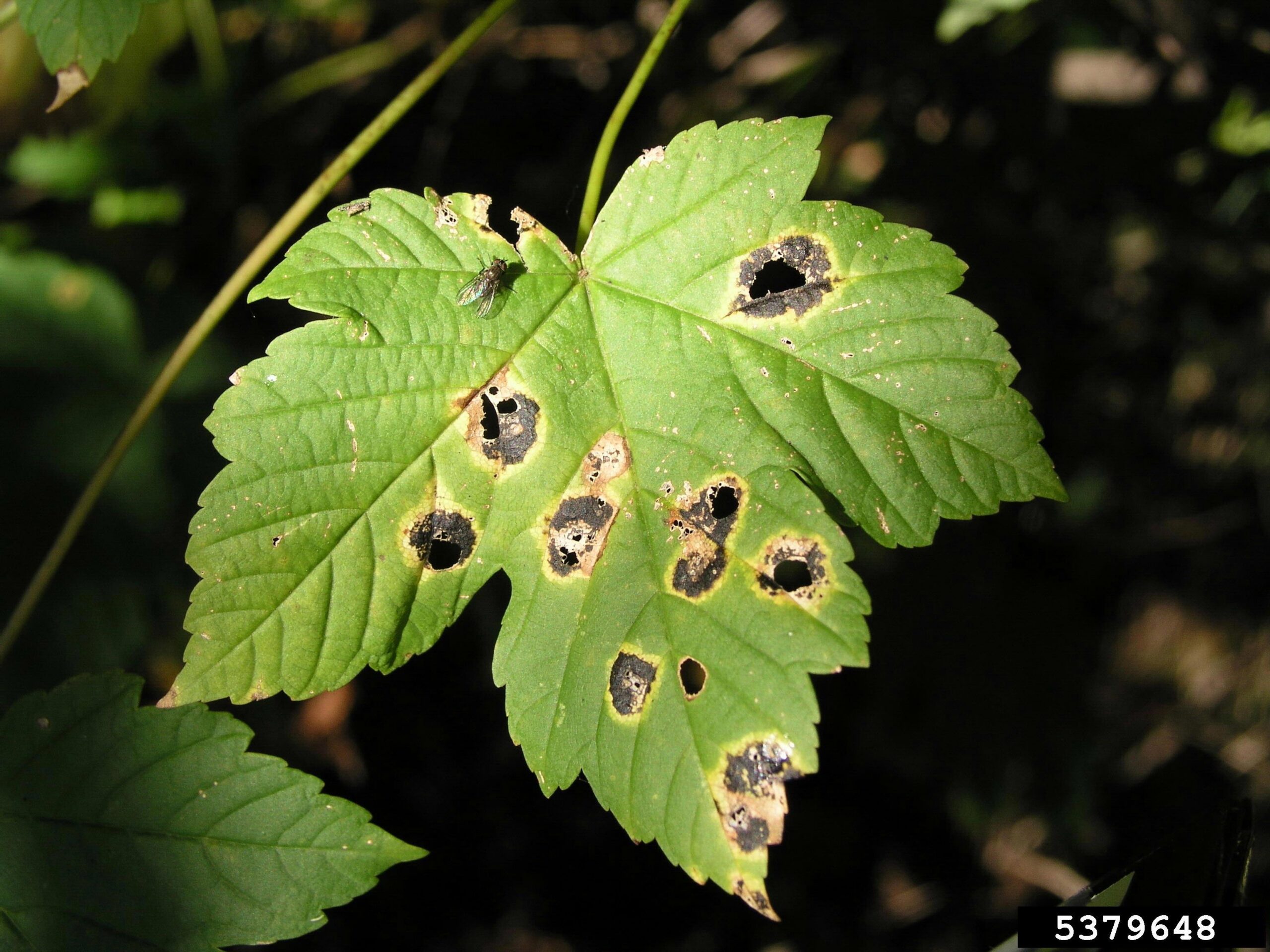
Tar spot of maple (Rhytisma species).
Photo by Andrej Kunca, Bugwood.org
Cause
Caused by Rhytisma acerinum, R. americanum, and R. punctatum.
Symptoms
- Spots appear in late spring or early summer
- Light green or yellow early spots
- Raised, shining black, tar-like dots within yellow spots on the upper leaf surfaces in late summer
- Premature leaf wither and drop (rarely threatens tree health)
- More common in forest than in landscape situations
Prevention & Treatment
Cultural Controls
Rake up and discard fallen leaves in the fall, as fungus survives in fallen leaves.
Chemical Control
Spraying three times at two-week intervals in spring, beginning at leaf unfurling with:
- Copper-based fungicide
- Mancozeb
- Triadimefon
See Table 1 for specific products.
Read and follow all directions on the label.
Maple Insect Pests: Aphids on Maple
Aphids are sap-feeding insects that infest new maple growth and produce honeydew.
Cause
Aphids are soft-bodied insects that range from 1/16 to ⅜ inch long. They may be green, yellowish, pink, gray, or black.
Aphids feed by piercing plant tissue and sucking plant sap. They prefer feeding on new growth, such as shoots, buds, and the undersides of leaves.
As they feed on plant sap, they excrete honeydew (a sugary waste material). The sooty mold fungus grows on honeydew, resulting in unsightly, dark patches.
Symptoms
- Distorted or shriveled leaves
- Honeydew (sugary waste material) accumulation
- Sooty mold fungus growth, resulting in unsightly, dark fungal growth.
- Sticky sidewalks and cars
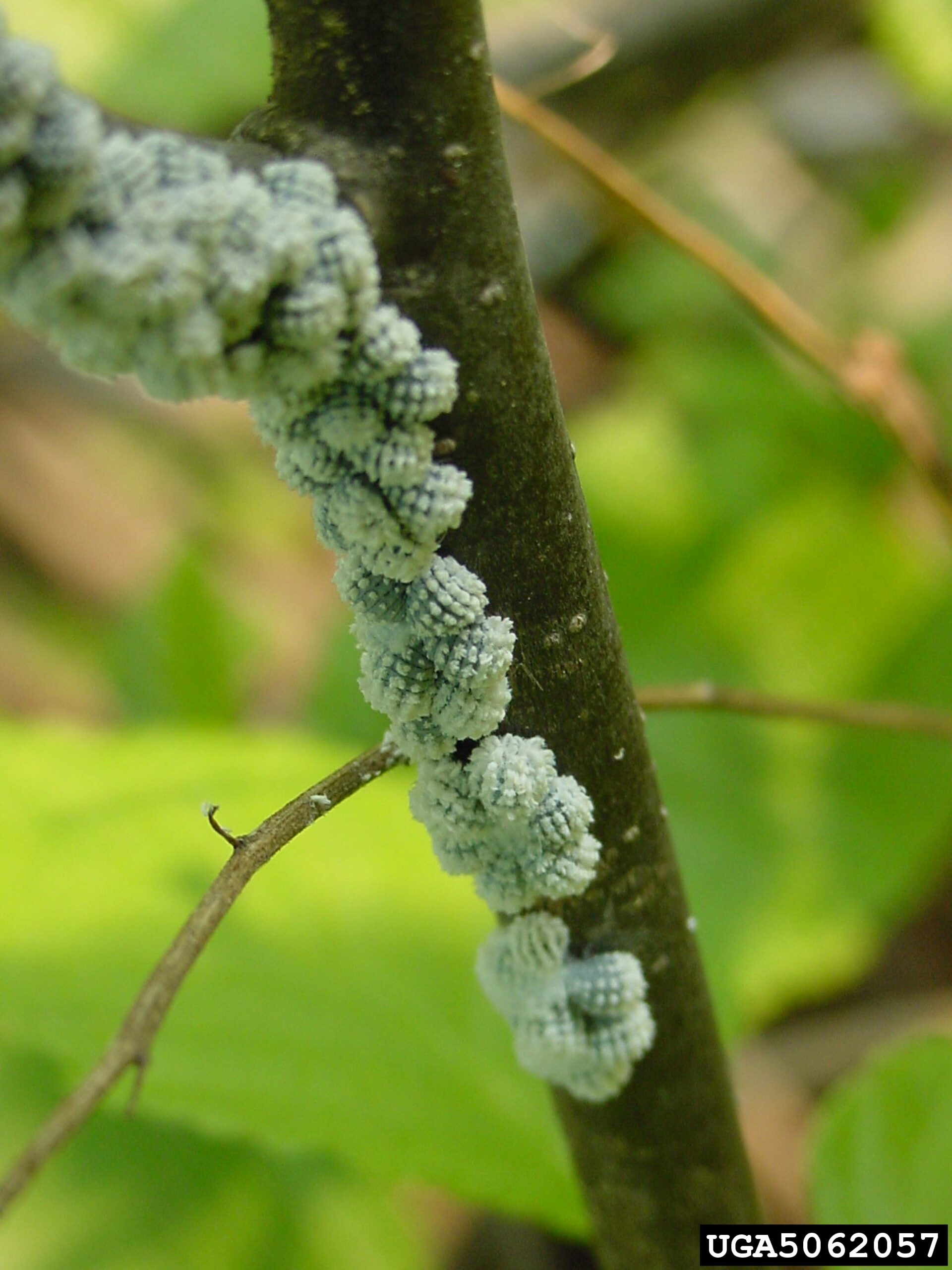
Woolly alder aphid (Paraprociphilus tessellatus).
Bob Lepak, Bugwood.org
Aphid Species on Maple
Woolly Alder Aphid (Paraprociphilus tessellatus)
The woolly alder aphid is gray to black. It gets its name from the fluffy, white wax found on its abdomen.
This aphid requires alder and silver maple to complete its life cycle, although it is occasionally found on red maple.
Colonies of these pests are obvious because of their white, fuzzy appearance. They are usually seen on leaves, twigs, or bark.
Although infested leaves shrivel and drop early, the pests cause little permanent damage. As a result of the honeydew, sidewalks and cars may become sticky.
Prevention & Treatment
Biological Control
Several natural enemies feed on aphids, including:
- Ladybird beetles (ladybugs)
- Lacewings
Allow natural predators to reduce aphid populations as much as possible.
Cultural Controls
Controlling this pest on a large tree using chemicals is expensive and often not practical. Since little permanent damage results from woolly alder aphids, tolerating some damage is often the best choice.
Chemical Control
Aphids reproduce rapidly, making chemical control difficult. In addition, insecticides may kill beneficial insects that normally keep aphid populations under control.
If natural predators do not reduce aphid populations sufficiently, the following are recommended:
Chemical Control
Foliar spray insecticides:
- Cyfluthrin
- Cyhalothrin
- Permethrin
- Bifenthrin
- Pyrethrin
- Neem oil
Treat when aphids appear and repeat at seven- to 10-day intervals as needed.
Soil drench insecticides:
- Dinotefuran
- Imidacloprid
Apply around the root zone of aphid-infested plants. Soil drench insecticides are systemically taken up by the root system.
See Table 1 for specific products.
Read and follow all label directions and precautions.
Related HGIC Resources
Maple Insect Pests: Scale Insects on Maple
Scale insects are sap-feeding pests that weaken maple trees by removing plant sap from stems, branches, and leaves.
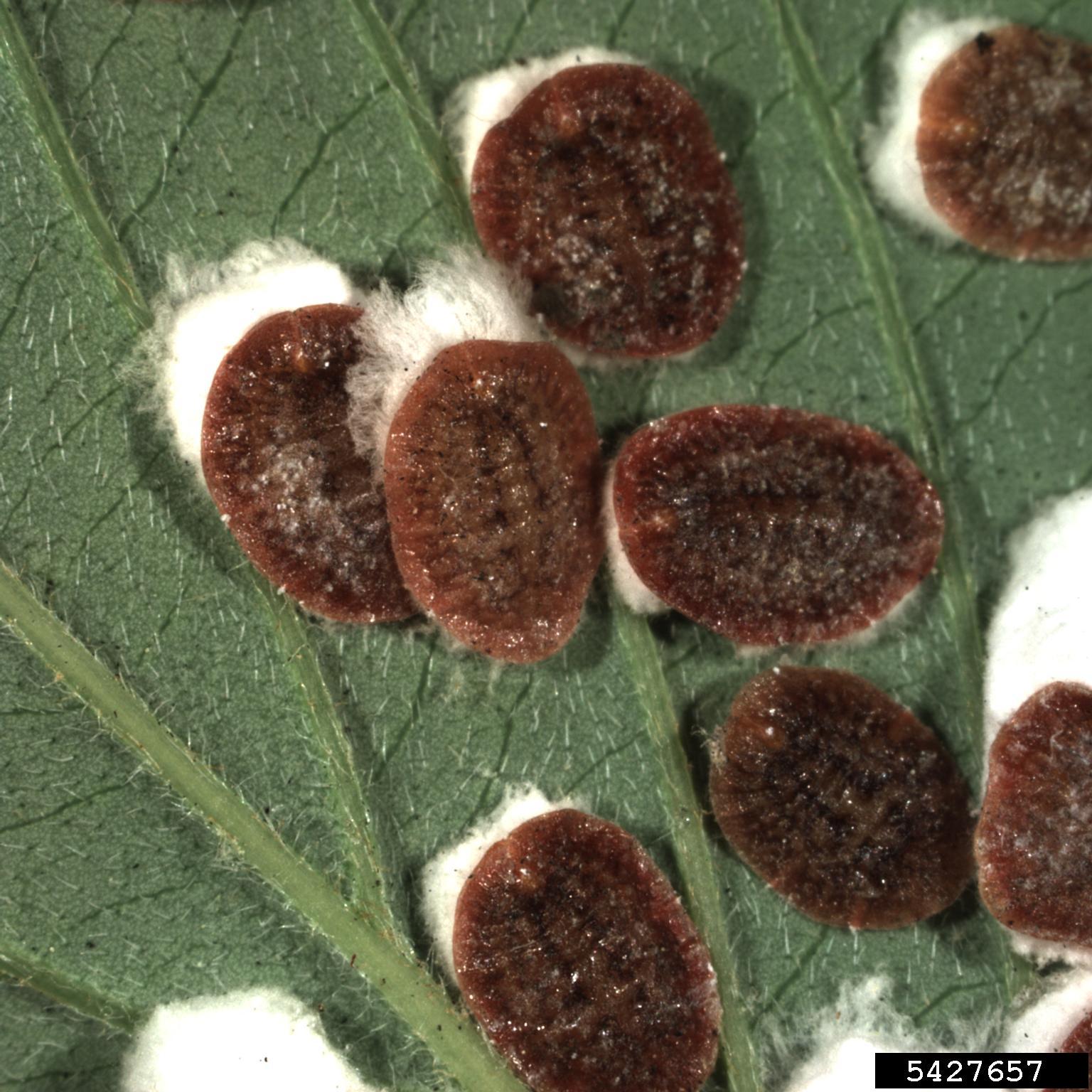
Cottony maple leaf scale adults (Pulvinaria acericola).
Photos by Nancy Gregory, University of Delaware
Cause
Many scale species infest maples, including:
- Pulvinaria acericola
- Pulvinaria innumerabilis
- Melanaspis tenebricosa
Scales are unusual insects in appearance. They are small and immobile, with no visible legs. Their appearance varies depending on age, sex, and species.
Some scales are flat and resemble small shells attached to the plant, while others appear as white cottony masses.
Symptoms
Scales feed by piercing plant tissue and sucking sap from leaves, stems, or branches.
Symptoms include:
- Weakening or death of branches
- Stunted trees with smaller flowers and leaves
- Yellowing leaves
- Premature leaf drop
Soft scales (such as Pulvinaria species) excrete honeydew, which leads to sooty mold growth.
Armored scales (such as Melanaspis tenebricosa) do not excrete honeydew because they feed differently than soft scales.
Prevention & Treatment
Biological Control
Natural enemies commonly control scale populations, including:
- Ladybird beetles (ladybugs)
- Parasitic wasps
Cultural Controls
- Scrap off scales on small trees
- Remove and destroy infested branches
Chemical control on large trees is often impractical because:
- Large tree size
- Specialized equipment requirements
- High treatment costs
Chemical Control
A waxy covering protects adult scales, but the crawler stage is susceptible to insecticides.
Recommended insecticides include:
- Cyfluthrin
- Cyhalothrin
- Bifenthrin
- Permethrin
Apply treatments when crawlers appear and repeat after 10 days.
Both soft and armored scales may also be controlled with dinotefuran soil drenches, applied in spring as new plant growth begins.
Soil drench:
- Dinotefuran
See Table 1 for specific products.
Read and follow all label instructions and precautions.
Related HGIC Resources
Maple Insect Pests: Gall Makers on Maple
Gall makers are mites or insects that cause abnormal leaf growth on maple.
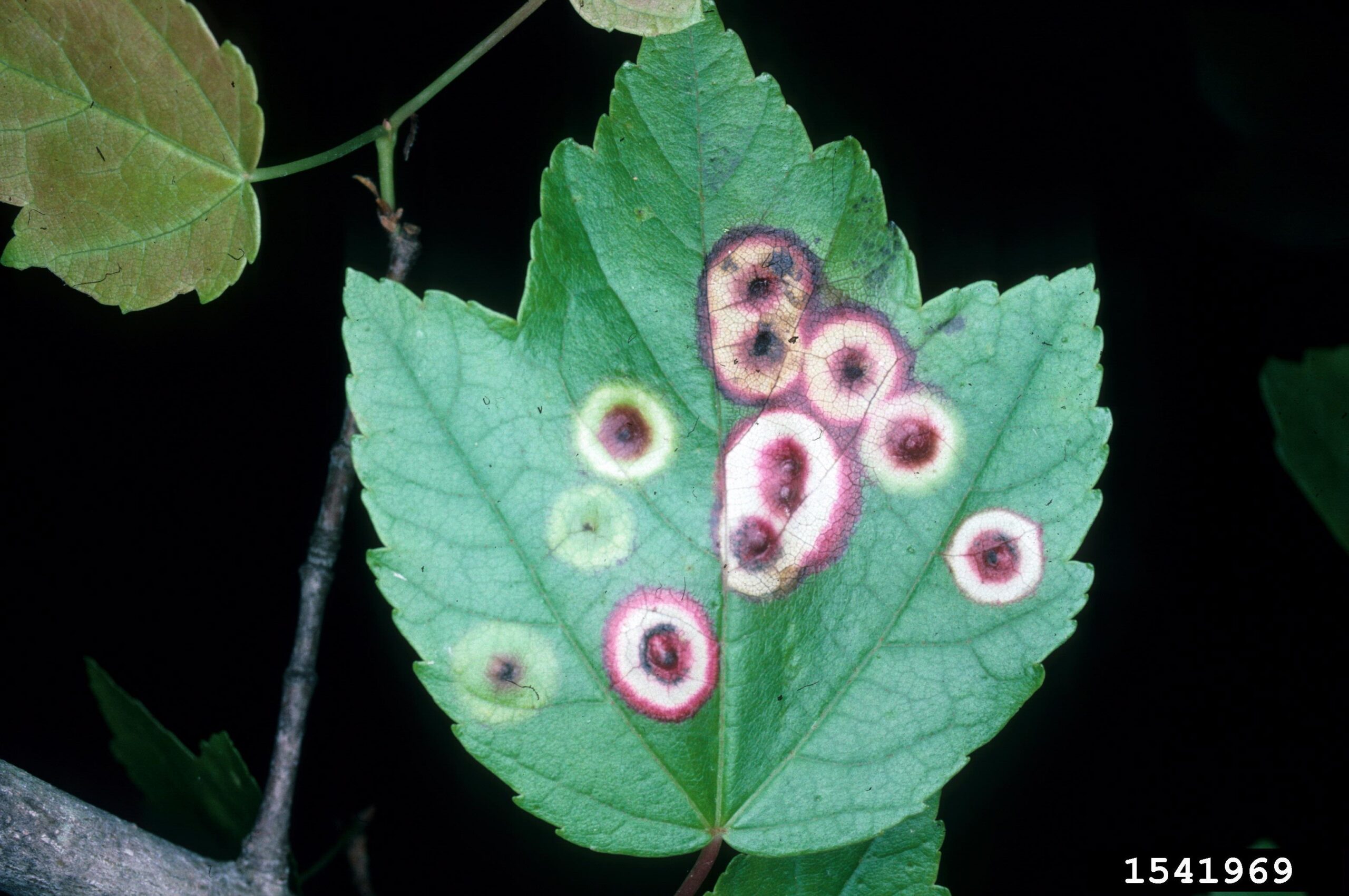
Ocellate gall midge (Acericecis ocellaris).
Photo by Lacy L. Hyche
Cause
Galls develop when leaf tissue reacts to feeding or egg-laying by mites or insects, including:
Mites:
- Vasates quadripedes
- Vasates aceriscrumena
Insects:
- Acericecis ocellaris
- Cecidomyia ocellaris
Symptoms
Galls vary greatly in appearance and may include:
- Wart-like bumps
- Spindle-shaped protrusions
- Felt-like patches on the leaf surface
Each pest produces a distinctive gall shape, which often allows it to be identified.
Galls usually develop in spring when leaves are expanding. Once the gall forms, the pest is protected inside the structure.
Although these growths can appear alarming, they rarely cause permanent injury to the tree.
Prevention & Treatment
Control measures are usually unnecessary.
Cultural Controls
On small trees, homeowners may:
- Handpick affected leaves
- Destroy leaves before exit holes form to prevent the release of the pest.
Chemical control is not typically recommended.
Maple Insect Pests: Asian Ambrosia Beetles on Maple
Asian ambrosia beetles are wood-boring pests that attack stressed or newly transplanted trees.
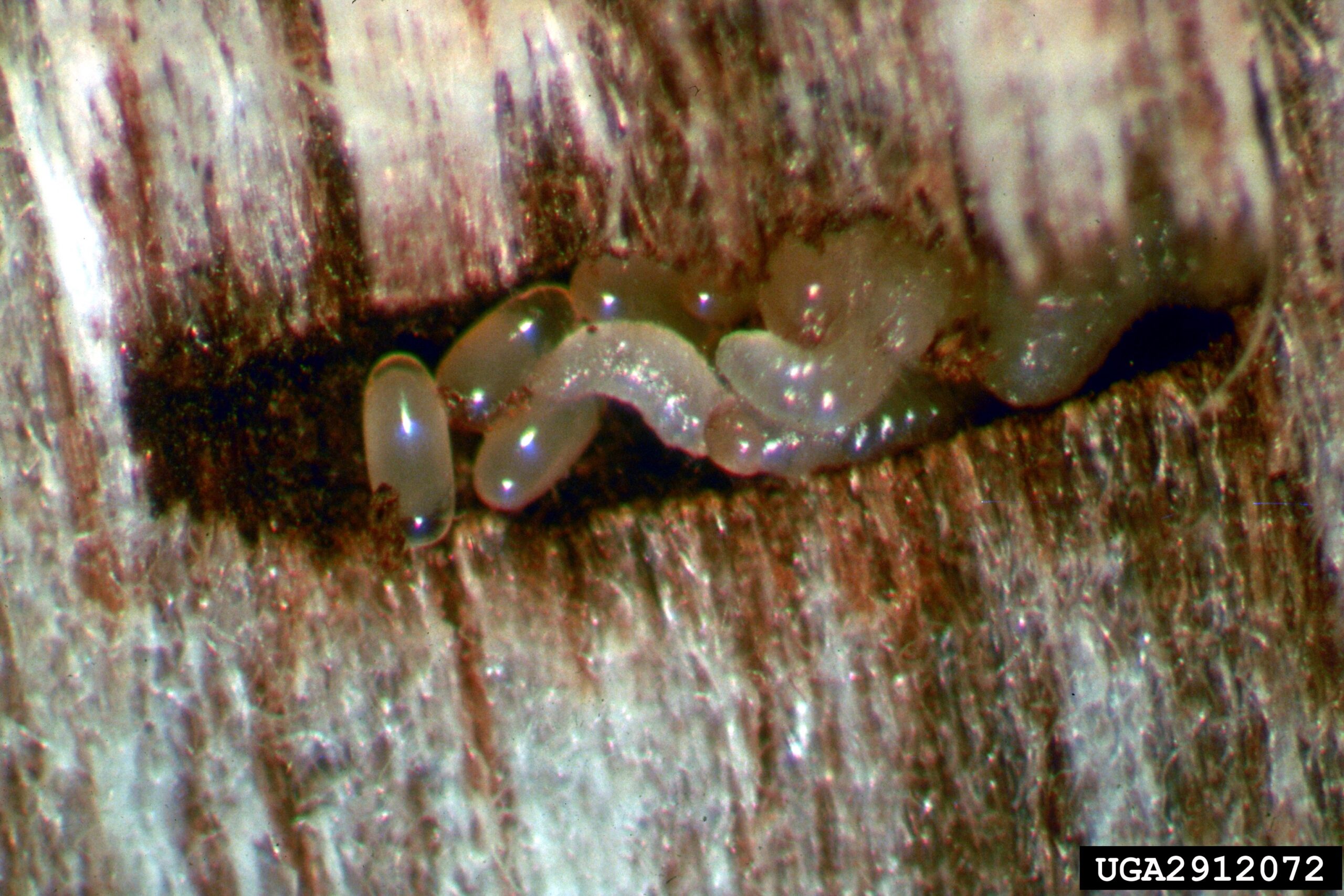
Granulate ambrosia beetle (Xylosandrus crassiusculus) larvae.
Photo by Will Hudson, University of Georgia
Cause
Japanese maples are common hosts of the granulate ambrosia beetle (Xylosandrus crassiusculus).
Other hosts include:
- Styrax
- Ornamental cherry (especially Yoshino)
- Pecan
- Peach
- Plum
- Dogwood
- Persimmon
- Sweetgum
- Magnolia
- Fig
- Chinese elm
- Azalea
The beetle becomes active in early March or earlier.
Female beetles bore into the trunks or branches of thin-barked hardwood trees, often those less than four inches in diameter.
The beetle does not feed directly on wood. Instead, it introduces an ambrosia fungus that grows inside the galleries and serves as food. This fungus clogs the host plant’s xylem, contributing to its death.
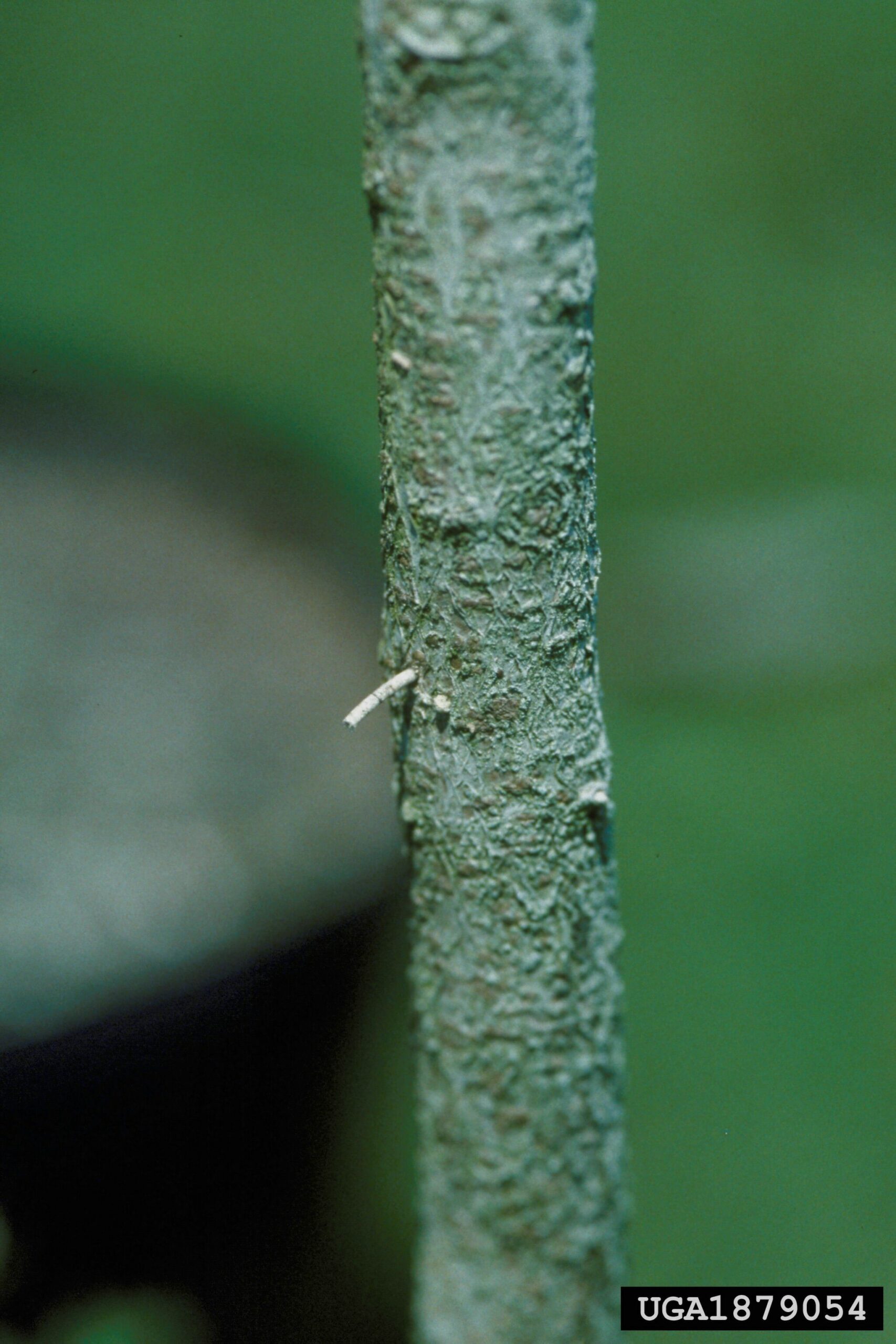
Granulate ambrosia beetle (Xylosandrus crassiusculus) frass protruding from bark.
G.Keith Douce, University of Georgia, Bugwwod.org
Symptoms
- Wilted foliage
- Pencil-lead-sized entry holes
- Toothpick-like strands of frass protruding from bark
Once a tree is attacked, it becomes more attractive to additional beetles.
Prevention & Treatment
Cultural Controls
- Remove heavily infested plants.
- Prune and destroy infested branches if damage is limited.
The beetle life cycle is approximately 55 days to emergence, so prompt removal or burning of the wood is important.
Chemical Control
Protective sprays may help reduce their spread.
Permethrin may be used as a trunk and scaffold limb spray beginning in March (see Table 1 for specific products).
- Thoroughly wet the bark surfaces.
- Multiple treatments may be needed during the season.
Research indicates that spraying infested trunks with permethrin may cause the beetles to leave their galleries.
Soil systemic treatments with dinotefuran and imidacloprid are ineffective because the beetles do not feed on plant tissue.
Related HGIC Resources
Maple Other Problems: Girdling Roots on Maple
Girdling roots can restrict water and nutrient movement in maple trees and may cause decline symptoms that resemble disease problems.
Cause
This problem occurs when a root grows around a large root or the base of the tree, preventing or hindering water and nutrient movement.
Often, girdling roots develop below the soil surface, making them difficult to detect.
Symptoms
- Reduced tree vigor
- Small leaves
- Death of small limbs
- Top dieback
- Leaf scorch symptoms
A common visual indicator is the absence of a normal root flare at the base of the trunk, suggesting roots may be constricting the tree underground.
Prevention & Treatment
Cultural Controls
- Remove the portion of the root that is girdling the tree.
- Ensure clean pruning cuts with sharp tools.
- Tree fertilization after root removal will aid in recovery.
Chemical Controls
Chemical control is not applicable.
Related HGIC Resources
Fungicides for Maple Disease Control (Table 1)
Fungicides |
Examples of Brand Names & Products |
| Chlorothalonil | Bonide Fung-onil Multi-purpose Fungicide Concentrate Bonide Fung-onil Multi-purpose Fungicide Ready to Use Ferti-lome Broad Spectrum Landscape & Garden Fungicide GardenTech Daconil Fungicide Concentrate GardenTech Daconil Fungicide Ready-to-Use Hi-Yield Vegetable, Flower, Fruit And Ornamental Fungicide Ortho MAX Garden Disease Control Concentrate Southern Ag Liquid Ornamental and Vegetable Flowable Fungicide Tiger Brand Daconil |
| Copper-based Fungicides | Bonide Captain Jack’s Liquid Copper Fungicide Bonide Copper Fungicide Spray or Dust Ready to Use Camelot O Fungicide/ Bactericide Monterey Copper Fungicide Garden Spray Liqui-Cop Natural Guard by ferti-lome Copper Soap Fungicide Concentrate Natural Guard by ferti-lome Copper Soap Fungicide Ready to Use Southern Ag Liquid Copper Fungicide |
| Neem Oil | Bonide Captain Jack’s Neem Oil Concentrate Bonide Captain Jack’s Neem Oil Ready to Use Bonide Rose Rx 3-in-1 Concentrate Bonide Rose Rx 3-in-1 Ready to Use Garden Safe Fungicide 3 Garden Safe Fungicide 3 Concentrate Garden Safe Neem Oil Extract Concentrate Monterey 70% Neem Oil Fungicide/Insecticide/Miticide Natria Neem Oil Concentrate Natria Neem Oil Ready-to-Use Natural Guard Brand by ferti-lome Neem Safer Brand Neem Oil Concentrate Fungicide/Miticide/Insecticide Safer Brand Neem Oil RTU Fungicide/Miticide/Insecticide Southern Ag Triple Action Neem Oil |
| Mancozeb | Bonide Mancozeb Flowable with Zinc Concentrate Southern Ag Dithane M-45 |
| Thiophanate-methyl | Southern Ag Thiomyl Systemic Fungicide |
Insecticides for Maple Insect Pest Control (Table 1)
Insecticides |
Examples of Brand Names & Products |
| Bifenthrin | Hi-Yield Bug Blaster Bifenthrin 2.4 Ready to Spray Hi-Yield Bug Blaster II Bifenthrin 2.4 Ready to Spray Monterey Mite & Insect Control Monterey Mosquito Control Martin’s FLEE Ready to Use Yard Spray Ortho Outdoor Insect Killer Concentrate Ortho Bug B Gon Insect Killer for Lawns & Gardens Concentrate1 & RTS Ortho BugClear Insect Killer for Lawns & Landscapes Concentrate & RTS Bifen I/T Talstar P Professional Insecticide Up-Star Gold Insecticide Hi-Yield Vegetable & Ornamental Insect Control Granules Bonide Eight Insect Control Flower & Vegetable Above & Below Soil Insect Granules |
| Cyfluthrin | BioAdvanced Science-Based Solutions 24 Hour Lawn Insect Killer Ready-to-Spray BioAdvanced Science-Based Solutions Complete Brand Insect Killer for Soil & Turf Ready-to-Spray I BioAdvanced Science-Based Solutions Insect Killer for Lawns Ready-to-Spray BioAdvanced Science-Based Solutions Rose & Flower Insect Killer Ready-to-Use |
| Cyhalothrin | Bonide Eight Insect Control Garden & Home II Ready to Use Cutter Backyard Bug Control Spray Concentrate Cyzmic CS Controlled Release Insecticide Martin’s Cyonara Lawn & Garden Insect Control Martin’s Cyonara Lawn & Garden Insect Control Ready-to-Spray Spectracide Triazicide Insect Killer for Lawns & Landscapes |
| Dinotefuran | Gordon’s Zylam Liquid Systemic Insecticide Valent Safari 20 SG Insecticide |
| Horticultural Oil | Bonide All Seasons Horticulture Spray Oil Ready-to-Use Bonide All Seasons Horticulture & Dormant Spray Oil Ready-to-Spray Ferti-lome Horticultural Oil Spray Monterey Horticultural Oil Concentrate Monterey Horticultural Oil RT Safer Brand Horticultural & Dormant Spray Oil Concentrate Southern Ag Parafine Horticultural Oil Summit Year-Round Spray Oil |
| Imidacloprid | BioAdvanced Science-Based Solutions 12 Month Tree & Shrub Insect Control Concentrate Landscape Formula BioAdvanced Science-Based Solutions 12 Month Tree & Shrub Protect & Feed Concentrate 2-1-1 BioAdvanced Science-Based Solutions 12 Month Tree & Shrub Protect & Feed II Concentrate 2-1-1 BioAdvanced Science-Based Solutions 12 Month Tree & Shrub Protect & Feed II Ready to Use Granules 2-1-1 BioAdvanced Science-Based Solutions 12 Month Tree & Shrub Protect & Feed Ready to Use Granules 2-1-1 BioAdvanced Science-Based Solutions 2 in 1 Systemic Rose & Flower Care Ready-to-Use Granules II Bonide Annual Tree & Shrub Insect Control w/ Systemaxx Bonide Systemic Granules Insect Control Bonide Systemic Insect Spray w/ Systemaxx Ready to Spray Ferti-lome Tree & Shrub Drench Hi-Yield Systemic Insect Granules Hi-Yield Systemic Insect Spray Ready-to-Spray Martin’s Dominion Tree & Shrub Insecticide Concentrate Monterey Once A Year Insect Control II |
| Malathion | Bonide Malathion 50% Insect Control Gordon’s Malathion 50% Spray Hi-Yield 55% Malathion Insect Spray Martin’s Malathion 57% Ortho Max Malathion Insect Spray Concentrate Southern Ag Malathion 50% EC Spectracide Malathion Insect Spray Concentrate Tiger Brand 50% Malathion |
| Neem Oil | Bonide Captain Jack’s Neem Oil Concentrate Bonide Captain Jack’s Neem Oil Ready to Use Bonide Rose Rx 3-in-1 Concentrate Bonide Rose Rx 3-in-1 Ready to Use Garden Safe Fungicide 3 Garden Safe Fungicide 3 Concentrate Garden Safe Neem Oil Extract Concentrate Monterey 70% Neem Oil Fungicide/Insecticide/Miticide Natria Neem Oil Concentrate Natria Neem Oil Ready-to-Use Natural Guard Brand by ferti-lome Neem Safer Brand Neem Oil Concentrate Fungicide/Miticide/Insecticide Safer Brand Neem Oil RTU Fungicide/Miticide/Insecticide Southern Ag Triple Action Neem Oil |
| Permethrin | Bonide Eight Insect Control Vegetable, Fruit, & Flower Concentrate Bonide Eight Yard & Garden Ready to Spray Hi-Yield 38 Plus Turf, Termite & Ornamental Insect Control Hi-Yield Lawn Garden Pet & Farm Insect Control Southern Ag Permetrol Lawn & Garden Insecticide Tiger Brand Super 10 Brand |
| Pyrethrin | Monterey Bug Buster–O PyGanic Crop Protection EC 1.4 II PyGanic Crop Protection EC 5.0 II |
Important Pesticide Notes
- Chemical control of diseases and insect pests by sprays on large trees is usually not feasible because adequate foliage coverage cannot be achieved.
- Horticultural oil may injure Japanese, amur, and red maples, but may not injure silver maple.
- Malathion may cause slight injury to many maple species.
- Neem oil may cause injury to Japanese maples.
- Spinosad may cause injury to Japanese maples.
- Acephate may damage red and sugar maples.
- Insecticidal soap should not be applied to Japanese maples.
- Do not apply insecticidal soap, horticultural oil, or neem oil when temperatures exceed 85°F.
- Apply these products in the early morning or evening.
- Always follow label directions for all pesticide rates and application instructions.
Pollinator Protection Statement
Pollinating insects, such as honey bees and bumble bees, can be adversely affected by pesticides. Avoid spray pesticides and systemic insecticides unless necessary. If spraying is required, apply in the evening to reduce the direct exposure to pollinating insects.
Always employ cultural controls first, then use less toxic alternatives such as:
- Insecticidal soap
- Horticultural oil
- Neem oil extract
- Spinosad
- Bacillus thuringiensis (B.t.)
- Botanical oils
If soil-applied insecticides are used, apply them immediately after flowering to reduce pollinator exposure.
For more information, contact the Clemson Home & Garden Information Center.
Pesticides are updated annually. The last updates were made on 3/26 by N. Jordan Franklin.
Originally published 01/01


