
Quick Guide / At-a-Glance
Affected Plants:
- Groundcovers
- Ornamental shrubs
- Trees
- Turfgrasses
Primary Pest:
Armored scale insects (family Diaspididae)
Common Hosts in South Carolina:
- Boxwood
- Camellia
- Cherry
- Cryptomeria
- Euonymus
- Holly
- Magnolia
- Maple
- Palm
- Pine
Primary Damage:
Removal of plant sap leading to:
- Yellowing foliage
- Branch dieback
- Reduced vigor
- Possible plant death in heavy infestations
Key Identification Feature:
Hard, waxy covering protects the insect’s body, making control difficult
Life Stages Present Throughout the Year:
- Eggs
- Crawlers (mobile immature stage)
- Nymphs
- Adults
Most Vulnerable Stage for Control:
Crawlers
Most Important Cultural Strategy:
Maintain plant health through:
- Proper fertilization
- Irrigation
- Mulching
- Correct planting practices
Most Effective Low-Toxicity Treatment:
Horticultural oil sprays kill scales by suffocation
When to Treat:
Spring, when armored scale crawlers are active
Systemic Control Option for Heavy Infestations:
Soil-applied products containing dinotefuran combined with horticultural oil sprays
Armored Scale Identification on Ornamental Plants
Armored scale insects are among the most common and difficult-to-control insect pests affecting ornamental landscape plants in South Carolina.
Armored Scale Life Cycle Stages
Many scales are serious pests of ornamental shrubs, trees, groundcovers, and turfgrasses in South Carolina. Almost 40% of the Clemson Plant Problem Clinic sample submissions for home landscapes during 2012 and 2013 were scale insects, with almost 90% being difficult-to-control armored scales.
Twenty-four different armored scales were identified on residential landscape plants. As winters have grown warmer in recent years, additional insect pests may have extended their range farther north into South Carolina from Florida and coastal Georgia. More armored scale samples on ornamentals were submitted from the coastal areas of South Carolina than from the rest of the state, probably due to the milder winter weather there (see Table 1 for scale insects identified).
Armored Scale Insects Identified on Landscape Plants in South Carolina by the Clemson University Plant & Pest Diagnostic Clinic (2012–2013) (Table 1)
The following armored scale insect species were identified on landscape plants in South Carolina by the Clemson University Plant & Pest Diagnostic Clinic.
Coastal Area
| Armored Scale Species | Host Plant |
| Holly Pit Scale | American Holly |
| Pine Needle Scale | Loblolly Pine |
| California Red Scale & False Oleander Scale | Oleander |
| Tea Scale | Camellia
Japanese Camellia Camellia |
| Tea Scale & Greedy Scale | Southern Magnolia |
| Greedy Scale | East Palatka Holly
Indian Hawthorn |
| White Peach Scale | Flowering Cherry |
| Citrus Snow Scale | Lemon, Tangerine & Grapefruit Trees |
| Purple Scale | Grapefruit |
| Obscure Scale | Flowering Dogwood |
| Gloomy Scale | Red Maple |
| Palmetto Scale | Palm |
| False Oleander Scale | Southern Magnolia |
| Bermudagrass Scale | St. Augustinegrass |
Mid-State
| Armored Scale Species | Host Plant |
| Pine Needle Scale | Shore Juniper |
| Palm Fiorinia Scale | Holly (evergreen) |
| Maskell Scale | Leyland Cypress |
| Bermudagrass Scale | Centipedegrass |
Upstate
| Armored Scale Species | Host Plant |
| Greedy Scale | Common Boxwood |
| Unknown Armored Scale | Sabel Palmetto |
| Pine Needle Scale | Japanese Cryptomeria |
| Lesser Snow Scale | Cherry Laurel |
| Asian Cycad Scale | Sabal Palmetto |
| Oystershell Scale | Pachysandra |
| Elongate Hemlock Scale | Eastern Hemlock |
| Euonymus Scale | Euonymus |
| Peony Scale | Japanese Holly |
| Cryptomeria Scale | Japanese Cryptomeria |
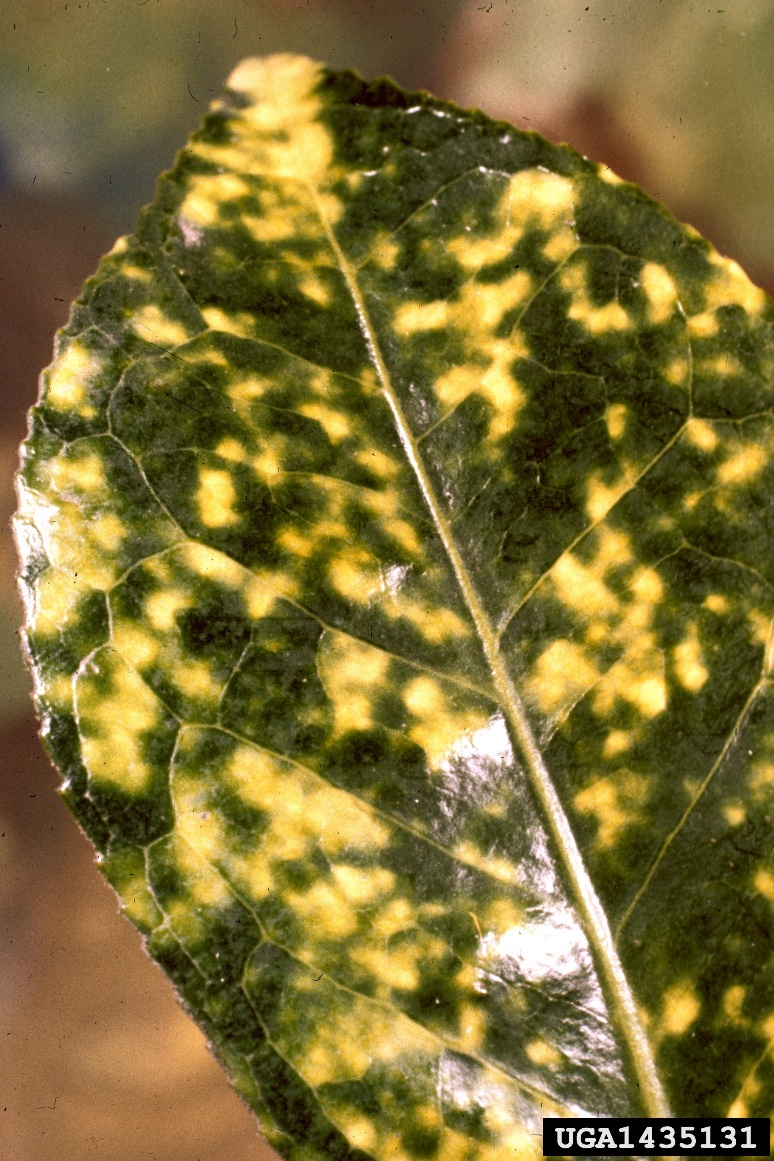
Tea scale injury on camellia upper leaf surface.
Clemson University – USDA Cooperative Extension Slide Series
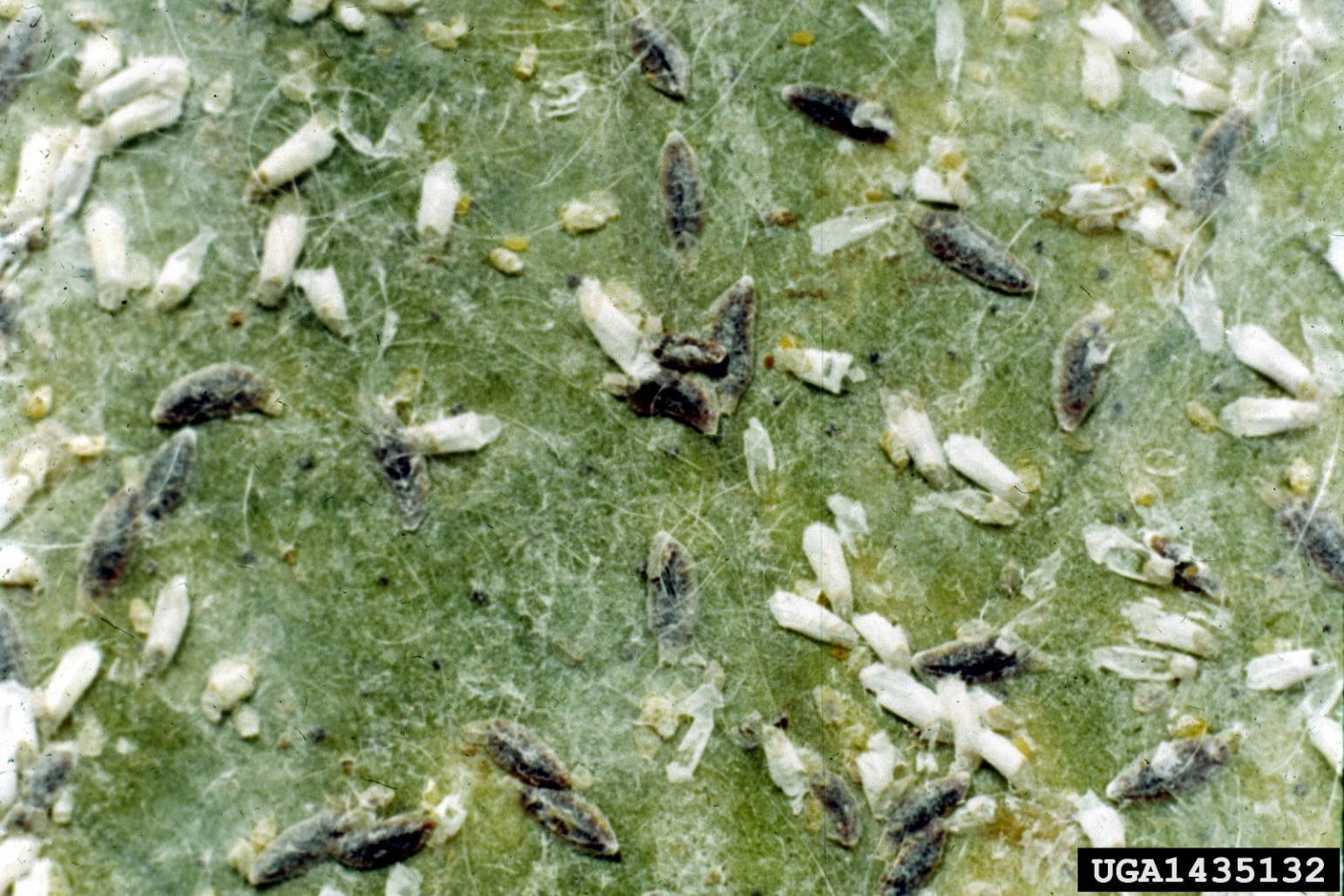
Adult tea scales on lower camellia leaf surface.
Clemson University – USDA Cooperative Extension Slide Series
Description of Armored Scale Appearance
Scale adults are the most noticeable stage on plants, and these may be white, gray, or brown. Adult scales may be round, pear-shaped, or oyster-shell shaped, but vary somewhat depending on the species.
They secrete a waxy protective covering over their bodies, making control difficult. Some or all life stages of the scale may be found throughout the year (eggs, crawlers or immatures, nymphs, and adults).
Distinguishing Armored Scales from Soft Scales
Armored scales do not produce honeydew as do soft scales. The test (a hard covering over the adult armored scales) often has concentric rings or overlapping layers.
Some soft scales may also have a hard covering that is smooth or ridged, with no overlapping layers. Flip an adult scale over, and if there is a separate soft body beneath the hard shell, it is an armored scale.
Importance of Accurate Armored Scale Identification
Identification of the scale is important as it may aid in better control. A sample of the infested plant material may be taken to the local Clemson Extension Service county office. From there, it will be sent to the Plant & Pest Diagnostic Clinic at Clemson University for accurate insect identification.
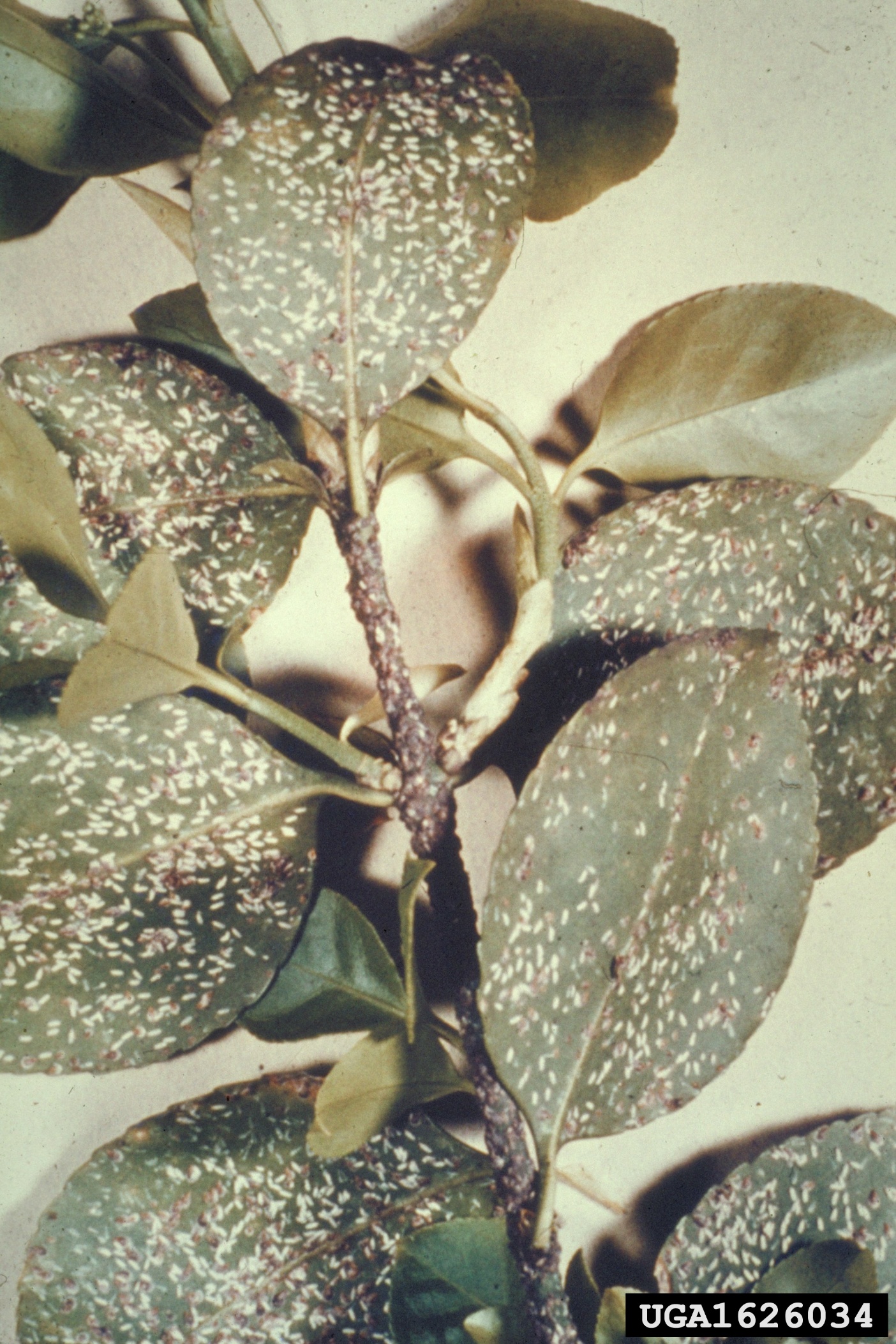
Euonymus scale on foliage.
John A. Weidhass, Virginia Tech University

White peach scale on peach limb.
Eric R. Day, Virginia Tech University
Armored Scale Damage on Ornamental Plants
Armored scale insects feed on plant sap, which can weaken ornamental plants and reduce overall vigor.
Plant Injury Caused by Armored Scale Insects
Some armored scales damage only branches, while others infest foliage or fruits.
A severe infestation of armored scales may weaken or kill a tree or shrub.
Armored Scale Cultural Control on Ornamental Plants
Maintaining proper plant health and reducing environmental stress can significantly decrease susceptibility to armored scale infestations.
Maintaining Plant Health to Reduce Armored Scale Infestations
Plants should be kept as healthy as possible to reduce the chance of scale infestation. Plants under stress are more susceptible to armored scale infestations.
Maintain plant vigor, but do not over-fertilize trees and shrubs, as this can lead to increased scale problems.
Fertilize trees and shrubs approximately mid-March along the coast or April 1st in the upstate with a slow-release tree & shrub fertilizer. Use an azalea and camellia fertilizer for plants that require acidic soil. Follow the fertilizer label directions for the rate.
Irrigation Practices to Reduce Plant Stress
Water trees and shrubs as needed during periods without rainfall, which is usually no more than once weekly during the growing season and once monthly during the winter.
Apply 1 inch of water per application.
Mulch plants 3 inches deep out to the drip line of the branches to conserve soil moisture.
Do not use weed killers, such as weed-and-feed products, beneath the canopy of trees and shrubs, as this will add another stress factor to the plants.
Proper Planting Practices to Prevent Armored Scale Problems
For new plantings, plant trees and shrubs in the proper amount of sunlight for the species, plant at the correct depth, and prepare the soil for best growth.
Related HGIC Resources
For more information on planting, see:
- HGIC 1050, Choosing a Planting Location
- HGIC 1052, Planting Shrubs Correctly
- HGIC 1001, Planting Trees Correctly
Pruning Heavily Infested Plant Material
If only a portion of the shrub is infested, prune out heavily infested shoots or limbs and promptly dispose of prunings.
Key cultural practices include:
- Maintaining proper fertilization practices
- Providing adequate irrigation during dry periods
- Applying mulch to conserve soil moisture
- Avoiding herbicide injury beneath tree canopies
- Planting in proper sunlight conditions
- Pruning heavily infested plant parts
Armored Scale Chemical Control on Ornamental Plants
Effective armored scale control in South Carolina landscapes using chemical control is most effective when treatments are properly timed to target the crawler stage.
Timing Insecticide Applications for Armored Scale Crawlers
In general, avoid using contact insecticides whenever possible, as they often kill the natural enemies of scale insects. Most contact insecticides cannot penetrate the waxy covering on scale nymphs and adults, so the crawler stage is the only life stage they control.
Failure of contact sprays often results from improper timing of application.
Monitoring for Armored Scale Crawler Activity
Armored scale crawler activity often coincides with the flush of new plant growth in the spring. However, in some scale insects, overlapping generations may result in an extended crawler emergence period.
The crawler emergence can be monitored using the following techniques:
- Wrap double-faced tape around a branch to capture crawlers
- Place an infested shoot or leaf into a sealed plastic baggie and observe for crawler movement
- Tap an infested twig sharply over white paper to detect moving crawlers
Crawlers are very small and will appear as moving specks of dust.
Horticultural Oil Applications for Armored Scale Control
Horticultural oils are safe to use and especially good choices for sensitive areas, such as where people will be present soon after treatment. Because of their short residual, they help to conserve beneficial insect species.
With good spray coverage, horticultural oil sprays may kill all stages of scales present at the time of application by suffocating them. However, as with all pesticides, multiple applications may be necessary depending on the scale species and infestation severity.
For most small landscape trees and shrubs, apply horticultural oil sprays when new leaves begin to expand in the spring, which often coincides with armored scale crawler activity.
At least three applications are needed at five- to six-week intervals, particularly when crawler emergence occurs over an extended period.
Thorough spray coverage so that oil drips or “runs off” from the upper and undersides of leaves, twigs, and plant stems is important. See Table 2 for examples of horticultural oils labeled for scale control.
Horticultural oil is one of the most efficient control options and helps conserve beneficial insects.
Horticultural Oil Mixing Rates and Application Timing
Tall trees are difficult to treat, but smaller landscape trees and shrubs can be sprayed with 1 to 2% horticultural oil solution (2½ to 5 tablespoons per gallon of water) during the growing season.
If the spring foliage has not yet emerged on a deciduous plant, spray with a horticultural oil to improve coverage of the trunk and limbs.
For application during the dormant season, late fall through early spring, apply horticultural oil sprays at a 2 to 4% mixture (5 to 10 tablespoons per gallon of water).
Horticultural oils are of the highest grade and may be used on tolerant plants during the growing season, but at reduced spray concentrations.
Temperature and Plant Sensitivity Considerations
Most trees and shrubs tolerate horticultural oil application during the summer months. However, some species may be sensitive during periods of high heat and humidity, and drought stress.
Examples of sensitivity include:
- Maples during hot, dry weather
- Eastern hemlock new needle growth before the needles mature
Refer to the product label for plant sensitivity precautions and temperature restrictions.
In general, apply sprays when temperatures are between 45°F and 85°F and no rainfall is forecast for 24 hours. To reduce the chance of plant injury, water trees or shrubs thoroughly a couple of days before spraying.
If phytotoxicity (damage) occurs, delay additional applications until leaf drop in the fall. More dilute sprays may be needed when foliage is present on sensitive plants.
Contact Insecticides for Armored Scale Crawlers
Contact insecticides may be applied at the proper time to control the crawler stage of armored scale insects.
Apply pesticides when shrubs and trees are not in bloom to reduce risk to pollinating insects. Applications should be made in the early evening when pollinator activity is low.
Active ingredients labeled for crawler control include:
- Acephate
- Bifenthrin
- Cyfluthrin
- Cyhalothrin
- Insecticidal soap
- Malathion
- Permethrin
See Table 2 for examples of contact insecticides for scale crawler control.
Soil-Applied Systemic Insecticides for Armored Scale Control
Soil-applied systemic insecticides may provide supplemental control of armored scale insects when combined with horticultural oil treatments.
Although soil treatments with products containing imidacloprid will control some tree and shrub pests, such as aphids, lace bugs, and white flies, they provide poor control of both soft and armored scales. In some cases, applications of imidacloprid may increase spider mite populations during summer.
Systemic insecticides containing dinotefuran provide improved control of armored scales and soft scales. Granular formulations are applied around the base of the tree or shrub and watered into the soil. Liquid formulations are mixed with water and slowly poured around the base of the plant.
Dinotefuran soil treatment can be combined with horticultural oil sprays for improved control. Apply dinotefuran insecticides in the spring as new growth appears. Evergreen plants can also be treated in the fall.
See Table 2 for examples of soil-applied products for armored scale control and soft scale control.
Armored Scale Insecticides Labeled for Residential Landscape Control
Insecticide Active Ingredients & Products Labeled for Armored Scale Control in Residential Landscapes. (Table 2.)
Active Ingredients |
Examples of Brands & Products |
Soil Applied Systemic Insecticide for Ornamentals |
|
| Dinotefuran | Gordon’s Zylam Liquid Systemic Insecticide Valent Safari 20 SG Insecticide |
Spray Foliar Systemic Insecticide for Ornamentals |
|
| Acephate | BioAdvanced Science-Based Solutions 2-in-1 Systemic Rose & Flower Care Granules with 6-9-6 Fertilizer Bonide Systemic Insect Control II |
Spray Contact Insecticides (for crawler control only) for Ornamentals |
|
| Bifenthrin | Hi-Yield Bug Blaster Bifenthrin 2.4 Ready to Spray Hi-Yield Bug Blaster II Bifenthrin 2.4 Ready to Spray Monterey Mite & Insect Control Monterey Mosquito Control Martin’s FLEE Ready to Use Yard Spray Ortho Outdoor Insect Killer Concentrate Ortho Bug B Gon Insect Killer for Lawns & Gardens1 Ortho BugClear Insect Killer for Lawns & Landscapes Bifen I/T Talstar P Professional Insecticide Up-Star Gold Insecticide Hi-Yield Vegetable & Ornamental Insect Control Granules Bonide Eight Insect Control Flower & Vegetable Above & Below Soil Insect Granules |
| Cyhalothrin | Bonide Eight Insect Control Garden & Home II Ready to Use Cutter Backyard Bug Control Spray Concentrate Cyzmic CS Controlled Release InsecticideMartin’s Cyonara Lawn & Garden Insect Control Martin’s Cyonara Lawn & Garden Insect Control Ready-to-SpraySpectracide Triazicide Insect Killer for Lawns & Landscapes |
| Cyfluthrin | BioAdvanced Science-Based Solutions 24 Hour Lawn Insect Killer Ready-to-Spray BioAdvanced Science-Based Solutions Complete Brand Insect Killer for Soil & Turf Ready-to-Spray I BioAdvanced Science-Based Solutions Insect Killer for Lawns Ready-to-Spray BioAdvanced Science-Based Solutions Rose & Flower Insect Killer Ready-to-Use |
| Horticultural Oil | Bonide All Seasons Horticulture Spray Oil Ready-to-Use Bonide All Seasons Horticulture & Dormant Spray Oil Ready-to-Spray Ferti-lome Horticultural Oil Spray Monterey Horticultural Oil Concentrate Monterey Horticultural Oil RTU Safer Brand Horticultural & Dormant Spray Oil Concentrate Southern Ag Parafine Horticultural Oil Summit Year-Round Spray Oil |
| Insecticidal Soap | Bonide Insecticidal Soap Multi-purpose Insect Control Ready to Use Garden Safe Brand Insecticidal Soap Insect Killer Miracle-Gro Nature’s Care Insecticidal Soap Natria Insecticidal Soap Ready-to-Use Natural Guard by ferti-lome Insecticidal Soap Concentrate Safer Brand Insect Killing Soap Concentrate II Whitney Farms Insecticidal Soap 1 |
| Malathion | Bonide Malathion 50% Insect Control Gordon’s Malathion 50% Spray Hi-Yield 55% Malathion Insect Spray Martin’s Malathion 57% Ortho Max Malathion Insect Spray Concentrate Southern Ag Malathion 50% EC Spectracide Malathion Insect Spray Concentrate Tiger Brand 50% Malathion |
| Permethrin | Bonide Eight Insect Control Vegetable, Fruit, & Flower Concentrate Bonide Eight Yard & Garden Ready to Spray Hi-Yield 38 Plus Turf, Termite & Ornamental Insect Control Hi-Yield Lawn Garden Pet & Farm Insect Control Southern Ag Permetrol Lawn & Garden Insecticide Tiger Brand Super 10 Brand |
| RTS = Ready to Spray (a hose-end applicator) RTU = Ready-to-Use (pre-mixed formulation) |
|
Pesticides are updated annually. The last updates were made on 4/26 by N. Jordan Franklin.
Originally published 11/13


