
Crapemyrtle Bark Scale Quick Guide
Affected Plants: Crapemyrtles (Lagerstroemia spp.); also pomegranate, persimmon, edible fig, boxwood, American beautyberry, cleyera, privet, and raspberries.
Primary Insect Pest: Crapemyrtle bark scale (Acanthococcus lagerstroemiae).
Primary Damage Symptoms: White or gray waxy scale on stems, twigs, branch crotches, pruning sites, and trunks; honeydew and black sooty mold; reduced plant vigor and flowering; delayed leaf-out; and possible premature bark peeling.
Most Important Prevention Strategy: Plant crapemyrtles in full sun, maintain plant health, and inspect nearby susceptible plants for infestations.
Biological Controls: Lady beetles and mealybug destroyers can effectively control crapemyrtle bark scale.
Chemical Control: Apply a dinotefuran soil drench in spring as new growth begins. For crawlers, apply bifenthrin mixed with 2% horticultural oil in late April or May, and again in late summer, following all product label directions.
Related HGIC Resources
- Crapemyrtle Pruning (HGIC 1009): Recommended pruning practices for crapemyrtles.
Crapemyrtle Bark Scale Origin and Distribution
The crapemyrtle bark scale (CMBS; Acanthococcus lagerstroemiae) is an introduced pest from Asia that first infested crapemyrtles (Lagerstroemia spp.) in Texas in 2004. It then spread rapidly through Oklahoma, Arkansas, Louisiana, Mississippi, Georgia, North Carolina, and Virginia, likely through the movement of plant material. CMBS was first confirmed in South Carolina in 2019 and continues to spread within the state.
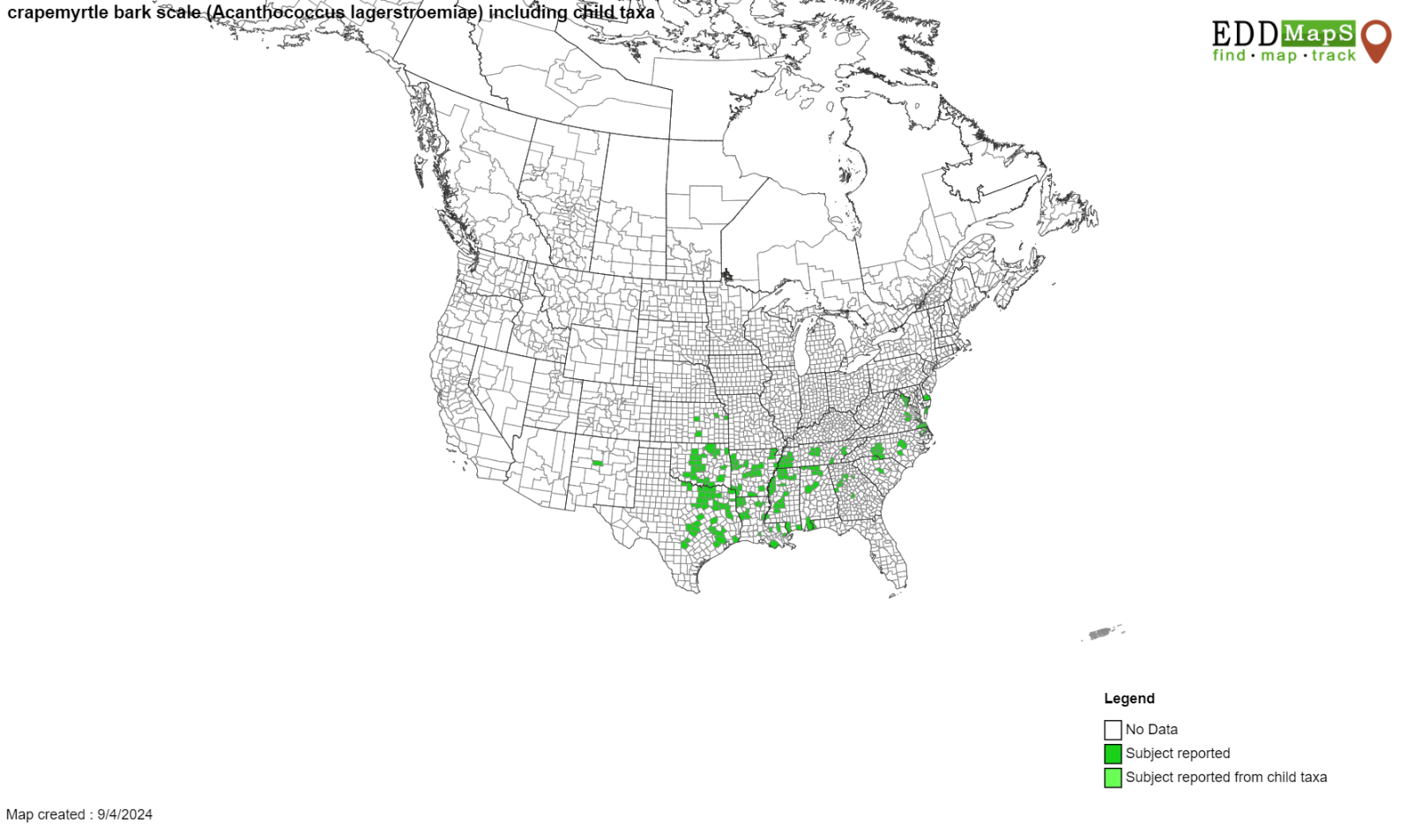
2024 Distribution map for CMBS from EDDMaps.org
https://www.eddmaps.org/distribution/uscounty.cfm?sub=80722
Identification of Crapemyrtle Bark Scale on Crapemyrtle
Crapemyrtle bark scale is a bark or felt scale that resembles a mealybug and feeds beneath loose, exfoliating bark on crapemyrtle stems, branches, and trunks.
- It differs from soft scales in that it has a similar waxy coating and produces honeydew.
- Bark scales belong to the family Eriococcidae, while soft scales belong to the family Coccidae.
- infestations appear as white or gray, waxy encrustations on stems, large twigs, branch crotches, pruning sites, and trunks.
- The scale rarely occurs on foliage.
- White adults and white ovisacs containing pink eggs may be visible on branches.
- CMBS often feeds beneath loose, exfoliating bark, making control by predators and contact pesticides more difficult.
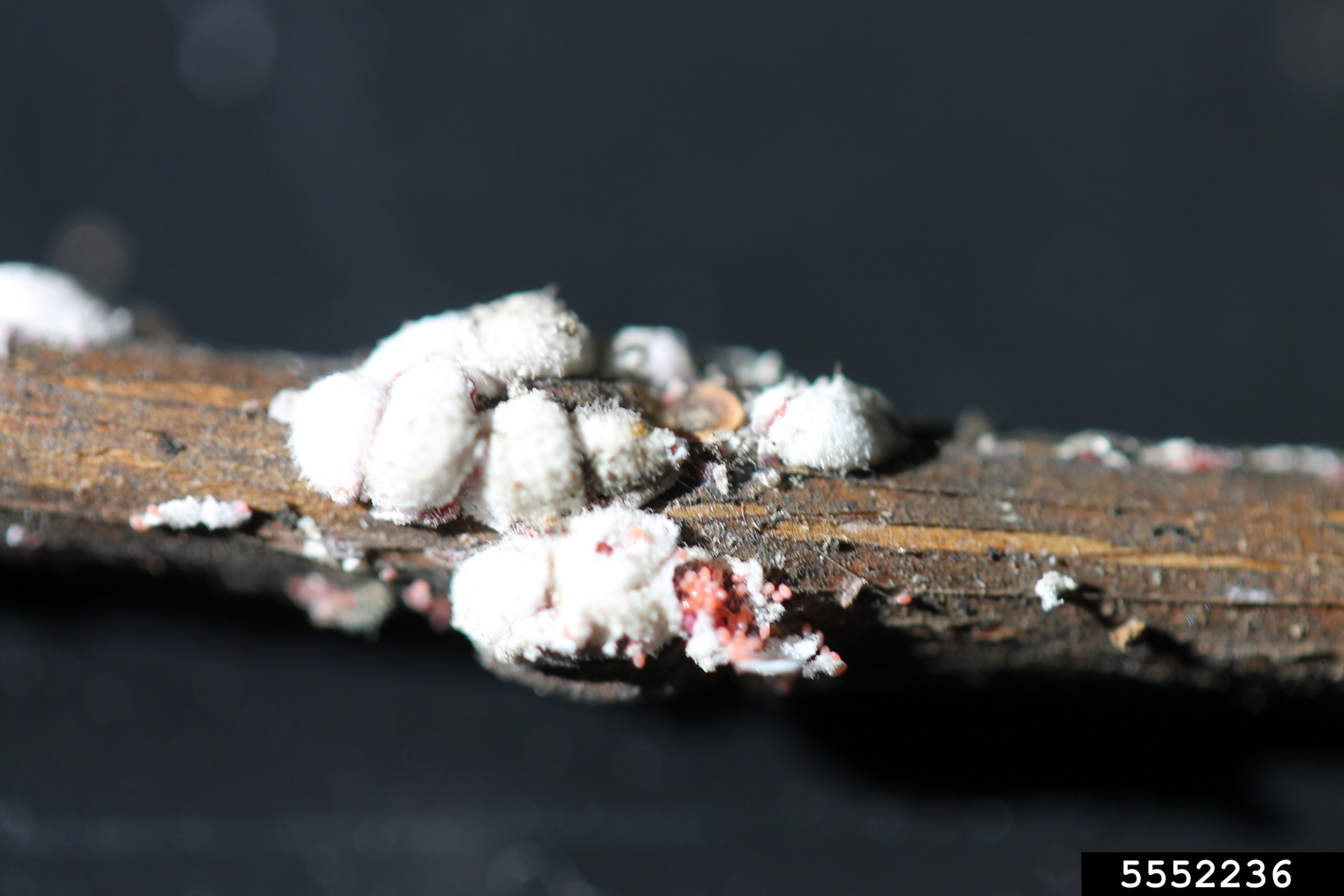
Crapemyrtle bark scale is a new insect pest to the Southeastern US. Above on a branch are the white adults and ovisacs containing their pink eggs.
Helene Dougherty, Virginia Polytechnic Institute & State University, Bugwood.org
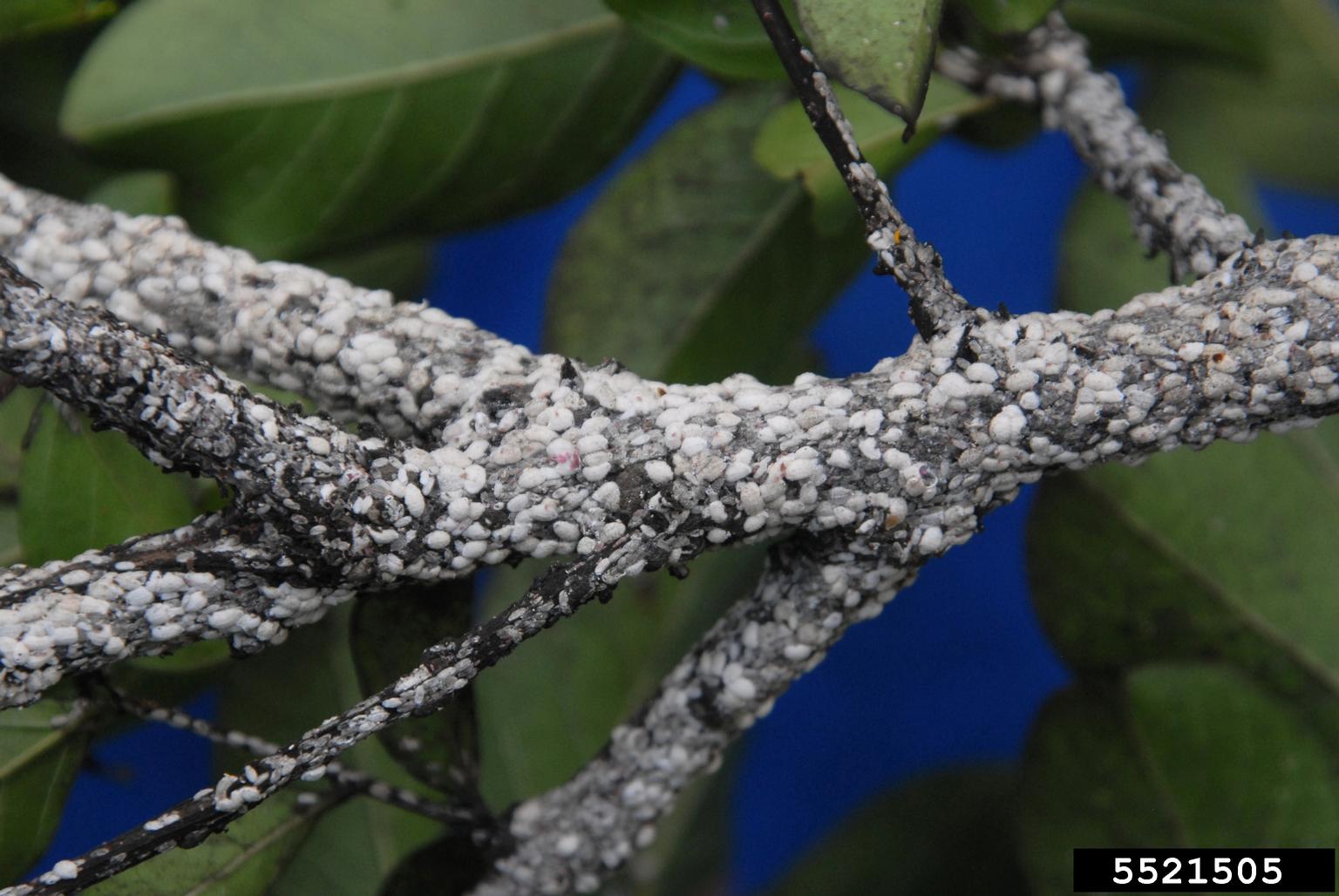
Crapemyrtle branches can become completely covered with crapemyrtle bark scale.
Jim Robbins, University of Arkansas CES, Bugwood.org
This scale will settle to feed beneath the loose, exfoliating bark of the crapemyrtle, making control by both predators and pesticides more difficult.
These bark scales produce copious amounts of honeydew, the sugary waste the scale produces as it feeds on the plant’s phloem. As a result, the leaves, branches, and trunk become covered with black sooty mold, which grows on the honeydew.
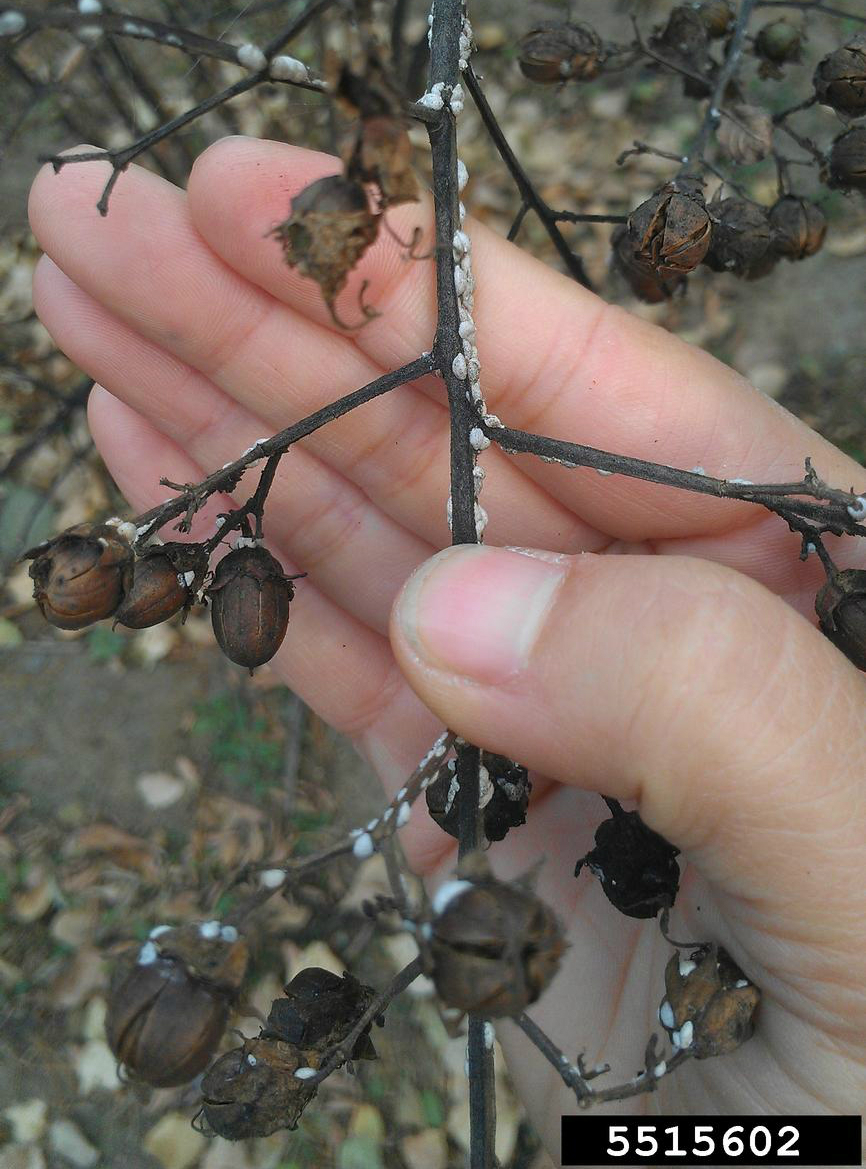
The spent crapemyrtle flower clusters may also be covered with crapemyrtle bark scale and sooty mold.
Mengmeng Gu, Texas A&M AgriLife Extension Service, Bugwood.org
Life Cycle of Crapemyrtle Bark Scale on Crapemyrtle
Crapemyrtle bark scale develops through egg, crawler, adult female, and winged adult male stages.
- Adult males are small and winged and fly to locate females for mating.
- After mating, females produce white ovisacs, lay their eggs, and die.
- Each female lays approximately 60 to 250 eggs.
- Eggs remain protected inside the ovisacs and may overwinter there.
- Pink crawlers hatch from mid- to late April through May and disperse onto branches.
- A second peak of crawler activity occurs in late summer.
- Crawlers move to new twigs and branches and begin feeding on the sugary phloem beneath the bark.
Damage and Symptoms of Crapemyrtle Bark Scale on Crapemyrtle
Crapemyrtle bark scale produces honeydew as it feeds on the plant’s phloem, which can lead to black sooty mold and reduced plant performance.
- Leaves, branches, and trunks may become covered with black sooty mold.
- Spent flower clusters may also be covered with scale and sooty mold.
- Infested plants may leaf out later than healthy plants.
- Heavy infestations may reduce plant vigor, flower production, and flower-cluster size.
- Premature bark peeling may occur.
- Crapemyrtle bark scale usually causes aesthetic damage and may not kill the plant.
- Adult females are often concentrated on the lower, shadier sides of branches.
Do not confuse the honeydew and black sooty mold produced by crapemyrtle bark scale with similar symptoms caused by aphids. Aphids feed on tender new growth at branch tips, while crapemyrtle bark scale is concentrated on stems, branches, and trunks.
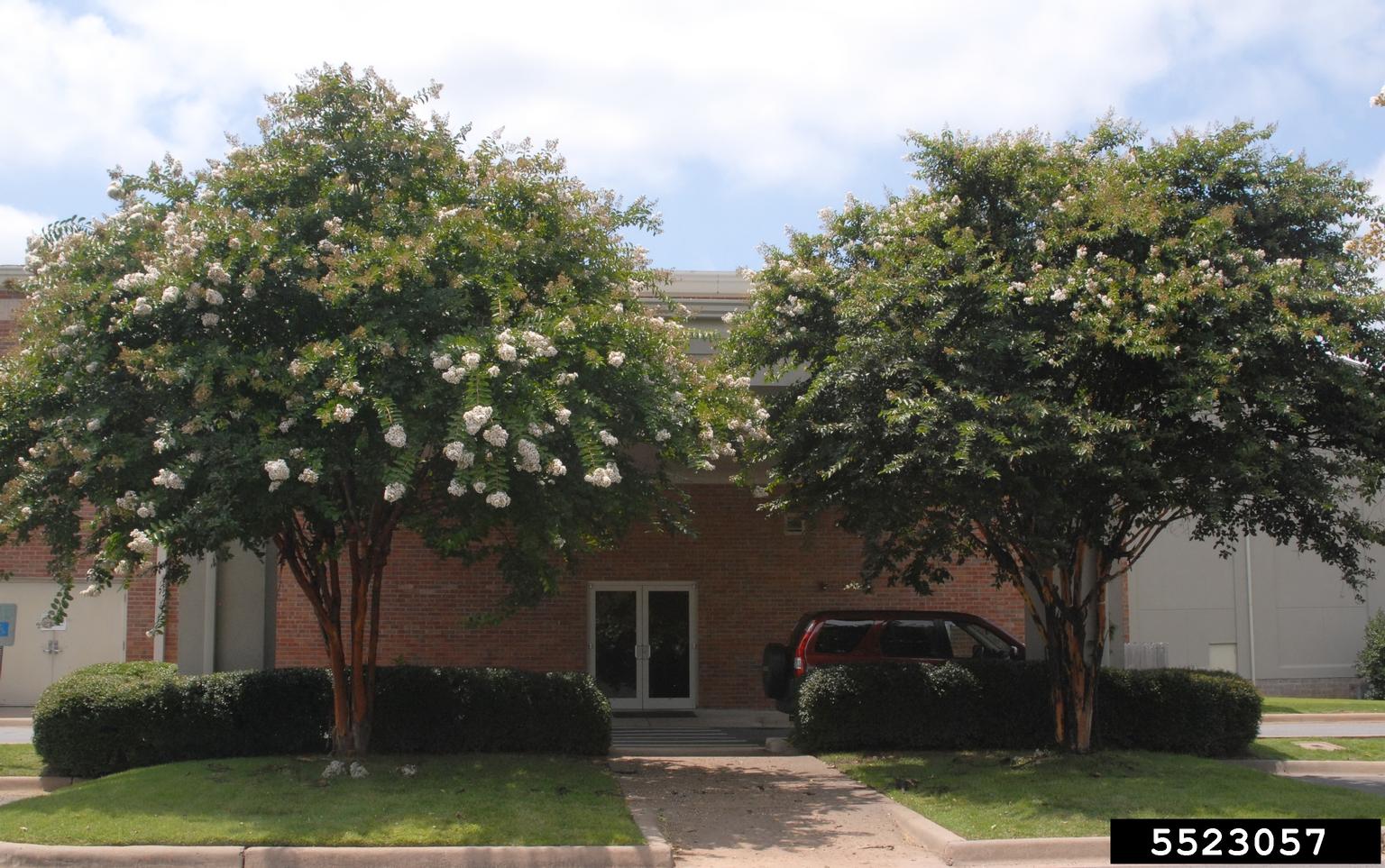
The crapemyrtle on the left was treated to control crapemyrtle bark scale. The tree on the right is infested and shows reduced flowering. A closer inspection of infested crapemyrtles will show copious sooty mold on leaves, branches, and trunks.
Jim Robbins, University of Arkansas CES, Bugwood.org
Management of Crapemyrtle Bark Scale on Crapemyrtle
Integrated pest management begins with monitoring for infestations and using cultural practices. Use biological controls when available, followed by chemical treatments when necessary.
Monitoring
- Inspect crapemyrtles and nearby susceptible plants for scale infestations.
- Examine branch crotches, pruning sites, loose bark, lower branch surfaces, stems, and trunks.
- Use double-sided sticky tape wrapped around small branches to monitor crawler emergence and help determine when to apply contact insecticide.
- After a soil-drench treatment, scrape adult scales from a branch. Reddish body fluid indicates that the scales are alive; dead scales will not “bleed.”
Cultural Control
- Maintain healthy plants through proper mulching, irrigation, fertilization based on soil-test recommendations, and pruning.
- Plant crapemyrtles in full sun. Plants in sunnier sites often have smaller infestations, while shaded plants typically have more crawlers.
- Closely inspect nearby pomegranate, persimmon, edible fig, boxwood, American beautyberry, cleyera, privet, and raspberry plants.
Rejuvenation Pruning
- If a plant is highly infested and insecticide treatment is not desired, cut it flush with the ground.
- Promptly burn the removed trunk and limbs, or cut them up and place them in garbage bags for trash pickup.
- Do not place the removed material at the curb for regular brush pickup.
- Select three equally spaced sprouts and prune out the rest.
- Mulch around the plant.
- Fertilize the sprouts twice during spring: April 1 and mid-May.
- Within three years, the crapemyrtle should again become a flowering plant.
Biological Control
Lady beetles and mealybug destroyers can effectively control crapemyrtle bark scale. Natural predator populations may take time to build.
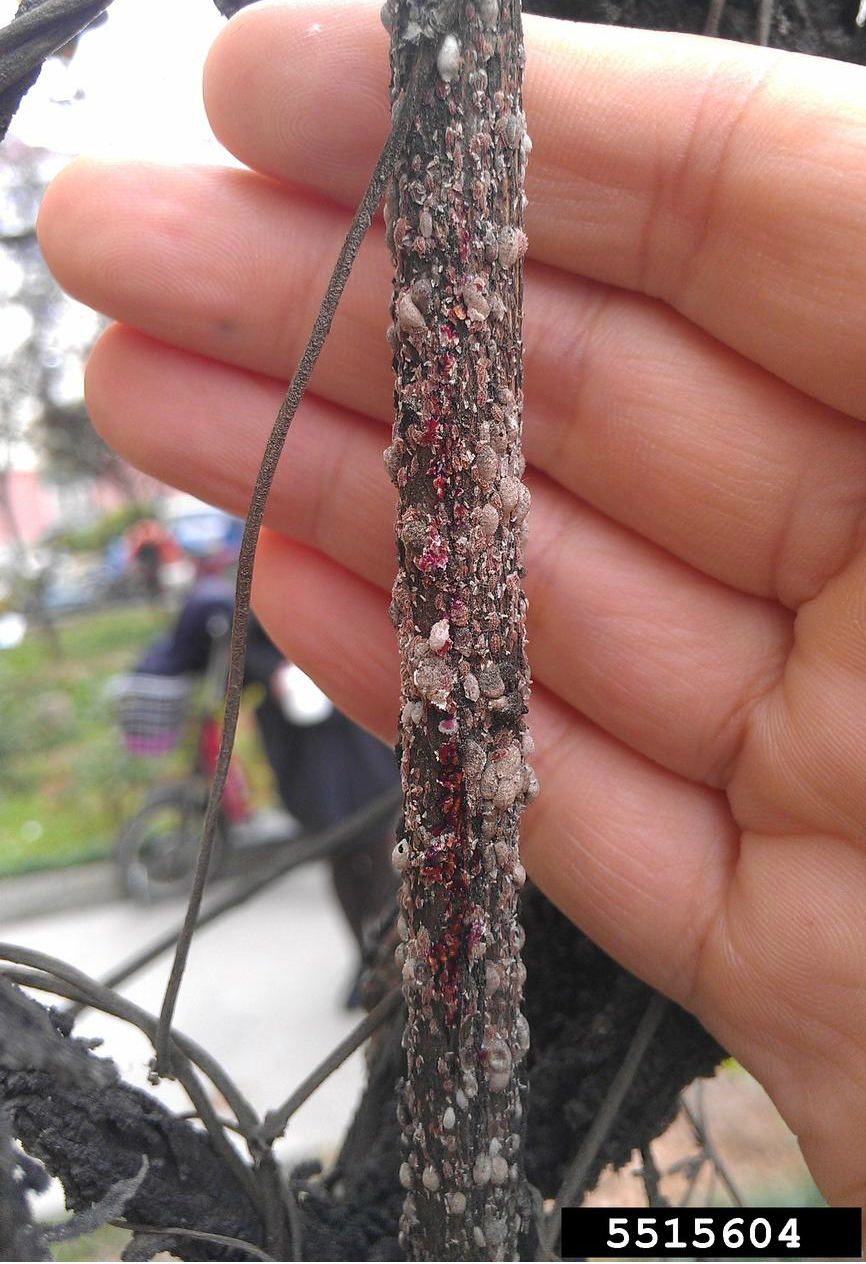
Scraping the soft crapemyrtle bark scales can reveal whether they are alive or dead. If alive, scraping will result in “bleeding” of their reddish body fluids.
Mengmeng Gu, Texas A&M AgriLife Extension Service, Bugwood.org
Chemical Control
- Apply a systemic soil drench containing dinotefuran or imidacloprid in spring as new growth begins.
- Systemic products may be available as concentrates for soil drenching or as granules that are scattered around the plant and watered into the soil.
- Systemic insecticides move upward through the plant and may provide control for at least one year.
- For crawler control, apply bifenthrin mixed with 2% horticultural oil in late April and May, and again in late summer when crawlers appear.
- Follow the bifenthrin product label for the application rate.
- Apply horticultural oil when temperatures are above 45°F and below 90°F, with no rainfall forecast for 24 hours.
- Follow all product-label directions for mixing, application, and protective equipment.
See Table 1 for examples of products containing these systemic insecticides.
Safety and Pollinator Protection
- Do not spray during windy conditions.
- Tall crapemyrtles can create a safety hazard and make thorough spray coverage difficult.
- Light pruning before spraying can reduce plant height, remove flowers exposed to bifenthrin, and improve spray coverage.
- Prune before spraying with the bifenthrin and horticultural oil mixture.
- Repeat the spray after 2 weeks, then repeat 2 weeks later, before the crapemyrtle begins flowering again.
- Avoid spray drift onto nearby flowering shrubs and herbaceous plants because bifenthrin may harm pollinators.
- Apply sprays in the very late evening to reduce effects on pollinators.
- Apply systemic treatments according to plant height or cumulative trunk diameter, as directed by the product label.
- Light pruning before a soil drench may reduce the amount of product required and delay flowering, reducing potential harm to pollinating insects.
- A soil drench is safer for applicators and generally has less impact on wildlife and beneficial insects than spraying the entire plant.
Insecticide Active Ingredients & Products Labeled for Crapemyrtle Bark Scale Control on Crapemyrtles (Table 1)
Systemic Insecticides
Active Ingredients |
Example Product Names |
| Dinotefuran | Gordon’s Zylam Liquid Systemic Insecticide |
| Valent Safari 20 SG Insecticide | |
| Imidacloprid | BioAdvanced Science-Based Solutions 12 Month Tree & Shrub Insect Control Concentrate Landscape Formula |
| BioAdvanced Science-Based Solutions 12 Month Tree & Shrub Protect & Feed Concentrate 2-1-1 | |
| BioAdvanced Science-Based Solutions 12 Month Tree & Shrub Protect & Feed II Concentrate 2-1-1 | |
| BioAdvanced Science-Based Solutions 12 Month Tree & Shrub Protect & Feed II Ready to Use Granules 2-1-1 | |
| BioAdvanced Science-Based Solutions 12 Month Tree & Shrub Protect & Feed Ready to Use Granules 2-1-1 | |
| BioAdvanced Science-Based Solutions 2 in 1 Systemic Rose & Flower Care Ready-to-Use Granules II | |
| Bonide Annual Tree & Shrub Insect Control w/ Systemaxx | |
| Bonide Systemic Granules Insect Control | |
| Bonide Systemic Insect Spray w/ Systemaxx Ready to Spray | |
| Ferti-lome Tree & Shrub Drench | |
| Hi-Yield Systemic Insect Granules | |
| Hi-Yield Systemic Insect Spray Ready-to-Spray | |
| Martin’s Dominion Tree & Shrub Insecticide Concentrate | |
| Monterey Once A Year Insect Control II |
Contact Insecticides
| Bifenthrin | Bifen I/T |
| Hi-Yield Bug Blaster Bifenthrin 2.4 Ready to Spray | |
| Hi-Yield Bug Blaster II Bifenthrin 2.4 Ready to Spray | |
| Martin’s FLEE Ready to Use Yard Spray | |
| Monterey Mite & Insect Control | |
| Monterey Mosquito Control | |
| Ortho Bug B Gon Insect Killer for Lawns & Gardens1 | |
| Ortho BugClear Insect Killer for Lawns & Landscapes | |
| Ortho Outdoor Insect Killer Concentrate | |
| Talstar P Professional Insecticide | |
| Up-Star Gold Insecticide | |
| Horticultural Oil | Bonide All Seasons Horticulture & Dormant Spray Oil Ready-to-Spray |
| Bonide All Seasons Horticulture Spray Oil Ready-to-Use | |
| Ferti-lome Horticultural Oil Spray | |
| Monterey Horticultural Oil Concentrate | |
| Monterey Horticultural Oil RTU | |
| Safer Brand Horticultural & Dormant Spray Oil Concentrate | |
| Southern Ag Parafine Horticultural Oil | |
| Summit Year-Round Spray Oil |
Definitions
RTS = Ready to Spray (hose-end sprayer)
RTU = Ready to Use (spray bottle)
Document last updated on 9/24 by Millie Davenport.
Pesticides are updated annually. The last updates were made on 9/26 by Jordan Franklin.
Originally published 02/18


