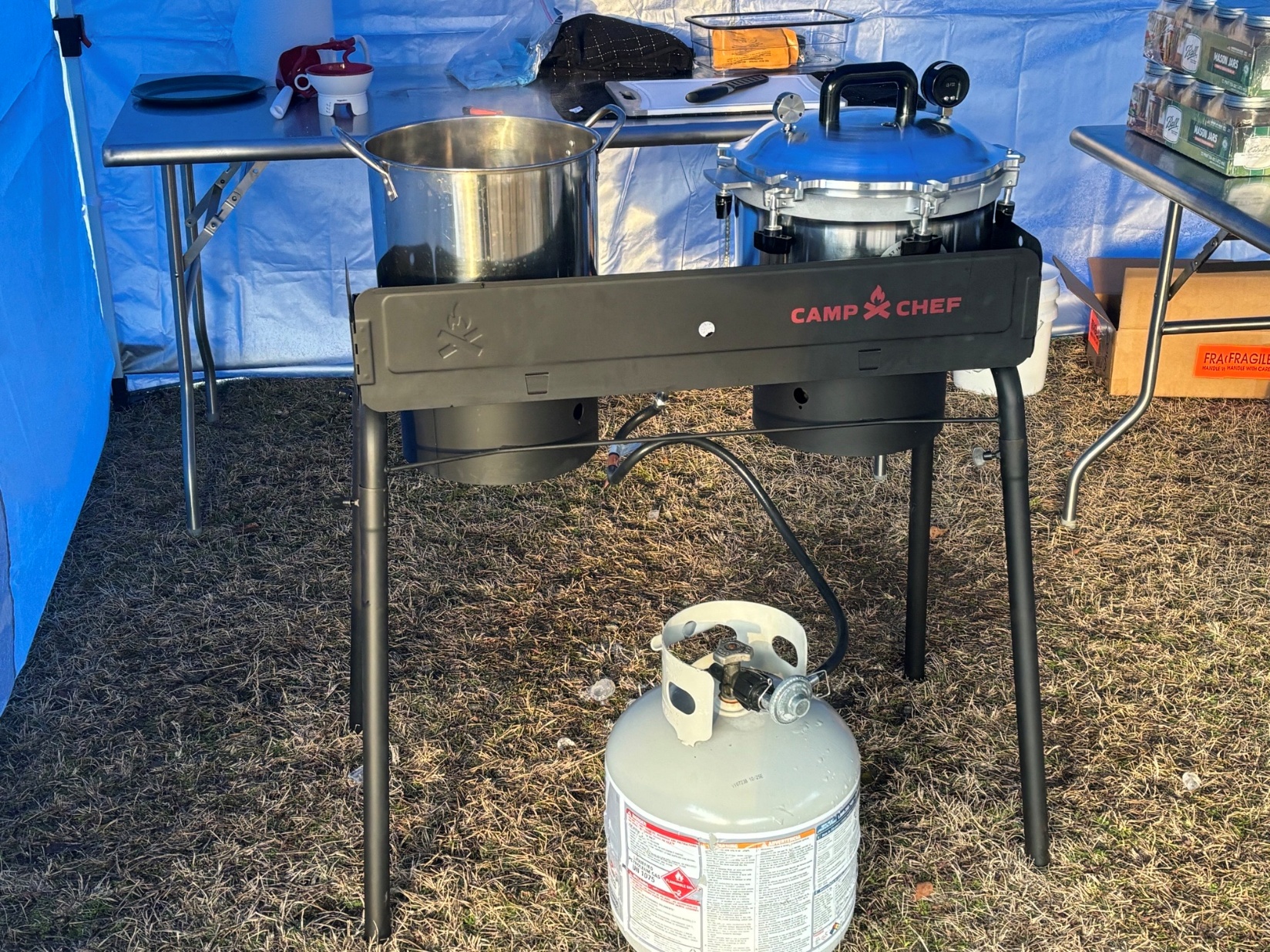
Outdoor canning station setup using a propane burner, pressure canner, and stainless work surfaces inside a ventilated tent to help manage wind, temperature, and environmental contaminants.
Stacy Kirby, ©2026, Clemson Extension
Creating an outdoor canning station requires careful planning to ensure safe food preservation.
With popularity and sometimes the necessity of canning outdoors, many variables need to be considered and addressed.
Weather and Environmental Contaminants
When planning and creating your outdoor canning station, consider the weather conditions, environmental contaminants, power source, equipment and location.
When planning an outdoor canning station, certain environmental factors must be taken into consideration. Those factors are temperature and wind. The ideal temperature for canning outdoors is 75°F. If the outdoor temperature is too hot, destroy the food. High heat can also impact the jar’s ability to seal, making the food unsafe for storage.
With cold temperatures, maintaining consistent heat and pressure is more difficult. The risk of thermal shock occurs when removing hot jars from the canner and exposing them to cold temperatures, which could result in breakage. Colder temperatures can cause jars to cool too quickly, leading to under-processing that may not adequately kill harmful pathogens.
How Wind Affects Outdoor Canning Safety
If you are using a gas burner as your heating source, wind is a mitigating factor. Wind can weaken or even blow out the flame, causing inconsistent pressure and under-processing, which risks food spoilage.
Combined with cold weather, a cool breeze blowing on hot jars increases the chances of thermal shock and breakage. Wind can interfere with safe canning by slowing the time needed for water to reach a vigorous boil in a boiling water canner or for pressure to build in a pressure canner.
Wind and cool air temperatures can also cause canners to cool too quickly, leading to under-processing that may not adequately kill harmful pathogens.
How Environmental Contaminants Affect an Outdoor Canning Station
Insects and debris must be considered in developing an outdoor canning area. Any of these contaminants could prevent seals and potentially introduce microbes into the food product, thereby compromising the canning process.
Choosing a Safe Power Source for an Outdoor Canning Station
Depending on the cooking platform you are using, a stable and consistent power source is needed. If you are not drawing power from a primary source, then propane, gas, and power stations are the most common options for power.
If you are using a propane burner or camping stove, the standard 20-pound propane tank can provide up to 35 hours of runtime for a 12,000 BTU camp stove or single burner.
If your cooking platform is electrical, a generator or a power station can be used. A gas or propane-powered generator can provide a steady, consistent power to your electric cooking platform. For instance, a 2500-watt gas generator can have a runtime of 4 to 12 hours on a gallon of gas, depending on the power load.
A propane-powered generator may not be as feasible for an electric cooking platform. Depending on the cooking platform and the specifics of the propane generator, a 2500-watt propane generator could use as much as 3 to 18 gallons of propane, again depending upon the power load. (There is approximately 4.7 gallons of propane in a 20 lb. tank)
Power stations are quiet and easy to operate. These battery-powered units offer a high level of versatility, with some models utilizing solar panels to charge and recharge the station. However, powering a high-wattage single burner for an extended period could require a powerful and expensive option.
When selecting a power source for your heating platform, it is recommended that you consult the manufacturer for the correct unit and specifications to meet your specific needs.
Selecting Processing Equipment for Outdoor Canning
Most pressure canners can be used for outdoor canning. When utilizing a propane burner, most manufacturers set a limit of 12,000 BTUs, with 10,000 BTUs being the optimal setting. Using an LP burner with higher BTUs could result in overheating or damage to the canner.
The All-American Pressure Canner does not have a high heat rating and a minimum BTU requirement of 12,000 BTUs. The manufacturers of the All-American recommend keeping the BTUs below 24,000 to prevent the risk of boiling the canner dry and possibly warping the canner.
Using a waterbath canner in an outdoor canning station is less restrictive. Most water bath manufacturers do not provide cautions, limitations, or recommendations for the outdoor use of their equipment. However, it is recommended that when using an LP burner, a rating of 12,000 BTUs or lower be used to prevent damage to the water bath canner.
Heating Elements for an Outdoor Canning Station
Heating elements for outdoor canning are limited to those that meet the specifications of the canners. If you have a power source for an electrical platform, you can choose from a standard electric coil, a solid base platform, or an induction cooking system.
The single electric element options must have a minimum power of 1,500 watts and a maximum of 1,850 watts and be able to support at least 50 pounds of weight. If you are using an induction system, a minimum of 1800 watts is recommended, supporting up to 50 pounds of weight.
To use an induction element, you must use specific canners compatible with the system. Restaurant or commercial-grade equipment is your best option for a good electrical heating element.
Single propane burners with BTU ratings of 10,000 to 12,000 and a capacity to support up to 50 pounds of weight are scarce. Consulting the manufacturer of the unit you have chosen before making a purchase is advisable.
Tables and Surfaces for an Outdoor Canning Station
When determining tables for your outdoor canning station, it is essential to identify how they will be used. For instance, if a single propane burner is placed on the table, a flame-resistant surface, such as stainless steel, is recommended.
Otherwise, a weather-resistant table that is waterproof and easy to clean can be a good choice. Plastic, blow-molded tables (such as Lifetime or Lancaster) can provide a sturdy, smooth, and cleanable surface.
For proper sanitation, a non-porous surface is recommended for easy cleaning and sanitizing.
Choosing the Best Location and Shelter for an Outdoor Canning Station
When determining a location and shelter for outdoor canning, consider the environmental elements, weather changes, and potential wind or drafts.
Existing structures, such as a covered porch, pole barn, or carport, may be good choices. Portable or temporary structures, such as a properly ventilated tent or a lean-to, can protect against direct sunlight and rain, creating space to control the environmental elements.
Windbreaks for Outdoor Canning Stations
A windbreak may be necessary, depending on your location and the type of shelter you need. Windshields for outdoor burners and camping stoves may be included with the equipment but can also be purchased separately.
A larger windbreak may be necessary to protect your canning area and prevent rapid temperature changes to your jars. A 3-sided, portable windbreak made with cellular PVC panels is an ideal product for a DIY project.
PVC panels are impervious to moisture and resist rot, insects, splitting, warping and UV damage. Marine Plywood is also an option; however, PVC panels are typically 30% lighter, making them easier for portability.
Several videos are available online that demonstrate how to create windbreaks.
Water Access for an Outdoor Canning Station
Full sinks are ideal for a canning station, but a food-grade drinking water hose connected to a potable water source, along with a clean and sanitized washbasin, allows for rinsing produce and filling pots.
Outdoor canning stations can be an ideal option for many families or individuals, provided certain variables and challenges are addressed.
Sources
- Andress, E.L., and J.A. Harrison. 2014. So Easy to Preserve, 6th Ed. Bulletin 989. Athens, GA: University of Georgia Extension Service
- El Dorado UCCE Master Food Preservers https://ucanr.edu/sites/mfp of cs/files/38576.pdf
- Zepp, M. (2023). Is Canning on a Portable Burner Safe? Https://extension.psu.edu/is-canning-on-a-portable-burner-safe
- Adamant, A. (2025). Setting Up an Outdoor Canning Kitchen. https://practicalselfreliance.com/outdoor-canning-kitchen
- https://www.allamerican1930.com/pages/faq#:~:text=If%20the%20heat%20is%20too,to%20four%20times%20per%20minute.
- Marlene Geiger, (2024) “Exploring Portable Burners and Other Options for Canning” https://blogs.extension.iastate.edu/answerline/2024/05/07/exploring-portable-burners-and-other-canner-options/
- Freedman, W. (2014). The Outdoor Canning Kitchen. www.motherearthnews.com/homesteading-and-livestock/the-outdoor-canning-kitchen-zbcz1409/
Originally published 2/26