Quick Guide to Year-Round Garden Productivity
Small garden spaces can provide bountiful harvests when carefully planned.
Determining how much to grow depends on:
- Number of people the garden will feed
- Crops desired
- Available space
- Time to maturity and harvest window
Fast-maturing and multi-harvest crops increase productivity in limited space.
Succession planting and seasonal planning support year-round production in South Carolina.
Excess harvests can be preserved or donated.

When properly planned and executed, a small space can yield a bountiful harvest year-round.
Zack Snipes, ©2021 HGIC, Clemson Extension
History of Home Gardening and Year-Round Garden Productivity
During World War II, Americans were encouraged to grow Victory Gardens to help feed their families and take pressure off farmers when resources were stretched thin.
During that time, 18.5 million citizens grew over 40% percent of America’s food supply in Victory Gardens.
Growing produce in the backyard was part of the American culture. After the war, the number of people growing their own produce dwindled. However, in recent years, there has been more interest in growing produce at home.
How Much to Grow: Yield Potential and Space Planning
Understanding Space, Time, and Yield Relationships
Selecting appropriate crops and planting appropriate quantities is crucial for gardening success.
Determining how many people a garden will feed, and which crops are desirable are the first steps in figuring out how much space is needed.
Another component to consider is the available area and the capacity of that spot to produce crops.
In small spaces, the gardener must consider the relationship between space, time, and yield.
Table 1. Estimated Crop Yields by Planted Linear Feet
| Vegetable | Number of Successive Plantings | Total linear Feet | Yield | Approximate Days to Maturity* | Multiple Harvest Crop | Approximate Length of Harvest | |
| Asparagus | 1 | 25 | 15 lbs. | 2- 3 years | Yes | 8 weeks | |
| Snap Beans | 3 | 75 | 30 lbs. | 50-60 days | Yes | 3 weeks | |
| Pole Beans | 1 | 20 | 12 lbs. | 60-80 days | Yes | 3 weeks | |
| Lima Beans | 2 | 50 | 16 lbs. | 65-75 days | Yes | 3 weeks | |
| Beets | 2 | 12 | 17 lbs. | 50-60 days | No | 2 weeks (Harvest immature until maturity**) | |
| Broccoli | 2 | 16 | 9 lbs. | 57-100 (check variety and season) | Yes | 4 weeks | |
| Cabbage | 2 | 13 | 21 lbs. | 70-85 days | No | 4 weeks (Harvest immature until maturity) | |
| Cantaloupe | 2 | 24 | 12 melons | 75-80 days | Yes | 3 weeks | |
| Carrots | 2 | 20 | 17 lbs. | 65-75 days | No | 4 weeks (Harvest immature until maturity) | |
| Collards | 2 | 24 | 30 lbs. | 50-70 days | Yes | 6 weeks or more | |
| Cucumber | 2 | 30 | 10 lbs. | 50-55 days | Yes | 3 weeks | |
| Eggplant | 1 | 8 | 9 lbs. | 60-75 days | Yes | 6 weeks | |
| Kale | 2 | 18 | 13 lbs. | 50-70 days | Yes | 6 weeks or more | |
| Lettuce | 3 | 12 | 17 lbs. | 28 days for mix; 55-70 for Romaine | Yes | 2 weeks | |
| Mustard/Turnip Greens | 2 | 12 | 11 lbs. | 40-60 days | Yes | 3 weeks | |
| Okra | 1 | 25 | 17 lbs. | 50-60 days | Yes | 10 weeks (if picked regularly) | |
| Dry Onions | 1 | 20 | 20 lbs. | 110-160 days | No | 4 weeks (Harvest immature until maturity) | |
| Green Onions | 2 | 20 | 100 onions | 60 days-150 days | No | 12 weeks (Harvest immature until maturity) | |
| Garden/English/Snap Peas | 1 | 50 | 15 lbs. | 50-65 days | Yes | 3 weeks | |
| Southern Peas | 1 | 50 | 20 lbs. | 60-90 days | No | 2 weeks | |
| Pepper | 2 | 16 | 10 lb. | 70-80 days | Yes | 3 weeks to 12 weeks or more | |
| Irish Potato | 1 | 75 | 50 lbs. | 70-100 days | No | 2 weeks (Harvest immature until maturity) | |
| Radish | 3 | 15 | 150 radishes | 21-35 days | No | less than one week | |
| Spinach | 2 | 20 | 6 lbs. | 35-45 days | Yes | 3 weeks | |
| Summer Squash | 2 | 12 | 30 lbs. | 50-55 days | Yes | 3 weeks | |
| Winter Squash | 1 | 18 | 30 lbs. | 80-120 days (depending on cultivar) | No | 2 weeks | |
| Sweet Corn | 3 | 30 | 40 ears | 60-100 days | No | less than one week | |
| Sweetpotato | 1 | 30 | 20 lbs. | 90-120 days | No | 4 weeks (Harvest immature until maturity) | |
| Tomato | 2 | 6 plants | 40 lbs. | 60-75 days | Yes | 2 weeks to 5 weeks | |
| Turnip, Top and Root | 1 | 12 | 8 lbs. | 50-60 days | Yes (tops) No (roots) | 4 weeks (Harvest immature until maturity) | |
| Watermelon | 1 | 12 | 6 melons | 80-90 days | Yes | 3 weeks | |
| * Days to maturity are counted by the traditional planting method (either from seed or from transplant).
** Many crops can be harvested while they are immature, spreading the harvest window. |
|||||||
Fast-Maturing Crops for Year-Round Garden Productivity
When selecting crop cultivars, note the number of days to maturity located on many seed packets or transplant sets.
If fast-maturing crops are grown in the garden, gardeners can maximize yield for a particular spot.
Comparison of two crops in the same-sized planting area:
- Mixed greens can be harvested in four weeks.
- Brussels sprouts may take 120 days (~17 weeks) to reach maturity.
Fast-maturing crops include:
- Arugula
- Mixed lettuce
- Squash
- Snap beans
- Radish
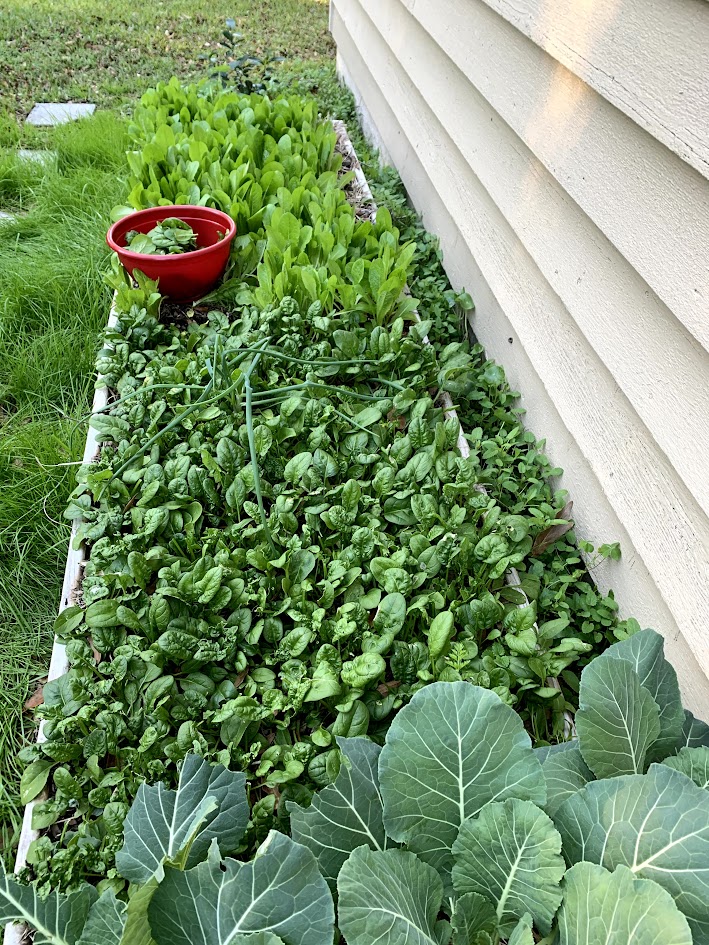
Collards, spinach, and lettuce are all fast-maturing, multi-harvest crops that can be harvested soon after planting and for multiple weeks, utilizing small spaces.
Zack Snipes, ©2020 HGIC, Clemson Extension
See Table 1 for a list of approximate days to maturity.
Multi-harvest Crops for Maximizing Garden Yield
Some crops offer the benefit of having a prolonged harvest.
For example, squash, okra, peppers, and snap beans can be harvested multiple times over the course of weeks, if picked regularly.
Gardeners can maximize garden production by growing these types of crops.
Table 1 shows the total yield over an estimated harvest window.
Estimating Yield from Multi-Harvest Crops
For multi-harvest crops such as okra, 17 pounds can be harvested from 25 linear feet over 10 weeks.
To estimate how much okra should be harvested each harvest, divide the total pounds by the number of harvests.
- 17 pounds ÷ 10 weeks = 1.7 pounds per week
- 1.7 pounds per week ÷ 5 harvests per week = 0.34 pounds per harvest
This method offers a reasonable yield estimate, but most multi-harvest crops start slow, reach peak production for a few weeks, and then fade during the last few weeks.
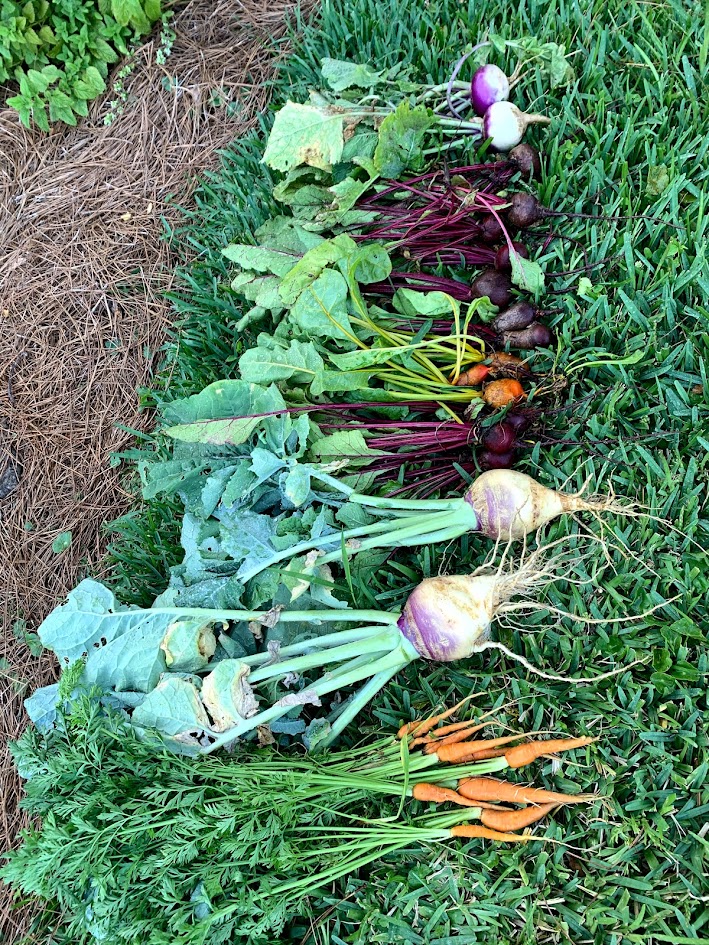
Single harvest crops can be harvested before they are mature and up to maturity to extend the harvest window.
Zack Snipes, ©2020 HGIC, Clemson Extension
Single Harvest Crops and Storage Planning for Garden Productivity
Single-harvest crops, where the entire crop is harvested when mature, include:
- Onions
- Potatoes
- Carrots
- Beets
- Sweet corn
Storage considerations need to be carefully planned when growing these crops.
Many gardeners will harvest small sections of these crops over a period of time to lengthen their harvest.
Often, crops can be harvested before they are fully mature to stretch out the harvest window.
Many of these crops will begin to lose quality if not harvested at the appropriate time.
Relay or Succession Planting for Consistent Year-Round Harvests
Relay or succession planting involves making multiple small plantings several days or weeks apart, rather than one large planting.
This gardening method:
- Spreads out the risk of a crop failure
- Provides a more consistent supply of produce
- Prevents one massive harvest at a single time.
Seasonality and Year-Round Garden Planning in South Carolina
When deciding which crops and how much to grow, it is essential to consider the crop’s preferred growing season.
HGIC 1256, Planning a Garden, includes a planting calendar detailing when certain crops should be planted.
Planning strategies
- Select planting dates carefully.
- Choose cultivars with maturity dates in mind.
- Record planting and harvest dates on a calendar.
Daylight affects crop maturity
- Crops planted in late spring will grow faster due to longer days.
- Crops planted in late fall will grow more slowly due to shorter days.
Weather impact harvest windows
- Warm spells shorten the lifespan of cool-season crops.
- Early or late frosts end warm-season crops rather quickly.
Growing Extra Produce: Preservation and Donation from Productive Gardens
When the harvest is plentiful in the spring or summer months, canning is a good way to utilize produce that would otherwise go to waste.
Clemson Extension Agents regularly host canning workshops to keep gardeners safe, as major food safety concerns can occur when storing produce.
Local food banks and emergency pantries will often accept produce, provided there is enough advance notice.
References
- Polomski, R. (2007). The South Carolina master gardener training manual (812 pp.). Clemson Extension, Clemson University Public Service Publishing.
- Springate, M. E. (n.d.). Victory gardens on the World War II home front (Web article). National Park Service, Cultural Resources Office of Interpretation and Education. https://www.nps.gov/articles/000/victory-gardens-on-the-world-war-ii-home-front.htm
- Texas A&M AgriLife Extension Service. (2021). EHT‑066: Easy Gardening. Asparagus (pdf). Aggie Horticulture, Department of Horticultural Sciences, Texas A&M University.
Originally published 3/26