
Quick Guide
Affected Plants: Gardenia (Gardenia jasminoides)
Primary Insect Pests: Whiteflies, scale insects, aphids, and thrips
Related Pests: Two-spotted spider mites (Tetranychus urticae)
Primary Damage Symptoms: Yellowing leaves, distorted new growth, honeydew, sooty mold, curled foliage, flower damage, leaf drop, and plant decline
Most Important Prevention Strategy: Maintain healthy plants through proper cultural care and inspect foliage regularly to manage infestations before populations become severe.
Biological Controls: Lady beetles, lacewings, parasitic wasps, predatory mites, and other beneficial insects naturally suppress many gardenia pests.
Chemical Control: Begin with insecticidal soaps or horticultural oils when appropriate. Reserve conventional insecticides for significant infestations and always follow label directions.
This publication covers the identification and management of whiteflies, scale insects, aphids, thrips, and spider mites commonly found on gardenias.
About Gardenia Insect Pests
Gardenias (Gardenia jasminoides) are prized for their fragrant white flowers and glossy evergreen foliage, making them popular shrubs among gardeners throughout South Carolina and the Southeast. Healthy gardenias are less susceptible to common gardenia insect pests and related pests than plants weakened by environmental stress.
Although proper growing conditions help reduce stress, gardenias are somewhat high-maintenance plants with fairly specific cultural requirements. When plants become stressed, they are more susceptible to insect pests and related pests, such as spider mites, which can weaken plants, reduce flowering, and contribute to secondary problems such as sooty mold.
Regular monitoring, correct pest identification, and integrated pest management (IPM) practices provide the most effective long-term approach to protecting gardenias while conserving beneficial insects and pollinators.
Proper plant care is the foundation of insect pest prevention. For information on site selection, watering, fertilization, and routine maintenance, see Gardenia (HGIC 1065).
For help diagnosing diseases, sooty mold, nutrient disorders, and other non-insect problems, see Gardenia Diseases & Other Problems (HGIC 2058).
Insect Pests
Gardenias are susceptible to several insect pests that feed by piercing and sucking plant sap. Early detection and IPM practices help reduce plant damage while conserving beneficial insects that naturally suppress many pest populations.
Gardenia Insect Pests: Whiteflies on Gardenia
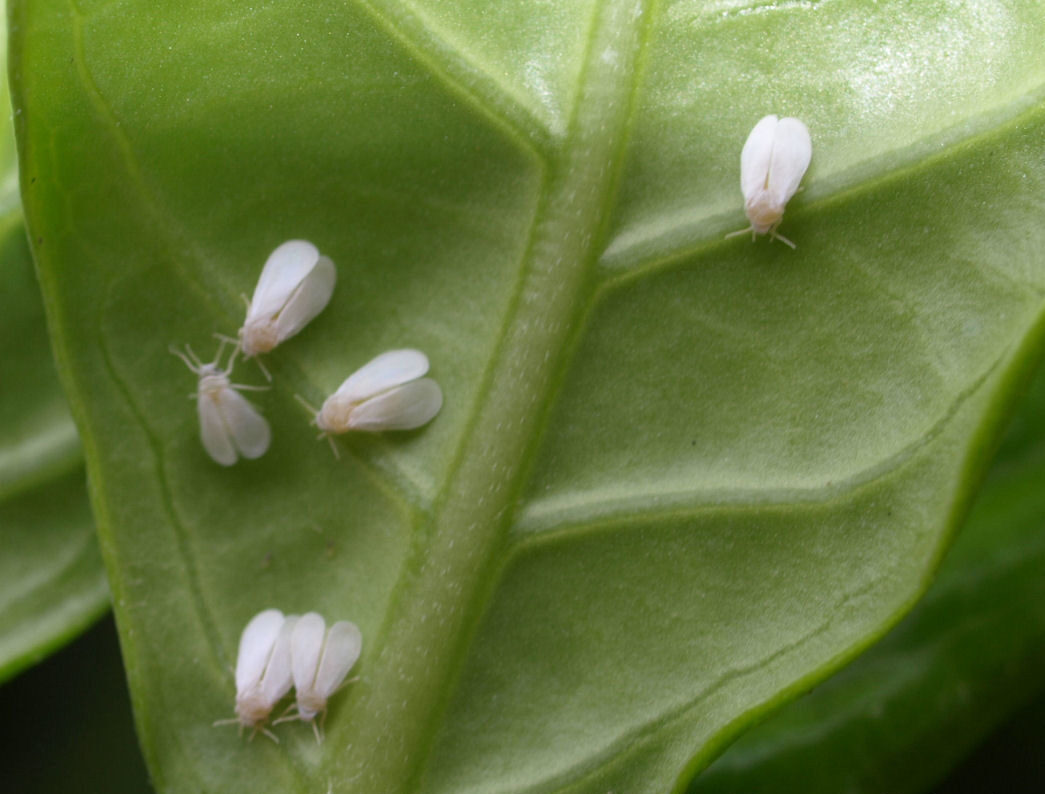
Whitefly adults (Dialeurodes citri) on the underside of a gardenia leaf.
J. McLeod Scott, ©2010 HGIC, Clemson Extension
Whiteflies are common sap-feeding insects that can weaken gardenias, cause yellowing foliage, and promote the growth of sooty mold.
Identification
Whiteflies are not true flies but are more closely related to scale insects, mealybugs, and aphids. Adults are very small (about 1/10 to 1/16 inch long) and have a powdery white appearance, resembling tiny moths. When at rest, the wings are held at an angle, roof-like over the body.
Immature whiteflies are flat, scale-like, and do not move. Both adults and immature forms feed by sucking plant sap. When an infested plant is disturbed, adults flutter briefly before settling again.
Damage and Symptoms
Both adults and immature whiteflies feed by sucking plant sap.
Common symptoms include:
- Stunted plant growth
- Yellowing leaves
- Premature leaf drop
- Sticky honeydew on leaves
- Black sooty mold growing on honeydew
Honeydew produced by whiteflies encourages the development of sooty mold fungi, which coats leaves with a dark, superficial fungal growth. For additional information, see Gardenia Diseases & Other Problems (HGIC 2058).
Prevention and Treatment
Monitoring
- Inspect the undersides of leaves regularly, especially on new growth.
- Watch for adult whiteflies flying up when foliage is disturbed.
- Look for immature whiteflies attached to leaf undersides.
- Check leaves for sticky honeydew and developing sooty mold.
Cultural Controls
Maintain plant vigor through proper watering and routine care.
Chemical Control
For light infestations:
- Insecticidal soap
- Horticultural oil
Thoroughly cover the upper and lower leaf surfaces. Repeat applications three times at 5- to 7-day intervals for best control.
Foliar injury from soaps and oils may occur on plants under drought stress.
Water the plants well the day before spraying.
Only apply horticultural oils or insecticidal soaps if temperatures are below 90 °F, and apply very late in the day to prevent foliar injury.
Apply horticultural oil sprays when there is no rainfall in the forecast for the next 24 hours.
If stronger control is needed, products containing the following active ingredients may be used:
- Acephate
- Bifenthrin
- Cyfluthrin
- Esfenvalerate
- Permethrin
- Pyrethrin
- Lambda-cyhalothrin (or other labeled cyhalothrin products)
Acephate is a foliar systemic insecticide and may provide better control than contact-spray insecticides.
Soil-applied insecticides, such as imidacloprid or dinotefuran, can give season-long control of whiteflies. These are applied as a soil drench or as granules, which are watered into the soil.
Soil-applied insecticides are most effective if applied in spring as new growth appears. See Table 1 for products that contain these insecticides.
Gardenia Insect Pests: Scale Insects on Gardenia
Scale insects are common sap-feeding pests of gardenias. Several species of both soft scales and armored scales can infest leaves, twigs, and branches, weakening plants and reducing their vigor.
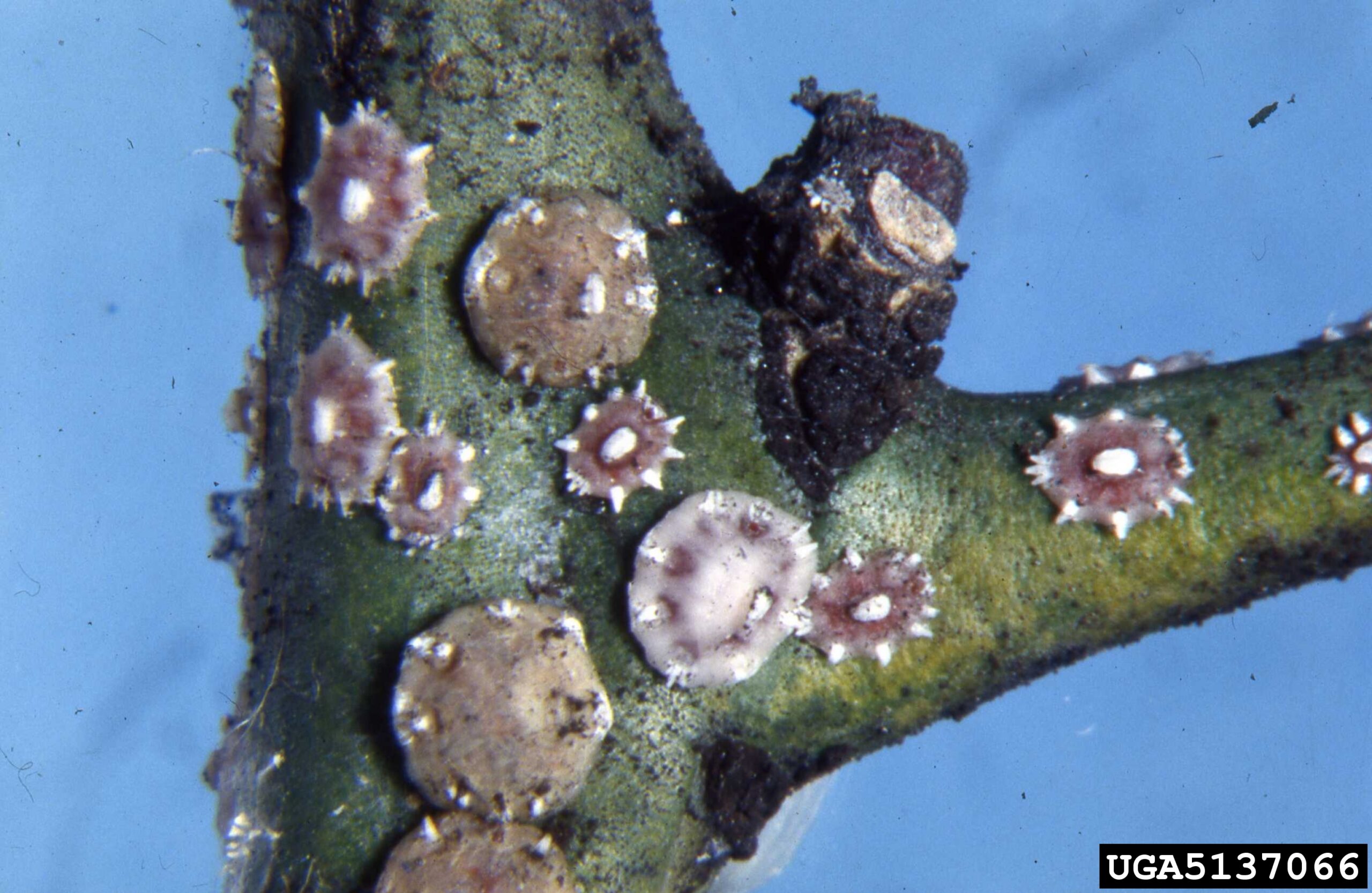
Japanese wax scale (Ceroplastes japonicus), a soft scale that attacks gardenias, is typically found on twigs and branches.
Giuseppina Pellizzari, Faculty of Agriculture, Dept. of Entomology, www.insectimages.org
Identification
Various scale insects feed on gardenias, including:
Soft scales
- Japanese wax scale (Ceroplastes japonicus)
- Cottony cushion scale (Icerya purchasi)
Armored scales
- Tea scale (Fiorinia theae)
- Greedy scale (Hemiberlesia rapax)
- Oleander scale (Aspidiotus nerii)
Scales are unusual insects in appearance and are often misidentified as parts of the plant itself or as a disease rather than as insects. Adult female scales are small and immobile, with no visible legs. They secrete a waxy coat that varies significantly in shape and color among species. Adult males are very small and have wings, allowing them to fly and locate females.
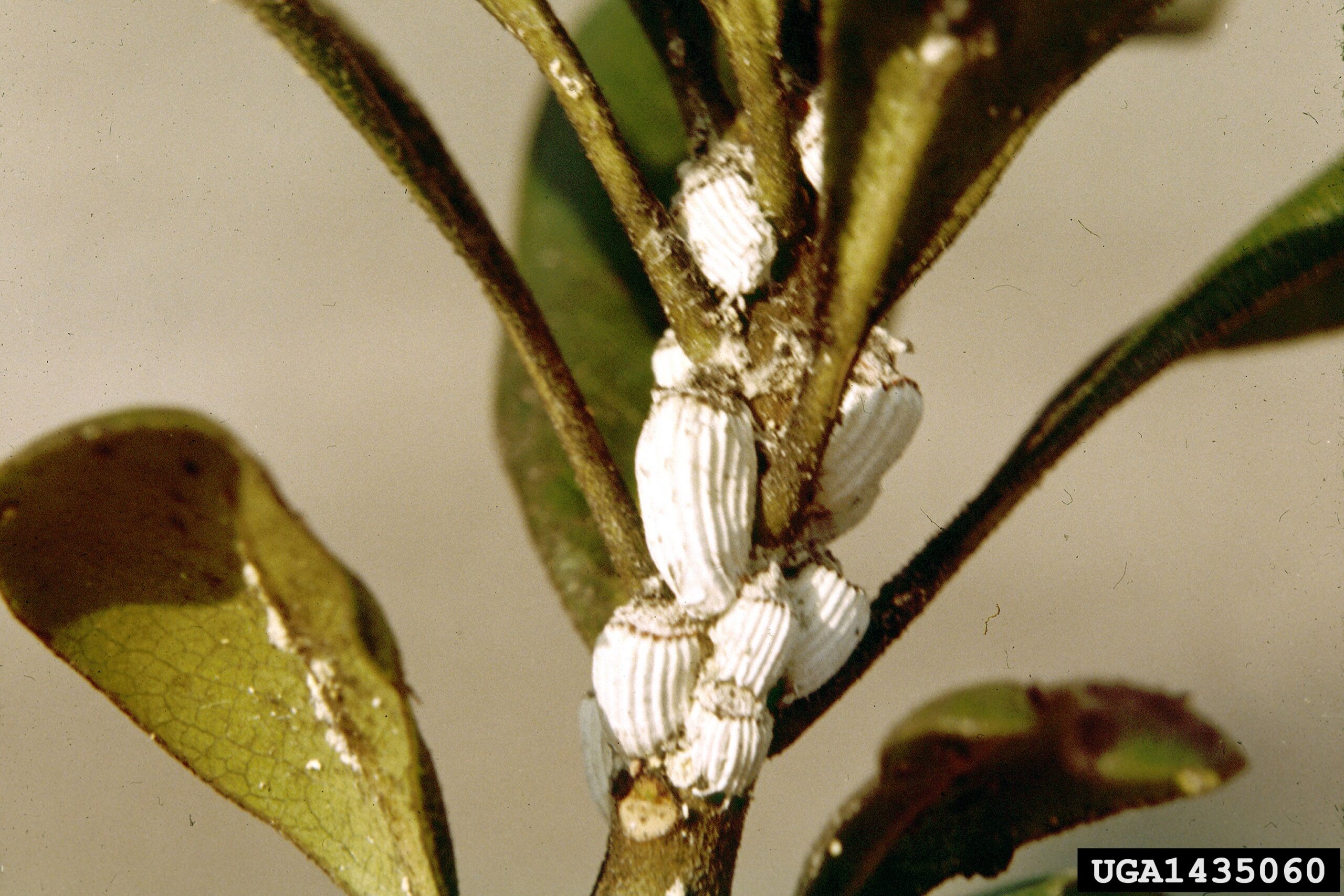
Cottony cushion scale, a soft scale (Icerya purchasi).
Clemson University – USDA Cooperative Extension Slide Series, Bugwood.org
Scales feed on plants by piercing the leaf, stem, or branch with their mouthparts and sucking sap.
Common symptoms include:
- Weak or dying branches
- Stunted growth
- Smaller flowers
- Smaller leaves
- Yellowing foliage
- Premature leaf drop
Soft scales produce honeydew, which encourages the growth of sooty mold fungi on leaves. Armored scales do not excrete honeydew. For additional information about sooty mold, visit Gardenia Diseases & Other Problems (HGIC 2058).
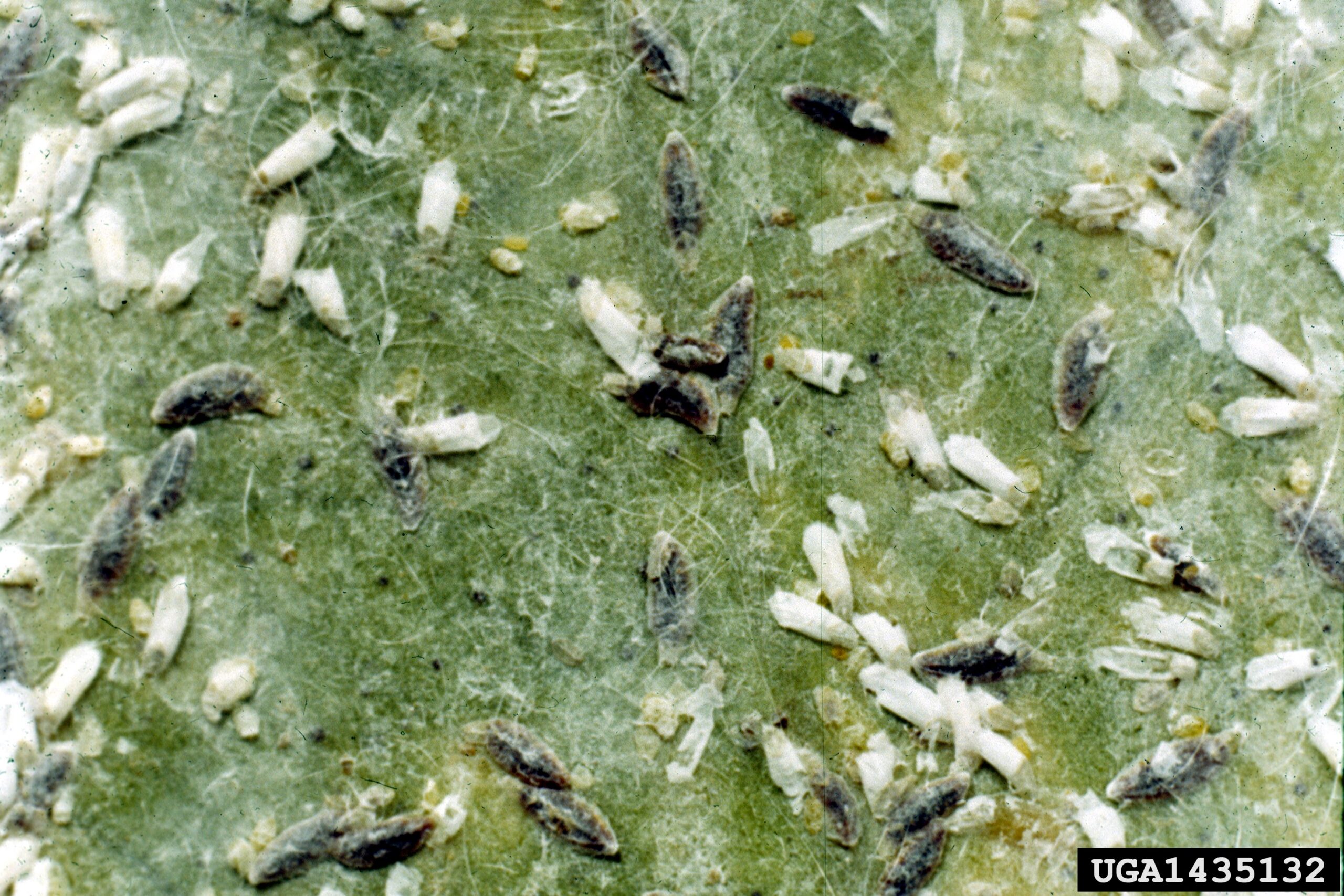
Tea scale (Fiorinia theae) is an armored scale that feeds on gardenias. This scale is found mainly on the lower leaf surfaces.
Clemson University – USDA Cooperative Extension Slide Series, www.insectimages.org
Prevention and Treatment
Monitoring
- Inspect leaves, twigs, and branches regularly for scale insects.
- Inspect in early spring and during crawler activity.
- Look for crawler activity, as the immature crawler stage is most susceptible to traditional contact insecticides.
- Light infestations can often be managed before significant plant damage occurs.
Cultural Controls
- Scrape off small infestations by hand when practical.
- Prune and destroy heavily infested branches.
- Maintain plant health through proper cultural care.
Biological Control
A combination of natural enemies, including ladybird beetles (ladybugs) and parasitic wasps, usually keeps scale insects under control. Conserving these beneficial insects helps reduce the need for insecticide applications.
Chemical Control
Horticultural oil
Horticultural oil is an excellent, proven product for controlling scale insects. It alone controls all stages of armored scales on gardenias and other shrubs, and is also effective against soft scales. Horticultural oil sprays suffocate scale insects and are an especially good choice for sensitive areas where people may be present soon after treatment. Because horticultural oils have a short residual, they also help conserve beneficial insect species.
For best results:
- Apply in early spring to control overwintering adults, crawlers, and eggs.
- Apply again as new leaves begin to expand.
- Make at least two additional spring applications at 5- to 6-week intervals.
- Thoroughly cover the upper and lower leaf surfaces, branches, and trunk until the spray begins to run off.
- Apply when temperatures are above 45°F and below 90°F.
- Spray during the early evening.
- Do not apply if rainfall is expected within the next 24 hours.
- Apply a 1% solution (2½ tablespoons per gallon of water) to tender spring growth.
- Apply a 2% solution (5 tablespoons per gallon of water) to mature foliage.
- Follow label directions for mixing rates.
Insecticidal soap
Insecticidal soaps are effective against soft scale adults and crawlers.
- Apply when temperatures are below 90°F.
- Spray in the evening to reduce drying time.
- Thoroughly cover leaves, branches, and trunk to run off.
- Follow label directions for mixing and use.
Traditional insecticides
Traditional contact insecticides are effective only against the crawler stage.
Active ingredients for use against crawlers include:
- Acephate
- Bifenthrin
- Cyfluthrin
- Cyhalothrin
- Esfenvalerate
- Permethrin
Apply when crawlers are present and repeat after 10 days if needed.
Systemic insecticides
Soil-applied dinotefuran can give season-long control of both soft and armored scale insects. This treatment is applied as a soil drench or as granules, which are then watered into the soil.
Spring applications are the most effective.
See Table 1 for example products, and always read and follow all label directions and precautions.
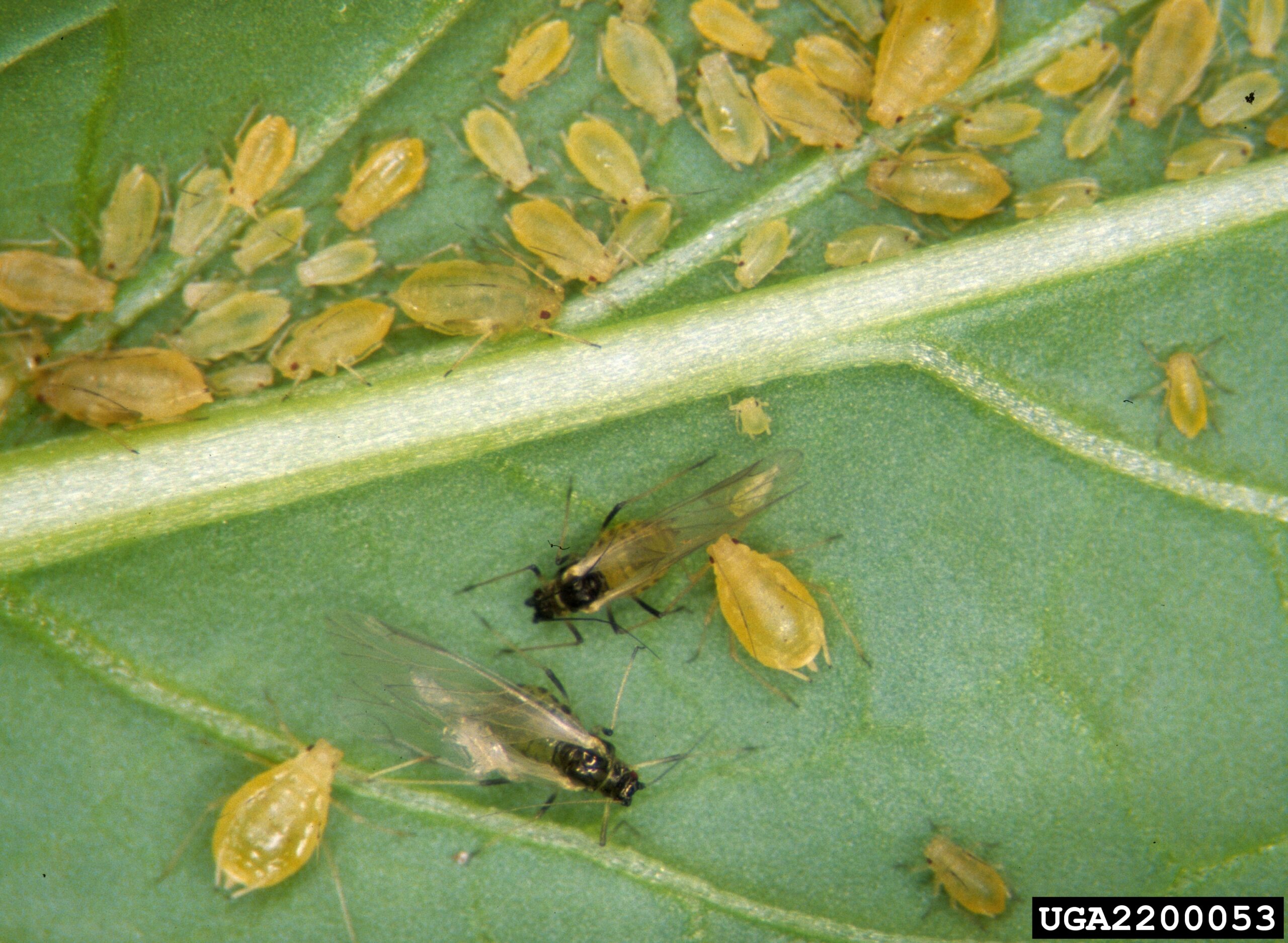
Both winged and wingless adults, as well as immature green peach aphids (Myzus persicae), are present on a leaf. Green peach aphids infest a wide range of plants, including gardenias.
Whitney Cranshaw, Colorado State University, www.forestryimages.org
Gardenia Insect Pests: Aphids on Gardenia
Aphids are common sap-feeding insects that can rapidly build large populations on new gardenia growth, causing distorted foliage, reduced flowering, and the development of honeydew and sooty mold.
Identification
Aphids are small (about 1/8 inch long), soft-bodied, pear-shaped insects that are sometimes referred to as plant lice. Depending on the species, they may be shades of green, yellow, pink, or black.
Both the green peach aphid (Myzus persicae) and the melon (or cotton) aphid (Aphis gossypii) feed on gardenias. Aphids are usually found in clusters on new growth of buds, leaves, and stems.
Damage and Symptoms
Aphids feed by piercing plant tissue and sucking sap. Although low populations cause little damage, aphids reproduce rapidly and can quickly reach numbers that injure gardenias.
Common symptoms include:
- Distorted or curled new growth
- Stunted shoots and leaves
- Reduced number and quality of flowers
- Sticky honeydew on leaves and stems
- Black sooty mold growing on honeydew
- Ant activity associated with aphid colonies
Honeydew produced by aphids often attracts ants, which protect aphids from their natural enemies. For more information on sooty mold, see Gardenia Diseases & Other Problems (HGIC 2058).
Prevention and Treatment
Monitoring
- Inspect new shoots, flower buds, and young leaves regularly.
- Look for colonies of aphids on tender growth.
- Watch for sticky honeydew, sooty mold, or ants, which may indicate an aphid infestation.
Cultural Controls
Aphids can be hosed off with a strong stream of water directed above and below the leaves. Spray frequently with water, repeating as needed, focusing on new growth.
If ants are present, they should also be controlled because they protect aphids from natural enemies.
Biological Control
Several beneficial insects naturally help suppress aphid populations, including:
- Green lacewing adults and larvae
- Ladybird beetles (ladybugs) and their larvae
- Parasitic wasps
These natural enemies usually keep aphid populations under control except during cool weather. Conserving beneficial insects helps reduce the need for insecticide applications.
Chemical Control
Insecticidal soap and horticultural oil
Gardenias may be sprayed with insecticidal soap or horticultural oil to control aphids. These products must contact the aphids to be effective.
For best results:
- Thoroughly cover aphid colonies.
- Repeat applications three times at 5- to 7-day intervals.
- Water drought-stressed plants the day before treatment.
- Apply only when temperatures are below 90°F.
- Spray very late in the day to reduce the potential for foliar injury.
Conventional insecticides
Although higher-toxicity insecticides are available, aphids are difficult to control because they reproduce rapidly. Leaving even one aphid alive can quickly result in a renewed infestation. In addition, these insecticides may kill the natural enemies that help keep aphid populations in check.
If stronger control is necessary, products containing the following active ingredients may be used:
- Acephate
- Bifenthrin
- Cyfluthrin
- Cyhalothrin
- Esfenvalerate
- Malathion
- Neem oil
- Permethrin
- Pyrethrin
Soil-applied products containing dinotefuran or imidacloprid provide longer-lasting control and help prevent future infestations. See Table 1 for example products.
Gardenia Insect Pests: Thrips on Gardenia
Thrips are small, slender insects that feed on gardenia flowers and expanding foliage, causing distorted blooms, discolored leaves, and premature leaf drop.
Identification
Several thrips species are pests of gardenias, including:
- Flower thrips (Frankliniella tritici)
- Western flower thrips (Frankliniella occidentalis)
- Other Frankliniella species
Thrips are slender, dark-colored insects with fringed wings. Adults are less than 1/16 of an inch long and are difficult to see without a magnifying lens. They are typically found on leaves and between flower petals, where both adults and nymphs (immature insect stages that resemble adults but are smaller) feed by scraping surface cells to suck plant sap.
Damage and Symptoms
Thrips feed on flower buds, flowers, and expanding leaves.
Common symptoms include:
- Flower buds that die before opening
- Silvery speckles or streaks on leaves
- Stunted or distorted flowers
- Brown, dying flowers
- Purplish-red spots on the undersides of expanding leaves
- Severely curled or rolled foliage
- Premature leaf drop
Because thrips are very small, damage is often noticed before the insects themselves are detected.
Prevention and Treatment
Monitoring
Thrips are difficult to detect because of their small size. To check for thrips:
- Inspect new growth with a magnifying lens.
- Hold a sheet of stiff white paper under damaged flowers and tap the blooms. In bright sunlight, any thrips present will move across the paper.
- Blowing lightly into flowers will cause thrips to move, making them easier to see.
Cultural Controls
- Keep grass and weeds around gardenias mowed or removed when possible.
- Inspect flower buds and new growth regularly so infestations can be detected early.
Biological Control
Several naturally occurring enemies feed on thrips. Contact insecticides should be avoided as much as possible to prevent killing these natural enemies, which reduce thrips populations.
Chemical Control
If insecticide treatment becomes essential, products containing the following active ingredients are available in homeowner-size packaging:
- Bifenthrin
- Cyfluthrin
- Cyhalothrin
- Permethrin
- Esfenvalerate
- Acephate
- Spinosad
Spinosad and acephate are foliar systemic insecticides that provide better control of thrips feeding in flower buds than contact insecticides.
- Apply treatments when thrips are present.
- Repeat application in 7 to 10 days if needed.
Soil-applied products containing dinotefuran or imidacloprid provide some thrips suppression. See Table 1 for specific products.
Related Pests
Although spider mites are not insects, they are common pests of gardenias and can cause damage similar to that of sap-feeding insects. Regular monitoring and early intervention help prevent populations from reaching damaging levels.
Gardenia Related Pests: Spider Mites on Gardenia
Spider mites are tiny arachnids that feed on plant sap, causing stippling, distorted foliage, and webbing. Populations are most damaging during hot, dry weather.
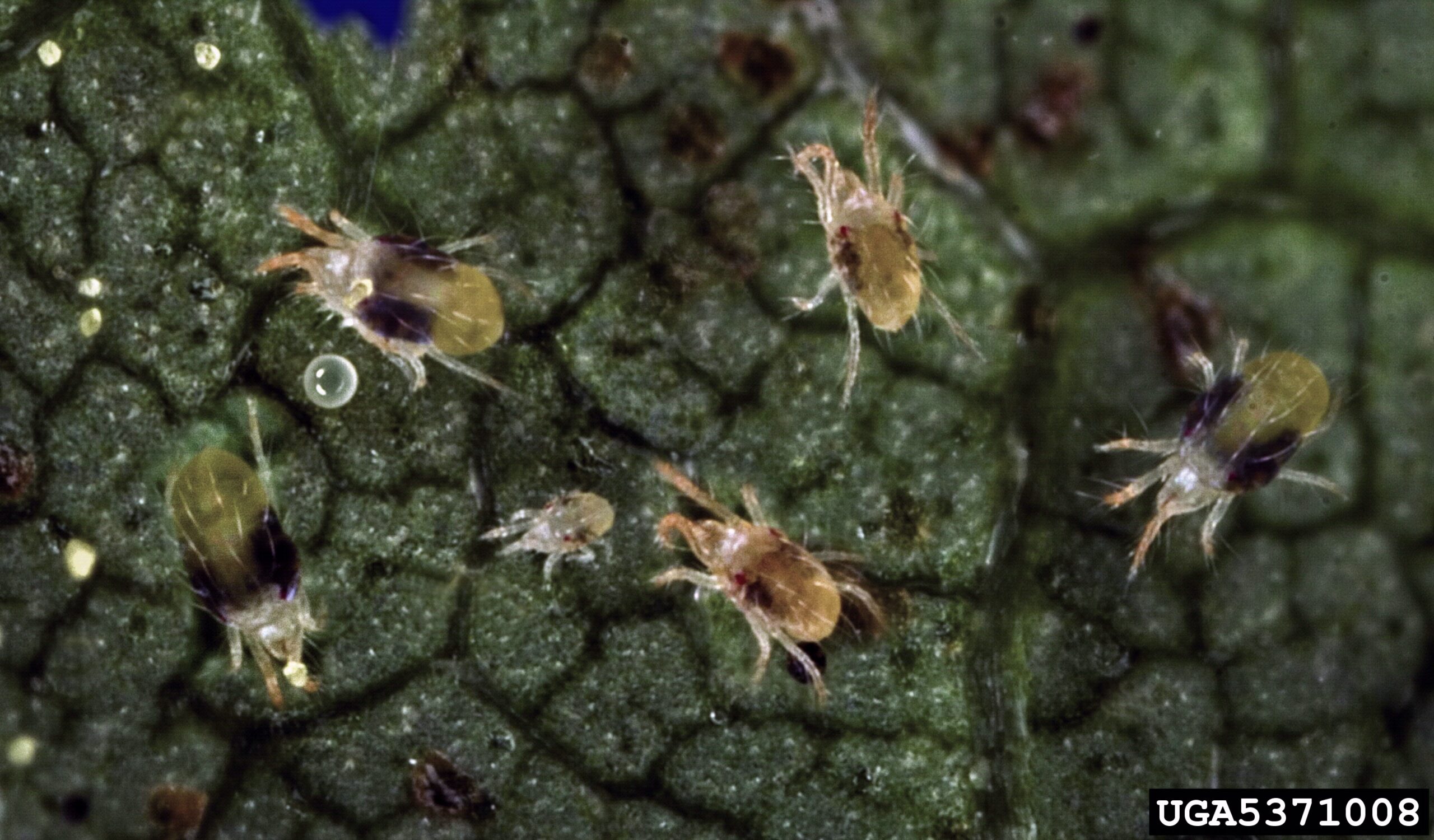
Two-spotted spider mites (Tetranychus urticae) on a leaf.
David Cappaert, Michigan State University, www.forestryimages.org
Identification
Spider mites are not insects. They are more closely related to spiders, and, as adults, have eight legs instead of six.
Spider mites are extremely small (about 1/50-inch long) and are difficult to see without a magnifying lens.
The two-spotted spider mite (Tetranychus urticae) is the primary mite pest of gardenias in South Carolina. While spider mites may be present throughout the growing season, populations tend to increase during hot, dry weather.
One way to detect spider mites is to hold a sheet of white paper beneath a branch and tap the branch sharply. If mites are present, they may be difficult to see at first, but wiping a hand across the paper will leave red streaks.
Damage and Symptoms
Spider mites feed by piercing leaf tissue and sucking plant sap, typically feeding on the undersides of leaves.
Common symptoms include:
- Yellow or white speckling on the leaf’s upper surface
- Distorted new leaves
- Fine webbing on the undersides of leaves
- Heavy webbing covering leaves and branches during severe infestations
- Dust and debris collecting in the webbing, giving plants an untidy appearance
Prevention and Treatment
Monitoring
- Inspect the undersides of leaves regularly, especially during hot, dry weather.
- Tap branches over a sheet of white paper to detect mites.
- Watch for fine webbing and leaf stippling, which often indicate increasing mite populations.
Cultural Controls
A strong spray of water can remove eggs, larvae (six-legged immature stage), nymphs (eight-legged immature stage), and adult mites.
For best results:
- Thoroughly spray the lower leaf surfaces.
- Repeat as needed.
- Begin treatments when infestations are first detected.
This method is most effective for light infestations and helps preserve natural enemies.
Biological Control
Beneficial insects and predatory mites help suppress spider mite populations.
Natural enemies include:
- Lacewings
- Lady beetles (ladybugs)
- Predatory mites
Predatory mites are about the same size as spider mites but can be distinguished from spider mites by their long legs and the speed with which they move.
Several species of predatory mites, lacewings, and lady beetles are available commercially for use as biological control agents.
Chemical Control
Insecticidal soap and horticultural oil
Insecticidal soaps and horticultural oils are effective control options for spider mites and are essentially nontoxic to humans, wildlife, and pets. They are only minimally toxic to beneficial predators.
Good spray coverage is critical to ensure these products contact the mites to be effective.
For best results:
- Thoroughly cover infested foliage, especially the undersides of leaves.
- Reapply as needed based on follow-up monitoring.
- Water the plants well the day before spraying.
- Apply very late in the day.
- Do not apply when temperatures exceed 90°F.
Foliar injury from soaps and oils may occur on plants under drought stress.
Miticides
Avoid broad-spectrum insecticides whenever possible, as these products can kill natural enemies that help keep spider mite populations under control. Also, avoid pesticides that claim to “suppress” mites, as they often provide only weak mite control.
If stronger chemical control is needed, products containing the following active ingredients include:
- Bifenthrin
- Tau-fluvalinate
See Table 1 for products containing these insecticides.
Table 1. Insecticides and Miticides for Managing Gardenia Insect Pests and Related Pests
The following products contain active ingredients labeled for managing insect pests and related pests on gardenias. Products are listed by active ingredient for ease of comparison. Inclusion of a product in this table does not constitute an endorsement by Clemson Extension. Always read and follow all pesticide label directions and precautions before use.
Active Ingredient |
Brand Names & Products |
| Acephate | BioAdvanced Science-Based Solutions 2-in-1 Systemic Rose & Flower Care Granules with 6-9-6 FertilizerBonide Systemic Insect Control II |
| Bifenthrin | Bifen I/T Bonide Eight Insect Control Flower & Vegetable Above & Below Soil Insect Granules Hi-Yield Bug Blaster Bifenthrin 2.4 Ready to Spray Hi-Yield Bug Blaster II Bifenthrin 2.4 Ready to Spray Hi-Yield Vegetable & Ornamental Insect Control Granules Martin’s FLEE Ready to Use Yard Spray Monterey Mite & Insect Control Monterey Mosquito Control Ortho Bug B Gon Insect Killer for Lawns & Gardens1 Ortho BugClear Insect Killer for Lawns & Landscapes Ortho Outdoor Insect Killer Concentrate Talstar P Professional Insecticide Up-Star Gold Insecticide |
| Cyfluthrin | BioAdvanced Science-Based Solutions 24 Hour Lawn Insect Killer Ready-to-Spray BioAdvanced Science-Based Solutions Complete Brand Insect Killer for Soil & Turf Ready-to-Spray I BioAdvanced Science-Based Solutions Insect Killer for Lawns Ready-to-Spray BioAdvanced Science-Based Solutions Rose & Flower Insect Killer Ready-to-Use |
| Dinotefuran | Gordon’s Zylam Liquid Systemic Insecticide Valent Safari 20 SG Insecticide |
| Esfenvalerate | Monterey Bug Buster II Concentrate & RTS |
| Horticultural oil | Bonide All Seasons Horticulture Spray Oil Ready-to-Use Bonide All Seasons Horticulture & Dormant Spray Oil Ready-to-Spray Ferti-lome Horticultural Oil Spray Monterey Horticultural Oil Concentrate Monterey Horticultural Oil RTU Safer Brand Horticultural & Dormant Spray Oil Concentrate Southern Ag Parafine Horticultural Oil Summit Year-Round Spray Oil |
| Imidacloprid | BioAdvanced Science-Based Solutions 12 Month Tree & Shrub Insect Control Concentrate Landscape Formula BioAdvanced Science-Based Solutions 12 Month Tree & Shrub Protect & Feed Concentrate 2-1-1 BioAdvanced Science-Based Solutions 12 Month Tree & Shrub Protect & Feed II Concentrate 2-1-1 BioAdvanced Science-Based Solutions 12 Month Tree & Shrub Protect & Feed II Ready to Use Granules 2-1-1 BioAdvanced Science-Based Solutions 12 Month Tree & Shrub Protect & Feed Ready to Use Granules 2-1-1 BioAdvanced Science-Based Solutions 2 in 1 Systemic Rose & Flower Care Ready-to-Use Granules II Bonide Annual Tree & Shrub Insect Control w/ Systemaxx4 Bonide Systemic Granules Insect Control Bonide Systemic Insect Spray w/ Systemaxx Ready to Spray Ferti-lome Tree & Shrub Drench Hi-Yield Systemic Insect Granules Hi-Yield Systemic Insect Spray Ready-to-Spray Martin’s Dominion Tree & Shrub Insecticide Concentrate Monterey Once A Year Insect Control II |
| Insecticidal soap | Bonide Insecticidal Soap Multi-purpose Insect Control Ready to Use Garden Safe Brand Insecticidal Soap Insect Killer Miracle-Gro Nature’s Care Insecticidal Soap Natria Insecticidal Soap Ready-to-Use Natural Guard by ferti-lome Insecticidal Soap Concentrate Safer Brand Insect Killing Soap Concentrate II Whitney Farms Insecticidal Soap 1 |
| Cyhalothrin | Bonide Eight Insect Control Garden & Home II Ready to Use Cutter Backyard Bug Control Spray Concentrate Cyzmic CS Controlled Release Insecticide Martin’s Cyonara Lawn & Garden Insect Control Martin’s Cyonara Lawn & Garden Insect Control Ready-to-Spray Spectracide Triazicide Insect Killer for Lawns & Landscapes |
| Malathion | Bonide Malathion 50% Insect Control Gordon’s Malathion 50% Spray Hi-Yield 55% Malathion Insect Spray Ortho Max Malathion Insect Spray Concentrate Southern Ag Malathion 50% EC Spectracide Malathion Insect Spray Concentrate Tiger Brand 50% Malathion |
| Neem oil | Bonide Captain Jack’s Neem Oil Concentrate Bonide Captain Jack’s Neem Oil Ready to Use Bonide Rose Rx 3-in-1 Concentrate Bonide Rose Rx 3-in-1 Ready to Use Garden Safe Fungicide 3 Garden Safe Fungicide 3 Concentrate Garden Safe Neem Oil Extract Concentrate Monterey 70% Neem Oil Fungicide/Insecticide/Miticide Natria Neem Oil Concentrate Natria Neem Oil Ready-to-Use Natural Guard Brand by ferti-lome Neem Safer Brand Neem Oil Concentrate Fungicide/Miticide/Insecticide Safer Brand Neem Oil RTU Fungicide/Miticide/Insecticide Southern Ag Triple Action Neem Oil |
| Permethrin | Bonide Eight Insect Control Vegetable, Fruit, & Flower Concentrate Bonide Eight Yard & Garden Ready to Spray Hi-Yield 38 Plus Turf, Termite & Ornamental Insect Control Hi-Yield Lawn Garden Pet & Farm Insect Control Southern Ag Permetrol Lawn & Garden Insecticide Tiger Brand Super 10 Brand |
| Pyrethrin | Monterey Bug Buster–O PyGanic Crop Protection EC 1.4 II PyGanic Crop Protection EC 5.0 II |
| Spinosad | Bonide Captain Jack’s Deadbug Brew Concentrate Bonide Captain Jack’s Deadbug Brew Ready to Spray Bonide Captain Jack’s Deadbug Brew Ready to Use Bonide Colorado Potato Beetle Beater Concentrate Conserve SC Turf & Ornamental Monterey Garden Insect Spray Monterey Garden Insect Spray RTU Natural Guard by ferti-lome Spinosad Bagworm, Tent Caterpillar & Chewing Insect Control Natural Guard by ferti-lome Spinosad Soap Ortho Insect Killer Tree & Shrub Concentrate Southern Ag Conserve Naturalyte Insect Control |
| Tau-Fluvalinate | BioAdvanced Science-Based Solutions All-in-One Rose and Flower Spray BioAdvanced Science-Based Solutions 3-in-1 Insect, Disease & Mite Control BioAdvanced Science-Based Solutions 3-in-1 Insect, Disease & Mite Control Ready-To-Use BioAdvanced Science-Based Solutions 3-in-1 Insect, Disease & Mite Control I |
- RTS = Ready to Spray (hose-end applicator)
- RTU = Ready to Use (pre-mixed spray bottle)
- Drench = Product mixed with water and poured around the base of the plant according to label directions.
Important Use Notes
- Never apply a horticultural oil spray within 2 weeks of a sulfur spray.
- Do not apply horticultural oils or insecticidal soaps when temperatures exceed 90°F or to drought-stressed plants.
- Apply these products late in the day to reduce the risk of plant injury.
- Gardenias are sensitive to some insecticidal soaps. Use only products labeled as safe for gardenias.
- Always read and follow all pesticide label directions and precautions.
Protect Pollinators
- Pollinating insects, including honey bees and bumble bees, can be adversely affected by pesticide use.
- Avoid using spray pesticides (both insecticides and fungicides) and soil-applied, systemic insecticides unless necessary.
- If treatment is required, always spray late in the evening to reduce exposure to pollinators.
- Whenever possible, use cultural controls first and select less toxic products such as insecticidal soap, horticultural oil, neem oil extract, spinosad, Bacillus thuringiensis (B.t.), or botanical oils.
- If soil-applied insecticides are used, apply them immediately after flowering to reduce pollinator exposure.
Frequently Asked Questions
What insects commonly attack gardenias?
Whiteflies, scale insects, aphids, thrips, and spider mites are among the most common pests of gardenias in South Carolina.
Why are my gardenia leaves sticky?
Sticky leaves are usually caused by honeydew produced by sap-feeding insects such as aphids, whiteflies, or soft scales. Honeydew often leads to the growth of black sooty mold.
What causes black mold on gardenia leaves?
Black sooty mold grows on the sugary honeydew produced by whiteflies, aphids, and soft scales. The fungus is usually a symptom of an insect infestation rather than a disease affecting the plant itself.
How do I identify scale insects on gardenias?
Scale insects are small, immobile insects covered by a waxy coating. They are commonly found on leaves, twigs, and branches and are often mistaken for part of the plant.
Are spider mites insects?
No. Spider mites are arachnids, making them more closely related to spiders than insects. Adult spider mites have eight legs instead of six.
When should I use horticultural oil?
Horticultural oil is most effective when applied thoroughly to the target pest and according to label directions. Spring applications are especially effective for managing scale insects, and oils are useful against whiteflies, aphids, and spider mites when coverage is thorough.
Why does my gardenia have fewer flowers?
Heavy infestations of aphids, thrips, whiteflies, or scale insects can reduce flowering by weakening plants or damaging flower buds.
Should I spray insecticides first?
No. Clemson Extension recommends integrated pest management: first identify the pest, monitor populations, encourage beneficial insects, and use cultural controls before applying insecticides when needed.
For more information, contact the Clemson Home & Garden Information Center.
Pesticides are updated annually. The last updates were made in 7/26 by N. Jordan Franklin.
Originally published 08/10


