

Close-up of ‘Coral Charm’ peony with coral-peach spring flowers and a yellow center.
Wikimedia Commons, Poupou l’quourouce, Creative Commons License 2.5
Quick Guide (At a Glance)
Bloom time: Mid-to-late spring
Flower colors/forms: Many colors and forms available
Best performers in South Carolina: Early-blooming, single, or Japanese cultivars
Climate limitation: Often do not perform well in the lower South due to insufficient winter chilling
Primary ornamental feature: Large, showy, often fragrant flowers
Landscape use: Specimen plants, borders, herbaceous hedges, and cut flowers
Plant Characteristics of Peonies
Height and Spread of Peonies
Most herbaceous peonies grow 2 to 3 feet tall in our area with a 3- to 4-foot spread when mature. Some cultivars and species will grow a foot taller or shorter.
Tree peonies (which are actually shrubs) grow to about 4 to 5 feet under normal conditions.
Growth Rate of Peonies
Peonies are long-lived, but slow-growing at first. Garden peonies usually begin blooming within three years of planting.
Tree peonies will begin blooming at about the same time, but increase slowly in size and number of blooms. They can live for up to a hundred years.
Ornamental Features of Peonies
Peonies are grown for their large, showy and fragrant flowers.
Most peonies have very attractive foliage, making them a useful addition to the landscape all season.
Landscape Uses for Peonies
Peonies are used as specimens in borders and herbaceous hedges and are excellent cut flowers.
Light Requirements for Peonies in South Carolina
Herbaceous peonies need at least six hours of direct sunlight a day for good bloom.
Afternoon shade will protect flowers from fading too quickly in hot areas.
Tree peonies should always have dappled or afternoon shade, as the large, silky petals are damaged by direct sunlight.
Best Soil for Peonies in South Carolina
Well-drained, loamy soil is best for peonies to grow well. Good drainage is vital to avoid root rot and fungal diseases.
To improve drainage and organic matter content in heavy clay soil, amend with:
- Compost
- Finely ground pine bark
- Well-rotted manure
Soil pH Requirements for Peonies
Peonies prefer a soil pH of 6.5 to 7.0.
Add lime to the soil to raise the pH for the best peony growth.
Peonies are long-lived in the garden and are worth the extra trouble at planting time, since they may stay in the same spot for many years.
How to Plant Peonies in South Carolina
Best Time to Plant Peonies in South Carolina
Fall planting is best for herbaceous and tree peonies.
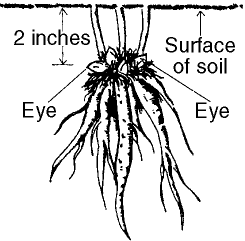
Image depicts proper way to plant peonies.
How Deep to Plant Peonies
- Dig a hole 12 to 18 inches deep and 12 inches wide.
- Replace part of the soil to form a cone.
- Spread the roots over the cone.
- Set the roots so that the tips of the eyes (swollen pink or reddish buds) are no deeper than 1 inch below the soil surface.
Note: Most failures to bloom are caused by deep planting.
Planting Tree Peonies Correctly
The graft union should be an inch below ground level.
Mound extra soil up around them for the first winter.
Firming and Watering After Planting Peonies
Firm the soil well around the roots, eliminating air pockets.
Water thoroughly.
Choosing Peony Divisions for Planting
Divisions with three to five eyes will reach maturity sooner than smaller divisions.
If one or two eye divisions are used, it may be several years before the plant flowers.
Watering and Fertilizing Peonies in South Carolina
Watering Requirements for Peonies
Water peonies thoroughly and deeply once every 10 to 14 days.
Deep watering will encourage deep rooting.
Once established, peonies are very drought resistant.
Fertilizing Peonies for Healthy Growth
Apply a low-nitrogen complete fertilizer, such as 5-10-5 or 5-10-10, at a rate of two to three pounds per 100 square feet in the spring, when the stems are about two or three inches high.
Well-rotted manure can improve soil if applied to the soil surface in a 1- to 2-inch layer.
Never let fertilizer or manure come into contact with the plant’s stems.
Pruning and Seasonal Care of Peonies in South Carolina
Spring Care for Peonies
When working around the plants in the early spring, be careful of the tender emerging shoots.
They will usually be dark red.
Deadheading Peonies After Bloom
Remove seed heads after flowering is finished to allow the plant to store more energy for next year’s bloom.
Fall Pruning of Herbaceous Peonies
In the fall, after frost, cut back the dead stems of herbaceous peonies down to the soil surface.
This is very important if you have had any disease problems.
Discard the stems. They should not be used in the compost pile.
Tree Peony Pruning Rules
NEVER cut back tree peonies.
They are shrubs and will not grow back if cut down.
Dividing and Moving Peonies in South Carolina
Peonies may be left undisturbed for many years.
Divide or move peonies in late September or October.
To divide and move peonies:
- Carefully lift the clump
- Wash away the soil to expose the eyes
- Use a clean, sharp tool to divide the clump into sections
- Ensure each section has three to five eyes and good roots
- Replant immediately
Supporting and Cutting Peonies for Indoor Use in South Carolina
Supporting Peony Plants
Most peonies need support to prevent the stems from flopping under the weight of their flowers.
Commercial hoops are available for this purpose.
A ring of three or four stakes with loops of tape or plant ties to attach the plants can also be used to support the plants.
How to Cut Peonies for Flower Arrangements
When cutting peonies for the house, pick the flowers at the soft-bud stage.
They should feel like soft marshmallows.
Leave at least 3 leaves per stem on the plant.
Recut the stems under warm water and strip off any leaves that would come into contact with water in the vase.
The flowers should open within a day of being placed in a vase.
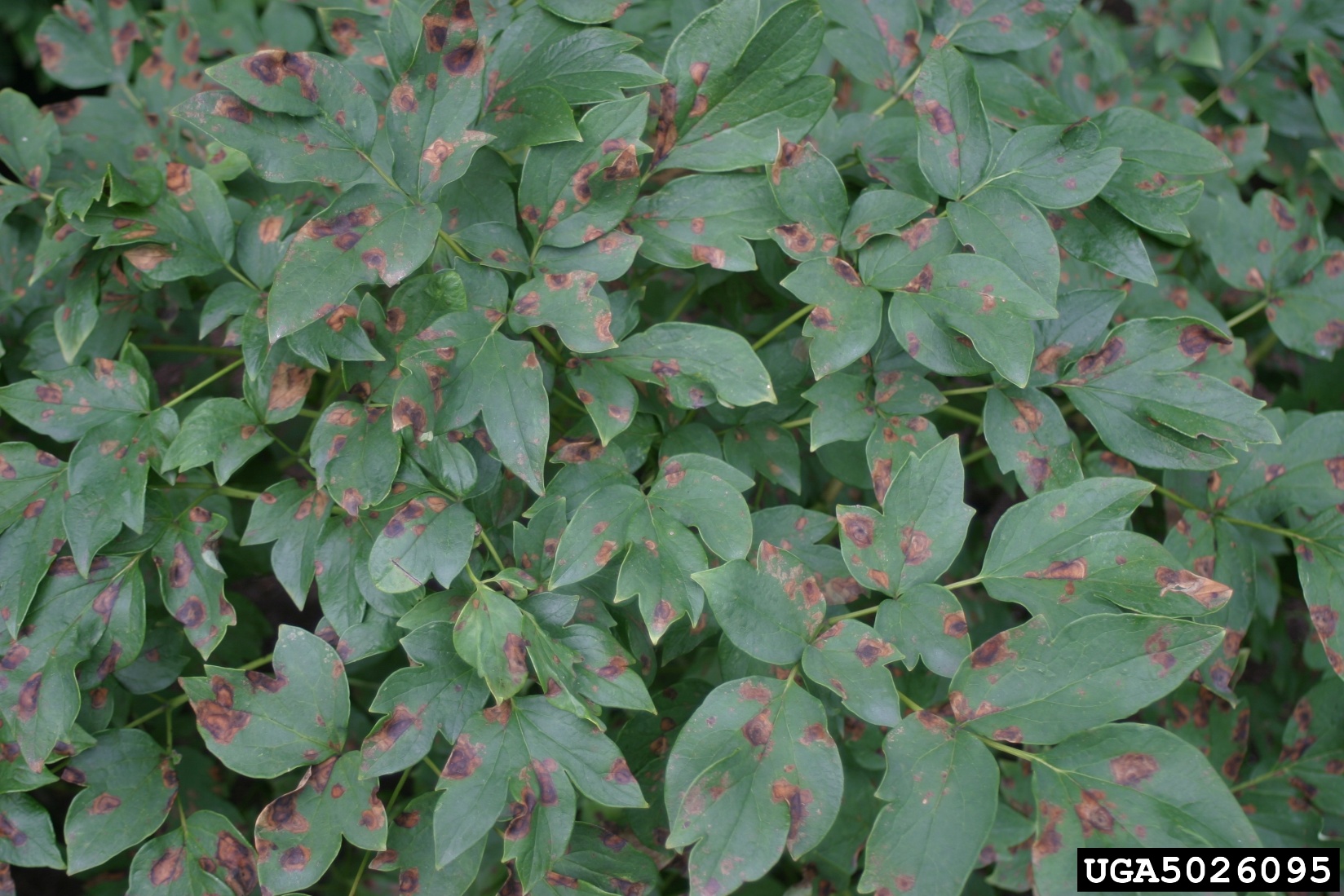
Peony leaves showing dark blotches caused by fungal leaf blotch disease.
Jody Fetzer, New York Botanical Garden, www.insectimages.org
Common Peony Problems, Pests, and Diseases in South Carolina
Peonies have few pests or diseases.
Fungal Disease of Peonies in South Carolina
The most frequently occurring fungal diseases are Botrytis blight and leaf blotch.
Disease Prevention for Peonies
To help control diseases:
- Avoid overhead irrigation
- Cut all peony plants to ground level in the fall
- Do not add the old tops to the compost pile
Insect Pests of Peonies in South Carolina
The only insect pests of any consequence on peonies are scales and Japanese beetles.
Ants on Peonies
Ants are attracted to peonies because of the sweet sap the flower buds secrete.
It is a myth that ants are necessary to permit peonies to bloom.
Why Peonies Fail to Bloom
A common problem of peonies is the failure to bloom.
Common causes of bloom failure include:
- Planting too deeply
- Immature plants
- Excess nitrogen
- Inadequate sunlight
- Overcrowding
- Nutrient deficiency
- Insect or disease problems
- Competition from nearby plant roots
- Late freezes
- Insufficient winter chilling (some cultivars in zones 8 and 9)
Peony Cultivars and Types for South Carolina Gardens
There is a vast array of peony colors and forms to choose from.
Most gardeners are familiar with the large, double-flowered peonies.
Garden peonies are available in:
- Single-flowered
- Semi-double
- Japanese
- Anemone-type blossoms
The single and Japanese bloom types usually perform much better in the South than the doubles do.
Flower colors include:
- White
- Pink and magenta
- Yellow
- Cream
- Red
Herbaceous Peony Cultivars (Paeonia lactiflora)
Modern hybrid peonies are complex crosses of other hybrids and several different species.
Paeonia lactiflora is the species of many old-fashioned herbaceous hybrids and is often used to refer to them.
These cultivars are known for reliable flowering and performance in Southern gardens.
Recommended Herbaceous Peony Cultivars for South Carolina
- ‘America’ has early, single, large, fiery red flowers with a golden center tuft.
- ‘Blaze’ is a true red, early single with rounded petals and a sunny yellow center.
- ‘Bride’s Dream’ is a creamy white Japanese. Center is soft yellow to cream.
- ‘Coral Charm’ has deep coral buds that soften to coral peach when open, with a gold center. Early, semi-double.
- ‘Do Tell’ is a Japanese midseason peony of shell pink with a rose, pink and white center.
- ‘Felix Crousse’ is a double Japanese flower type with ruby red flowers.
- ‘Festiva Maxima’ has fragrant, large, early white double flowers with crimson flecks. Strong, tall stems and dark green foliage. This double old favorite does well in the South.
- ‘Flame’ is an early blooming rose-red single with a yellow center.
- ‘Kansas’ has large, early double flowers of watermelon red that hold their rich color throughout bloom time. This is one of the best doubles for the South.
- ‘Miss America’ has snow white petals that open to a full, early semi-double. It is a heavy bloomer.
- ‘Monsieur Jules Elie’ has double pink flowers with silvery centers.
- ‘Paula Fay’ is a glowing pink early semi-double with waxy textured petals.
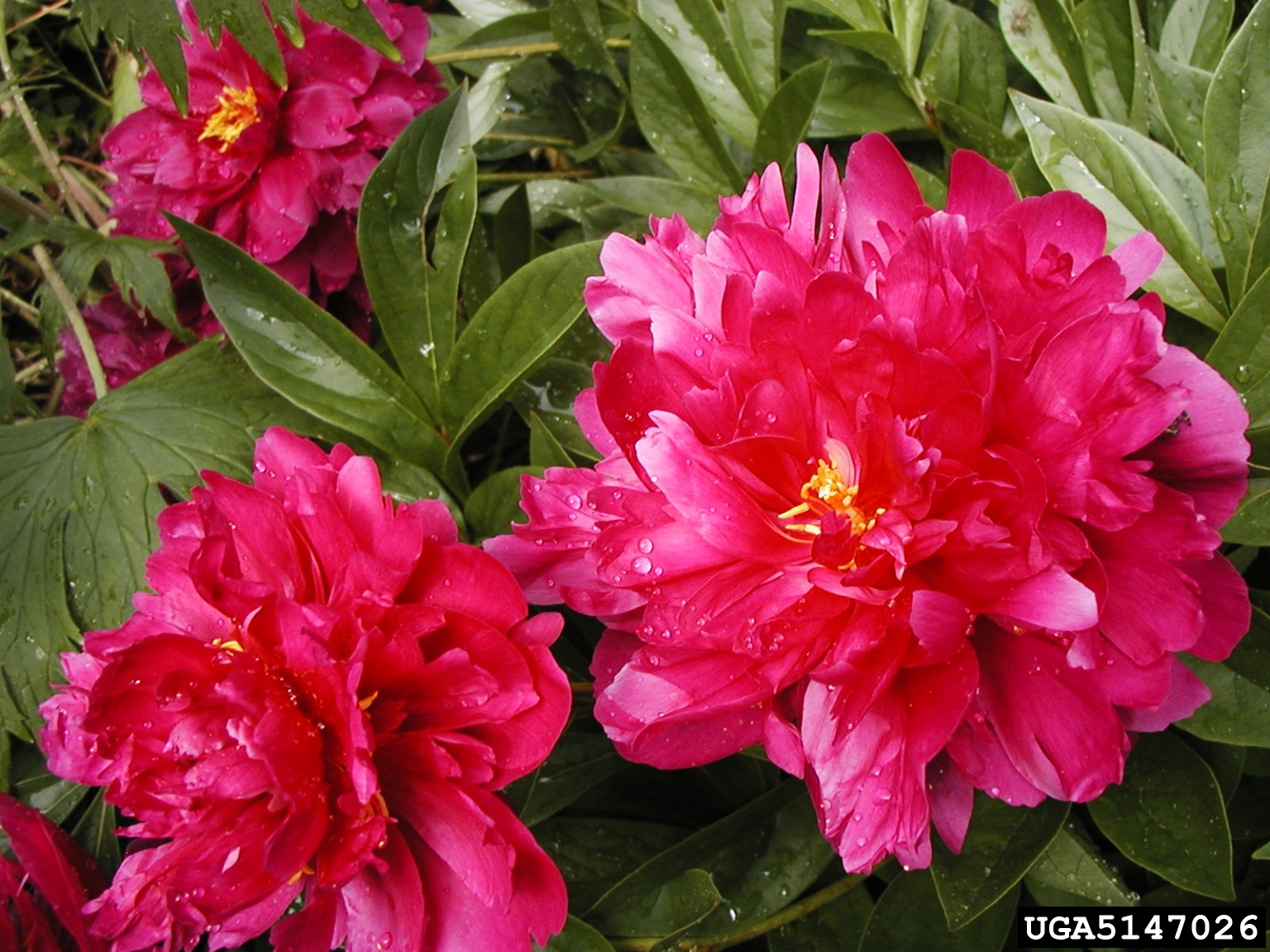
‘Felix Crousse’ peony with deep red, double Japanese-type flowers.
The Dow Gardens Archive, Dow Gardens, www.insectimages.org
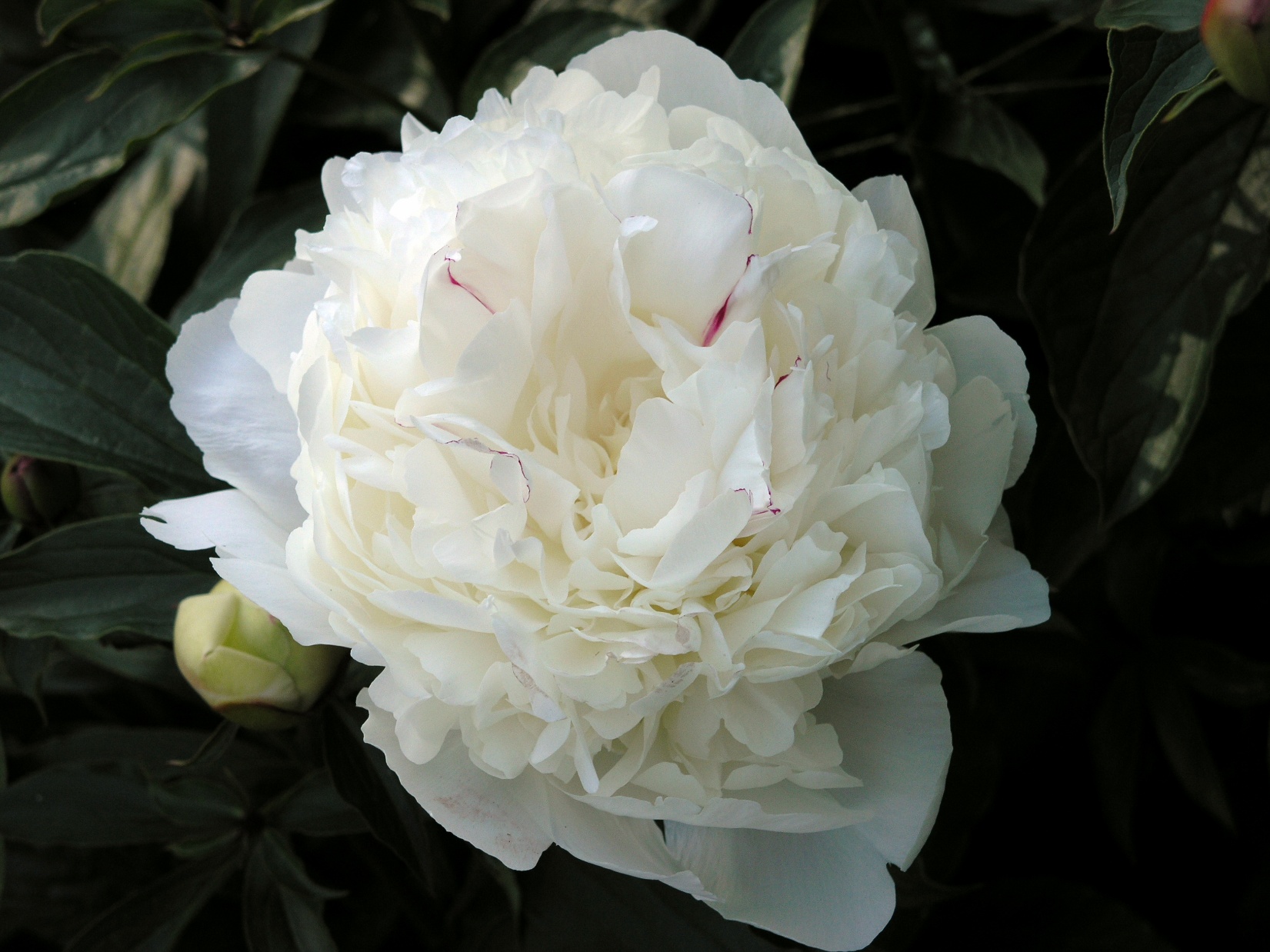
‘Festiva Maxima’ peony with large white double flowers marked with crimson flecks.
Flickr: van swearingen, Creative Commons License 2.0
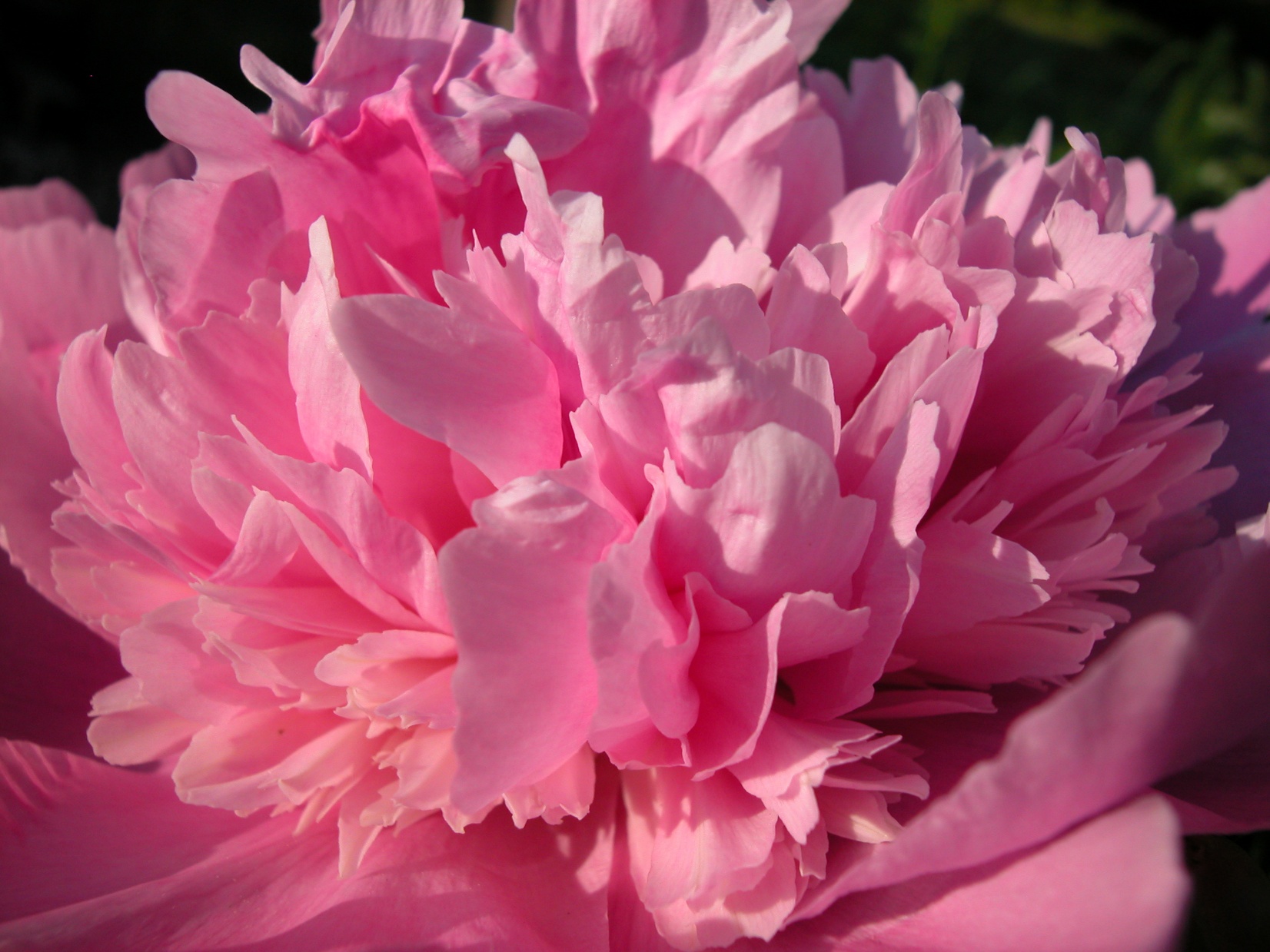
‘Monsieur Jules Elie’ peony with large pink double flowers and silvery highlights.
Flickr: Tie Guy II, Creative Commons License 2.0
Tree Peonies (Paeonia suffruticosa)
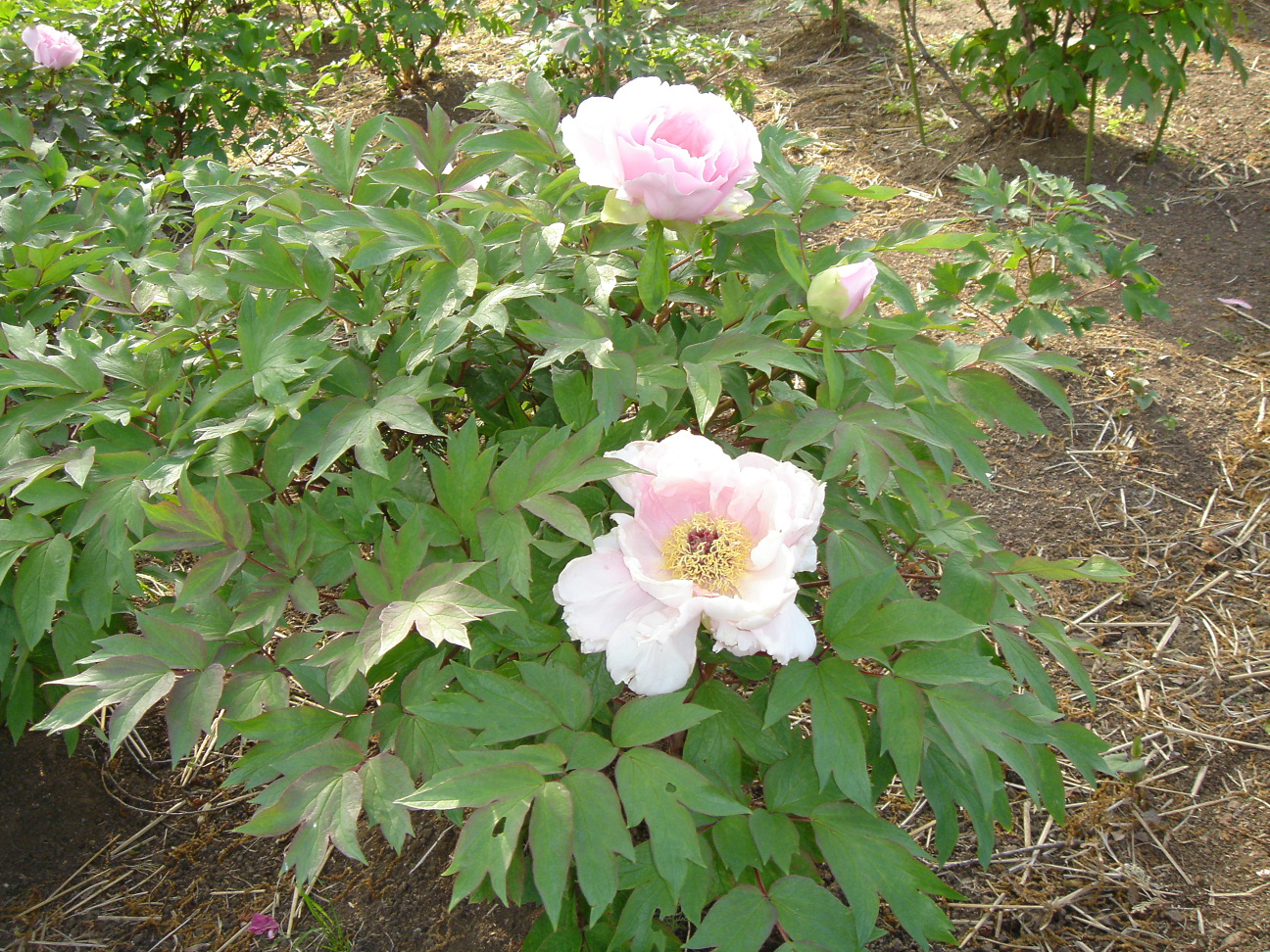
Tree peony shrubs have woody stems and large spring flowers.
Wikimedia Commons, Shin-改, released to common domain.
Tree peony flowers come in:
- Single
- Semi-double
- Double-flowered
The color range includes every color of the rainbow except blue.
Depending on the cultivar and weather conditions, peonies will flower as early as March or as late as May.
Tree peonies bloom a week or two earlier than herbaceous peonies.
Early-blooming cultivars do best in the South as they have time to bloom before hot weather sets in. They are also less prone to botrytis blight.
Tree peonies form woody branches that do not die back, but drop their leaves in the autumn, as does any deciduous shrub.
Their flowers are often larger than those of herbaceous peonies.
Tree peonies like the same soil conditions as the herbaceous peonies, but require more shelter from the wind.
The larger-flowered varieties will hold their flowers longer if protected from the sun during the hottest part of the day.
These cultivars are known for reliable flowering and performance in Southern gardens.
Recommended Tree Peony Cultivars for South Carolina
- ‘Age Of Gold’ has creamy lemon semi-double flowers showing red flares at the base of the ruffled petals.
- ‘Alice Harding’ is an old tree peony that is not grafted and can be propagated by division. Double lemon flowers.
- ‘Black Pirate’ is an early midseason, single or semi-double dark red, with darker flares.
- ‘Dusky Maiden’ is a dark red double-flowered tree peony, with the flowers standing well over the bush. Green foliage with a hint of red, good autumn color.
- ‘Gauguin’ has unusual flowers of light raspberry red, flushed on the back and inside base of the petals with a pale gold.
- ‘High Noon’ has lemon-yellow flowers that are red near the center. It may bloom again during the summer.
- ‘Kamata-nishiki’ is an early semi-double with dark purple, rose-like flowers.
- ‘Roman Gold’ is a free-flowering, wide bush with lemon-yellow single flowers with red flares at the base of the petals.
- ‘Taiyo’ is an early semi-double with ruby red blossoms.
- ‘Vesuvian’ is an excellent compact bush with finely cut foliage, dripping with deep maroon double blossoms.
Fernleaf Peonies (Paeonia tenuifolia)
These unusual peonies have finely divided fernlike foliage and deep red single or double flowers.
They are dwarf in stature and bloom very early.
Complex propagation makes them less available and more expensive.
Resources
- Paeonia, North Carolina Extension Master Gardeners Toolbox
- Paeonia x suffruticosa, North Carolina Extension Master Gardeners Toolbox
- Plant Your Peonies in the Fall and Other Southern Peony Tips, Lee County, North Carolina State Extension
Originally published 04/99


