Quick Guide to Managing Insect Pests on Pecan Trees
- Pests Covered
- Phylloxera
- Aphids
- Pecan weevil
- Stink bugs
- Caterpillars
- Shuckworm
- Spraying Challenges
- Large-scale air-blast sprayers are not practical for homeowners
- Best Options
- Spot-spraying with small sprayers
- Systemic drenches for aphids
- Other Tips
- Choose resistant cultivars
- Maintain good sanitation
- Ensure adequate sunlight and airflow
How to Manage Insect Pests for Pecan Trees in the Home Garden
Pecan trees are a staple in the Southeast and can be found in many places throughout South Carolina. Growing pecans on a large scale can be very time consuming and expensive.
This factsheet will focus on insect pests that are common for pecan trees in the home landscape and discuss the management options that are available to home gardeners.
Commercial growers and maybe even some serious hobbyists can afford to buy large air-blast sprayers to properly manage pests and diseases, but the average homeowner does not have the ability to buy this equipment. Not only this, but pest management options for pecans in home gardens are limited because there are only a few products labeled for pecans in small-scale use.
Chemical control of diseases and insects on mature pecan trees is usually not feasible for home gardeners since adequate coverage of the foliage with a pesticide is required to be effective.
For more general information on growing pecans, see HGIC 1356, Pecan Planting and Fertilization.
Treatment Methods for Insect Pests on Pecan Trees
Large air-blast sprayers are used by commercial pecan producers to apply a large volume of spray into the tree canopies. This equipment is rarely available to homeowners and is very costly.
Below are a few options that can be used to apply pesticides to young trees, tree trunks, or limited portions of the tree canopy.
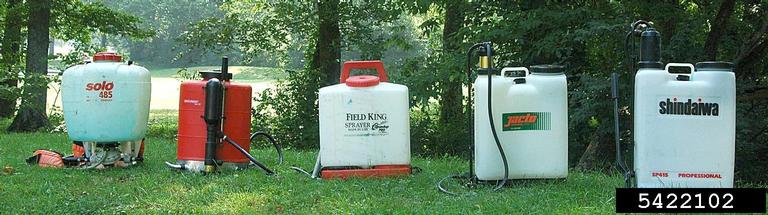
Different models of backpack sprayers.
Source: Steve Manning, Invasive Plant Control, Bugwood.org
Pump-up and Backpack Sprayers for Pecan Trees
- 1 to 5 gallon pump-up or backpack sprayers are best for treating small, recently planted trees or for spot-spraying clusters of walnut caterpillars or fall webworms.
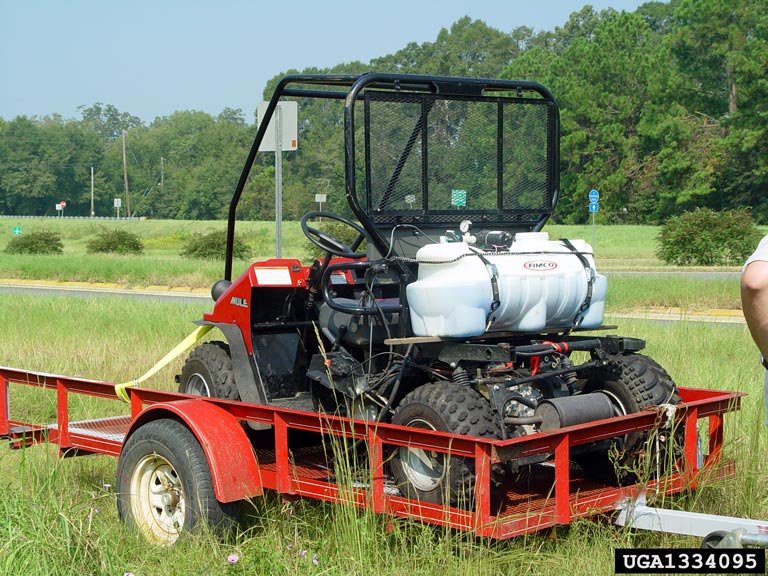
Small sprayer unit mounted on an ATV.
Source: Chris Evans, University of Illinois, Bugwood.org.
Tree and Shrub Hose-End Sprayers for Pecan Trees
- Hose-end sprayers are capable of spraying around 20 feet high, with adequate water pressure.
- They are useful for spraying small, recently planted trees, trunks for pecan weevils, and lower limbs of larger trees for diseases, stink bugs, and caterpillars.
12-Volt Pump ATV Sprayers for Pecan Trees
- Some ATV-mounted sprayers come with a 12-volt pump that delivers up to 5.5 gallons per minute. Nozzles specifically for spraying trees are available.
- They are only adequate for spraying young trees or trunks for pecan weevils, as these will only spray up to 25 feet high.
Hiring Commercial Applicators for Pecan Tree Pest Control
There is always the option to hire a commercial applicator who will apply foliar sprays to the tree canopy. However, applicators can be difficult to find, treatments are costly, and these insect pests usually do not cause enough damage on mature trees to warrant hiring a commercial applicator.
Insecticides for Pecans in the Home Garden
Application Methods for Pecan Tree Insecticides
- Soil-drench: Involves pouring a systemic pesticide mixed with water on the soil surrounding the tree for immediate uptake through the roots.
- Trunk basal spray: Pesticide is typically applied with a low-pressure sprayer to the lower portion of the trunk, where it can be absorbed through the bark and taken up into the vascular system. Please note that the chemical used will be less effective when applied to thick and/or wet bark.
- Foliar spray: A liquid pesticide mixture that is sprayed directly onto tree leaves for faster uptake. This method is very common, but might not always be feasible for larger, mature trees. Both sides of the leaf need to have good coverage for effective control.
Below is a table listing the limited options for insecticide products labeled for home pecan use.
Active Ingredients Labeled for Home Pecan Trees
| Active ingredient | Insects managed | Product name |
| Imidacloprid | Aphids, phylloxera | Ferti-lome Tree and Shrub Systemic Insect Drench Merit 2F Merit 75WP |
| Carbaryl | Phylloxera, pecan weevil | Sevin XLR Plus, Sevin |
| Bifenthrin | Fall webworm, walnut caterpillars, pecan weevil | Ferti-lome Broad Spectrum Insecticide Ortho Bug B Gone Max |
| Spinosad | Caterpillar pests | Ferti-lome Borer, Bagworm, Tent Caterpillar, and Leafminer Spray Bonide Captain Jack’s Dead Bug Brew |
Caution: Do not apply fungicides or insecticides to pecan trees with sprayers that have been previously used to apply herbicides. Be aware that Carbaryl and Bifenthrin are both highly toxic to bees and other pollinators. Follow label instructions for application of all pesticides. The label is the law!
Common Insect Pests of Pecan Trees
This section describes insect pests commonly found on pecan trees in the home landscape, including identification, life cycle, damage, and practical management options for home gardeners in South Carolina.
Phylloxera on Pecan Trees
Phylloxera are tiny, aphid-like insects that grow inside hollow, tumor-like galls formed by the tree as a response to feeding on stems, leaves, petioles, and nuts.
There are three different species that are commonly found on pecan trees in the Southeast.
Life-cycle stages
Overwintered eggs start hatching when leaf buds expand in the spring. The galls are formed when the young phylloxera start feeding on the young expanding leaves.
A second generation is completed inside the gall, and in May, the galls will split open to release the adults.
This third generation is free-living and only produces the overwintering eggs for the cycle to start over, so no significant damage is caused.
Damage symptom progressions
Heavy infestations of phylloxera can be unsightly, but they rarely harm the productivity of mature trees. Outbreaks are cyclical, so heavy infestations can occur for a year or two, and then trees can go several years without an infestation.
Phylloxera can also form galls on the leaf, but this is less damaging than the stem galls formed.
Phylloxera Control on Pecan Trees
- Phylloxera can be controlled by an insecticide with the active ingredient imidacloprid or carbaryl (Sevin).
- The treatment window is very narrow. Sprays need to be applied between bud break and before 1 inch of new green growth appears, and again 7-10 days later.
- Applications put out after galls are formed will not be effective as the phylloxera will be protected inside the gall.
- Trees with heavy infestations in the previous year could benefit from treatment, but trees that did not have galls last year do not require it.
Note: It might not be very practical to treat large trees for Phylloxera because all the branches and the entire trunk need to be covered for control.
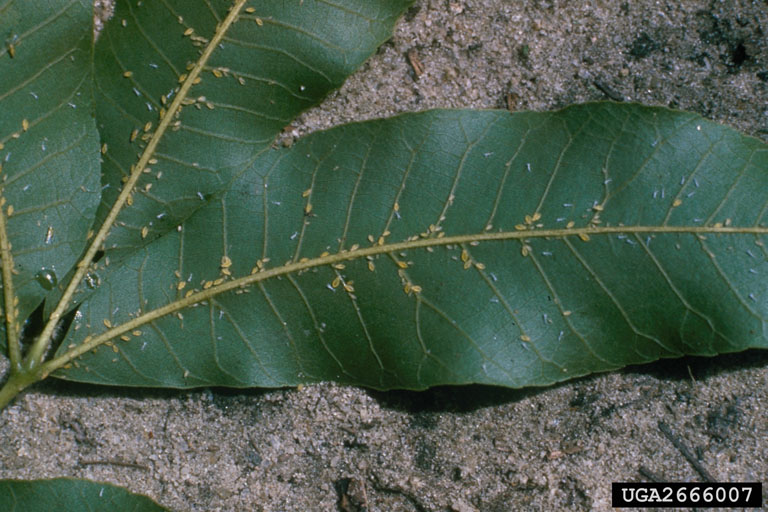
Yellow pecan aphids (Monelliopsis pecanis) on the underside of a pecan leaf.
Source: H C Ellis, University of Georgia, Bugwood.org
Yellow Pecan Aphids on Pecan Trees
Yellow pecan aphids (Monelliopsis pecanis) feed on the undersides of pecan leaves.
Trees can sustain high populations of aphids without serious yield loss.
The concern in home landscapes is the development of sooty mold from the large amounts of honeydew produced by aphids.
Yellow Pecan Aphids Control on Pecan Trees
Generally, it is not recommended to try and control yellow aphids with insecticide sprays in home landscapes.
This is because aphids are difficult to control with insecticides, and the products normally used to control these insects can increase aphid populations by disrupting the populations of beneficial insects.
Black Pecan Aphids on Pecan Trees
Black pecan aphids (Melanocalis caryaefoliae) also feed on the underside of leaves but do not produce honeydew and are much more damaging than the yellow pecan aphid.
They inject toxic saliva into the leaf when feeding, causing angular yellow spots to form on the leaves.
Eventually, the yellow spots will turn brown, and heavy infestations can cause trees to defoliate earlier than normal.
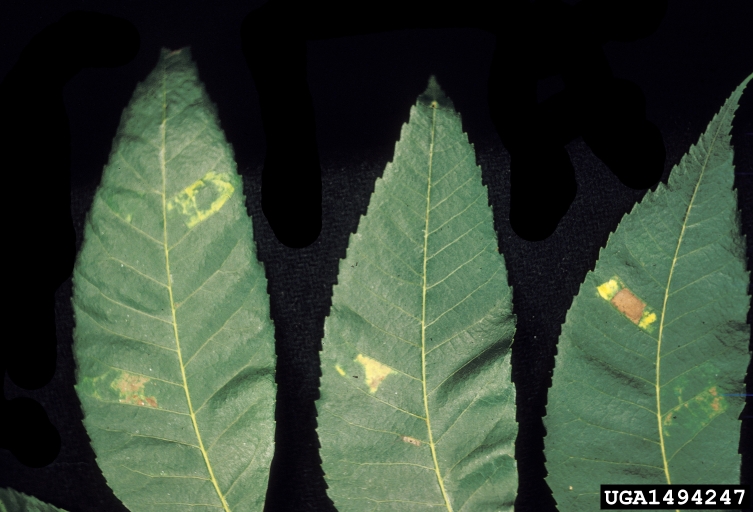
Black pecan aphid feeding produces angular yellow spots on the leaves.
Source: University of Georgia Plant Pathology, University of Georgia, Bugwood.org
Black Pecan Aphids Control on Pecan Trees
- There are some pecan cultivars that are more susceptible to black pecan aphids than others (Sumner, Schley, Gloria Grande), so try to avoid planting these cultivars.
- For both yellow and black pecan aphids, the systemic insecticide imidacloprid can be applied to the soil as a drench in the spring after leaves emerge. Note: As always, follow instructions on the label.
- Make sure to keep trees watered following treatment.
- Insecticidal soaps can be used on younger trees for control, but they would not be practical for mature trees.
Pecan Weevils on Pecan Trees
The pecan weevil (Curculio caryae) is a light-brown or grayish-colored beetle with a long, sharp snout, or proboscis.
Life-cycle stages
Adult pecan weevils are usually present from late July to August. Adults will begin feeding on kernels in the water stage before shell hardening. This feeding injury causes the nuts to shrivel, turn black inside, and drop prematurely.
The shell-hardening stage is when females chew into the nuts using their proboscis and lay eggs. The developing larvae feed on the inside of the nut for several weeks until they reach maturity.
The nuts will not drop to the ground once they are mature, but the larvae will destroy the kernels, and the shucks usually stick to the shell, making the infested nuts worthless.
Once mature, the larvae will emerge from the pecan by chewing an exit hole through the nut and outer shell.
After exiting the pecan, the larvae drop to the ground where they dig in to pupate.
Immature larvae are white, and mature larvae are fat, creamy-white with reddish-brown heads. Most larvae will remain in the soil for 2 years before emerging in late July-August as adults.
Note: Pecan weevil larvae are not found in nuts with unhardened shells. Any larvae present prior to shell hardening indicate damage from another insect.

Pecan weevil larva feeding on the inside of a pecan.
Source: Clemson University-USDA Cooperative Extension Slide Series, Bugwood.org
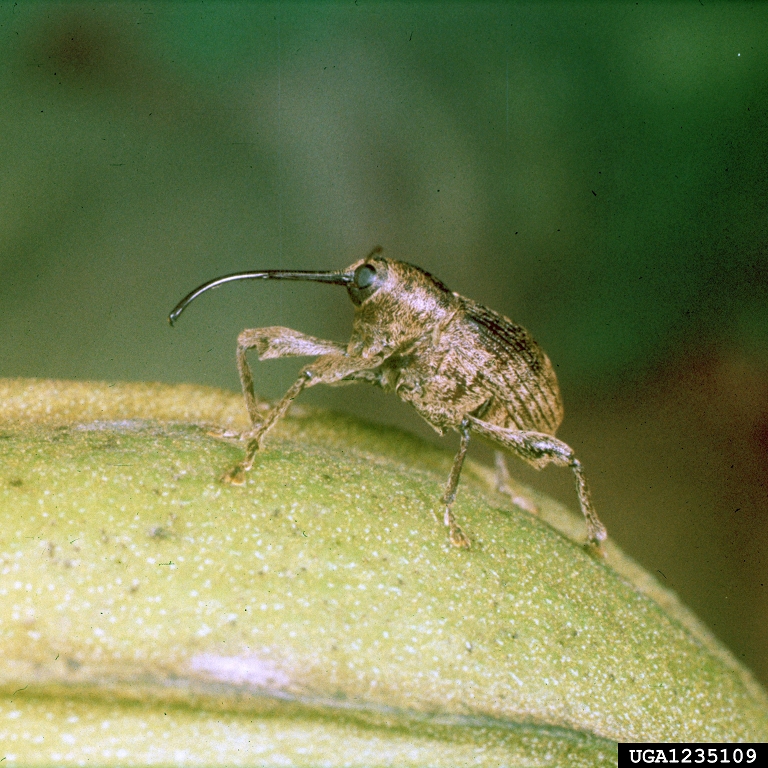
Adult pecan weevil (Curculio caryae) uses its long snout, or proboscis, to puncture the pecan shell and deposit eggs inside.
Source: Clemson University- USDA Cooperative Extension Slide Series, Bugwood.org
Pecan Weevil Control on Pecan Trees
- In commercial orchards, whole-tree foliar sprays are applied at 7–10-day intervals for pecan weevil control. This is usually not practical for pecan trees in the landscape or home garden.
- Homeowners can achieve partial control of pecan weevils with multiple applications of Sevin (carbaryl) to the lower 8 feet of the trunk.
- Adult pecan weevils can fly, but a large portion of the emerging weevils crawl or fly to lower parts of the trunk and then crawl higher into the tree. Because of this, the first step is to control the emerging weevils before they make their way up the tree into the canopy.
- The first treatment should be at the shell hardening stage with another 2-4 treatments applied at 7–10-day intervals.
- Applications should start 7-10 days after shell hardening (August 1-10) and continue until September, when the adults are no longer present.
Stink Bugs on Pecan Trees
Stinkbugs can be an occasional pest of pecans, especially if your pecan trees are adjacent to field crops like soybeans, corn, sorghum, and cotton.
They have piercing-sucking mouthparts that cause dark, sunken spots in the kernels.
The affected kernels can also have a bitter taste.
Stinkbug Control on Pecan Trees
- In commercial orchards, these insects are controlled by repeated applications of foliar insecticides such as bifenthrin or other pyrethroids.
- Repeated use of pyrethroids can be very damaging to beneficial insect populations.
- The best option for home gardeners is to control weed populations around the pecan trees.
Fall Webworms on Pecan Trees
Fall webworms (Hyphantria cunea) are native to the US and are frequent pests of 90 different species of trees, including pecans.
These caterpillars become active in early summer, feeding on leaves at the end of tree branches. In order to stay protected from predators, the caterpillars form large web masses where they feed.
They are heavy foliage feeders, but it is rare for them to cause yield-reducing damage on mature trees.
Fall webworms are 1 inch in length with a blackish-red head and a light yellow to greenish body with 2 long black stripes down the back. They are covered in long, white hair.
Once the caterpillars are mature and leave the web, they pupate and overwinter in tree bark or leaf litter at the base of the tree. The adult moth emerges in spring and starts laying eggs on the underside of leaves.
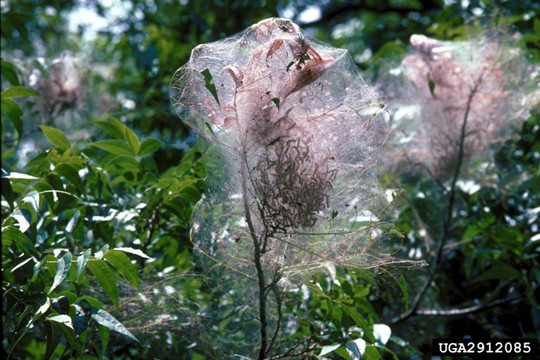
The web is full of fall webworms on the branch of a pecan tree.
Source: G. Keith Douce, University of Georgia, Bugwood.org
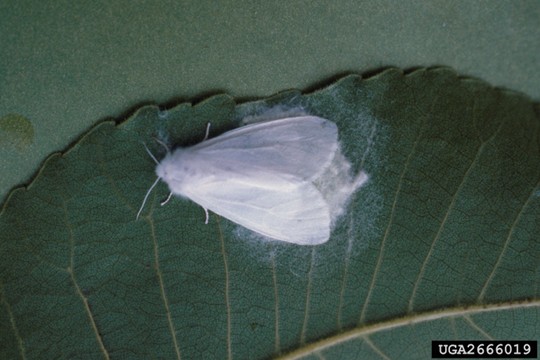
Fall webworm (Hyphantria cunea) adult laying eggs on a pecan leaf.
Source: H C Ellis, University of Georgia, Bugwood.org
Fall Webworm Control on Pecan Trees
- The damage to healthy trees is mainly cosmetic and will not cause a serious issue unless populations are very high.
- If management is necessary, you can remove the webbing from the ground with a pole. Just the act of breaking up the webbing will expose the caterpillars to their natural enemies, such as birds, stink bugs, and wasps.
- Insecticides such as Bacillus thuringiensus (Bt) or Spinosad are safer to apply and less toxic to natural enemies. Follow label directions and make sure to apply insecticide to the foliage closest to the webbing.
- A tree and shrub hose-end applicator can be used to spray recommended insecticides on small trees or the lower portions of larger trees.
- Do NOT attempt to burn webs from the trees. Pecan twigs that are defoliated by webworm will produce new leaves; however, twigs damaged by fire will not.
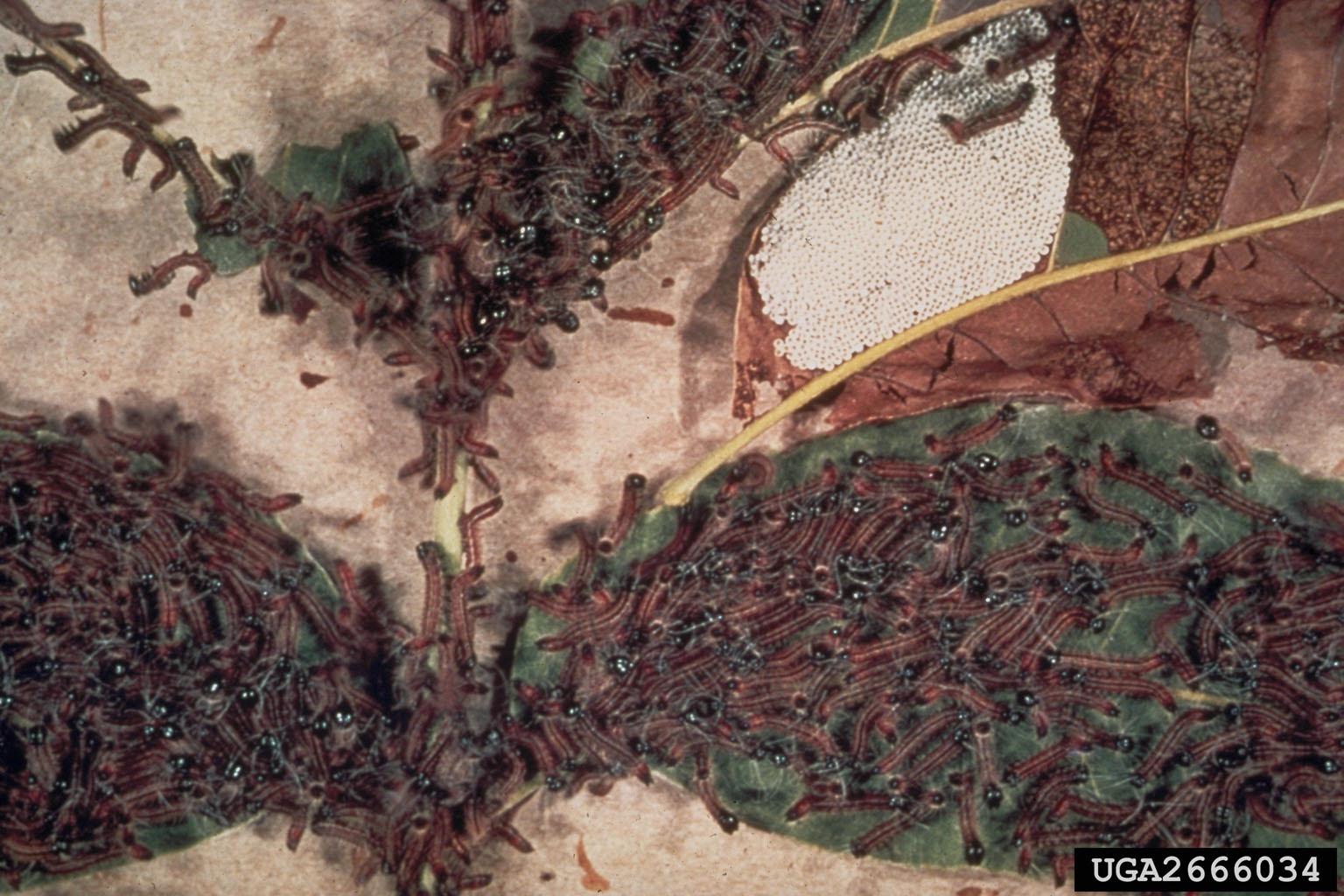
White mass of eggs and young walnut caterpillars.
Source: H C Ellis, University of Georgia, Bugwood.org
Walnut Caterpillars on Pecan Trees
Walnut caterpillars (Datana integerrima) are also foliage feeders, like the fall webworm, but the main difference is that walnut caterpillars do not make webs.
They also have a narrower host range, mainly feeding on pecan, hickory, and walnut trees.
Life-cycle stages
To grow larger or molt, these caterpillars will group together on the trunk of the tree and leave behind a mass of shed skins on the trunk after they move back out on the limbs to continue feeding.
Once the caterpillars are done feeding, they move to the ground from the trunk and pupate in the soil.
Aside from leaf damage, you can also look for their eggs, which are normally laid in groups on the leaves.
As they grow, the caterpillars will change in appearance:
- Younger caterpillars are red and white or yellow-striped
- Mature caterpillars are black with small white hairs
Walnut Caterpillar Control on Pecan Trees
- Infestations do not usually warrant insecticide control on mature trees.
- The easiest way to get rid of these caterpillars is when they are grouped on the trunk as they molt.
- Apply a labeled contact insecticide like Spinosad, bifenthrin, or carbaryl directly to the mass of caterpillars.
- For mature trees, use the tree and shrub hose-end sprayer with adequate water pressure to get as high in the tree as possible.
Hickory Shuckworm on Pecan Trees
The hickory shuckworm (Cydia caryana) is native to the US and found throughout most of the pecan-growing regions in the Southeast.
As the name implies, it is found on several species of hickory and has also been reported on black walnut.
This insect attacks when the nuts are first formed in early June and continues until harvest. Like other moth species, its larval form causes feeding damage.
Prior to shell hardening, larva feeding within the nut will cause premature nut drop.
After shell hardening, the larva is restricted to feeding in the shuck only.
Poor kernel development, shuck sticking, shell scarring and discoloring, and delayed nut maturity can all result from larva feeding in the shuck.
Damage from hickory shuckworm often goes unnoticed (except for premature nut drop) until the shuck is cut open to see the tunneling of the larva.
Premature nut drop can occur from many different factors, but one way to determine if it’s caused by hickory shuckworm is to look for a whitish residue around the entry hole in June or July.
Hickory shuckworm moths emerge in the spring, prior to nut formation, and lay eggs on pecan leaves, galls from pecan phylloxera, and nuts of early-developing hickories or pecans.
High populations of phylloxera in pecans are sometimes correlated with high populations of shuckworm as well.
Alt text suggestion: Hickory shuckworm larva feeding within the shuck of a developing pecan nut.
Hickory Shuckworm Control on Pecan Trees
- If you have an infestation of shuckworm or had one in the previous year, an insecticide, such as Spinosad, can be applied when the pecans are halfway through the shell-hardening stage and repeated 10-14 days later.
- Managing for pecan phylloxera can also help lower shuckworm populations.
- Remove and destroy old shucks, if possible, since the pupae will overwinter in old pecan shucks.
For more information on premature nut drop or other issues with pecan quality, see HGIC 2213, Reasons for Poor-Quality Pecans.