
Quick Guide to Hurricane-Resistant Trees for South Carolina
- Primary Risk Factors: Tree location, species, condition, and salt tolerance
- Best Practices: Plant trees 1 to 1.5 times the mature height away from structures; group trees in staggered clusters of 5 or more
- Resilient Features: Open canopies, strong trunks, flexible branches, wide root systems
- Common At-Risk Trees: Water oak, pecan, Bradford pear, maple, pine
- Resilient South Carolina Trees: Live oak, bald cypress, southern magnolia, river birch, sabal palmetto
How Hurricanes Affect Trees in South Carolina Landscapes
Hurricane Helene’s path through South Carolina in September 2024 impacted at least 1% of the state’s tree canopy, with some estimates as high as 4%.
The hurricane also raised awareness among homeowners of the potential damage to homes and other structures from falling trees.
While not all urban landscapes can be modified to reduce or remove the threat of tree loss and thus property damage, several factors can be considered when deciding how hurricane-resistant the trees in the home landscape may be.
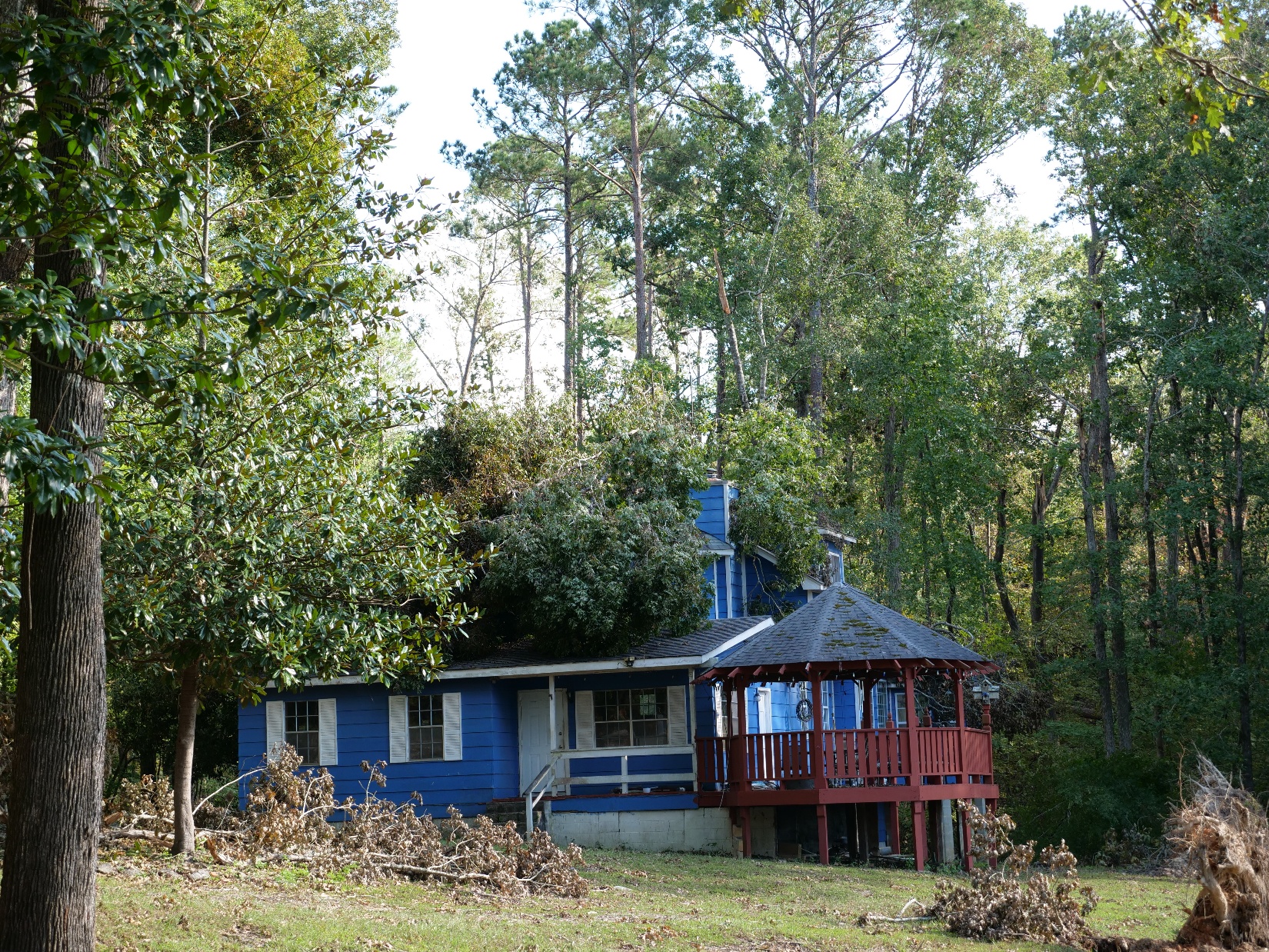
Trees within striking distance of a home can cause significant damage during a hurricane.
Jaime Pohlman, ©2024, Clemson Extension
How Tree Location Affects Hurricane Resistance
The first consideration is where trees are within the landscape. By estimating the height of mature trees, it is possible to determine which trees are located within striking distance of a house or other structure.
These trees should be examined regularly for signs of decline or structural issues.
Proper pruning can improve a tree’s ability to withstand high winds and remove hazardous limbs.
However, even Category 1 hurricane (74 to 95 mph) winds can be strong enough to cause healthy trees to fail under the right conditions, such as saturated soils, heavy crowns, and the presence of compromised limbs.
Best Practices for Hurricane-Resistant Tree Placement
When adding or replacing trees in the landscape, a good rule of thumb is to plant them at least 1 to 1.5 times their mature height away from homes, buildings, and utility lines.
Why Grouped Trees Survive Better
Trees located in groupings will often survive a hurricane better than individual stems, since a cluster of trees will have more wind resistance.
The recommended grouping size is five or more trees in a staggered formation, with about 10 feet of space between stems.
Improve Groupings with Species Diversity
This design can be improved by maintaining or establishing a mix of species with:
- Different mature heights and forms
- Rooting depths that vary
This leads to more available rooting space for each stem, which increases a tree’s ability to withstand higher winds.
Features of Hurricane-Resistant Trees
Trees vary by species in their resistance to stem and limb breakage and windthrow during a hurricane.
Hurricane-resistant species generally have:
- Open canopies, allowing winds to pass through; dense crowns catch the wind, leading to windthrow or stem breakage
- Sturdy trunks
- Deep, wide, spreading root systems
- Flexible branching
- Low, compact crowns
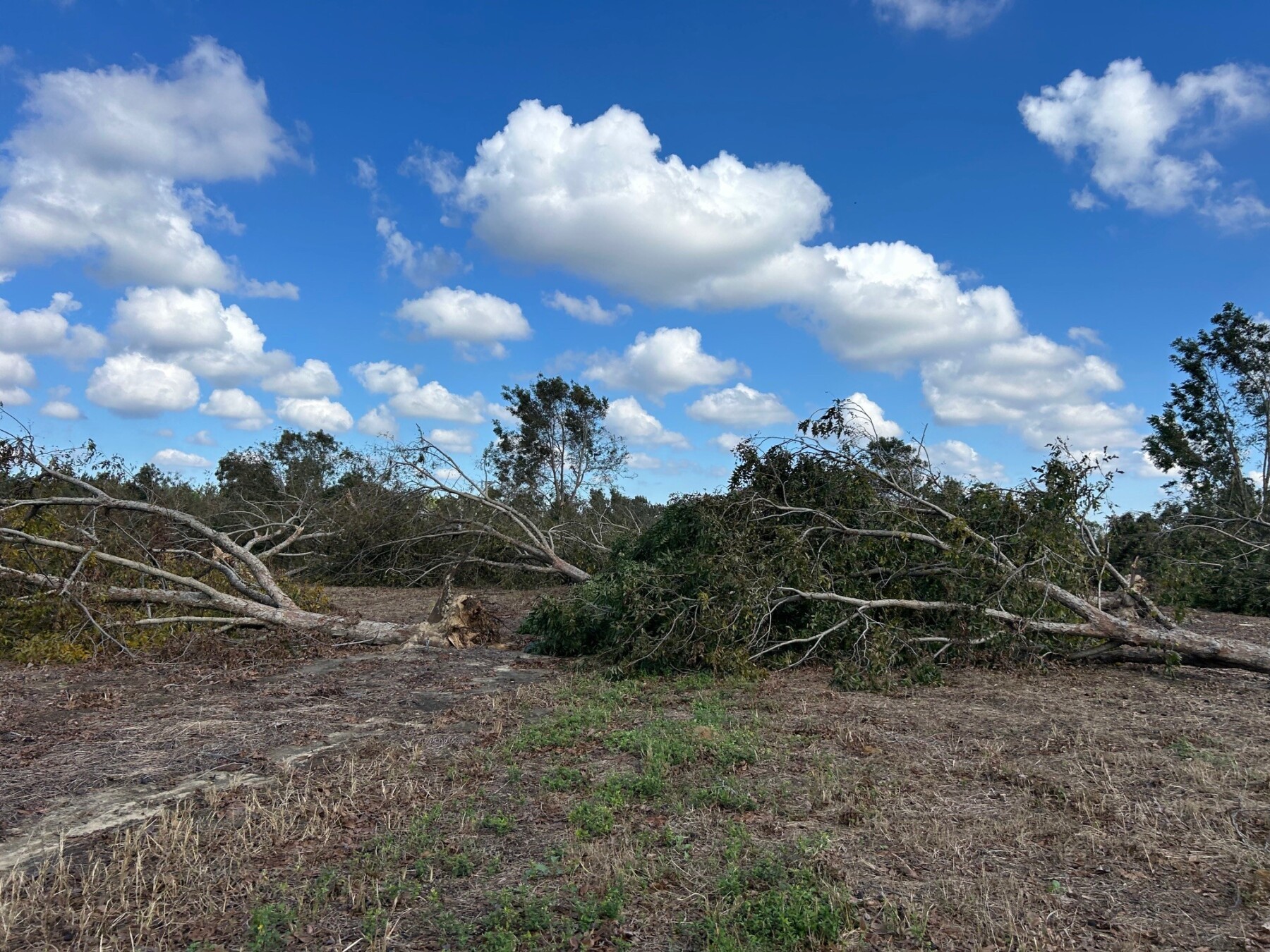
Pecan trees are prone to windthrow during hurricanes.
Photo Credit: Lenny Wells, UGA Pecan Extension
Trees Commonly Damaged in SC Hurricanes
Some common yard species in South Carolina that suffered losses from windthrow or breakage during Hurricane Helene include:
- Water oaks (Quercus nigra)
- Pecans (Carya illinoinensis)
- Bradford pears (Pyrus calleryana)
- Maples (Acer species)
- Pines (Pinus species)
Wind-Resistant Native Trees of South Carolina
South Carolina hurricane-resistant trees include:
High Wind Resistance (Mature Heights Included)
- Flowering Dogwood (Cornus florida) — 15 to 40 feet
- American Holly (Ilex opaca) — 40 to 60 feet
- Yaupon Holly (Ilex vomitoria) — 15 to 25 feet
- Eastern Redcedar (Juniperus virginiana) — 60 to 80 feet
- Southern Magnolia (Magnolia grandiflora) — 60 to 80 feet
- Turkey Oak (Quercus laevis) — 40 to 60 feet
- Live Oak (Quercus virginiana) — 40 to 80 feet
- Sabal/Cabbage palmetto (Sabal palmetto) — 40 to 50 feet
- Bald Cypress (Taxodium distichum) — 50 to 120 feet
Med–High Wind Resistance
- River Birch (Betula nigra) — 30 to 60 feet
- Pignut Hickory (Carya glabra) — 50 to 80 feet
- Mockernut Hickory (Carya tomentosa) — 50 to 80 feet
- Eastern Redbud (Cercis canadensis) — 20 to 30 feet
- Fringe Tree (Chionanthus virginicus) — 12 to 20 feet
- Persimmon (Diospyros virginiana) — 30 to 60 feet
- Sweetgum (Liquidambar styraciflua) — 60 to 80 feet
- Sweetbay Magnolia (Magnolia virginiana) — 10 to 35 feet
- Water Tupelo (Nyssa aquatica) — 50 to 100 feet
- Black Gum (Nyssa sylvatica) — 30 to 50 feet
- Swamp Chestnut Oak (Quercus michauxii) — 60 to 80 feet
- Post Oak (Quercus stellata) — 60 to 80 feet
- Shumard Oak (Quercus shumardii) — 40 to 60 feet
- Winged Elm (Ulmus alata) — 40 to 60 feet
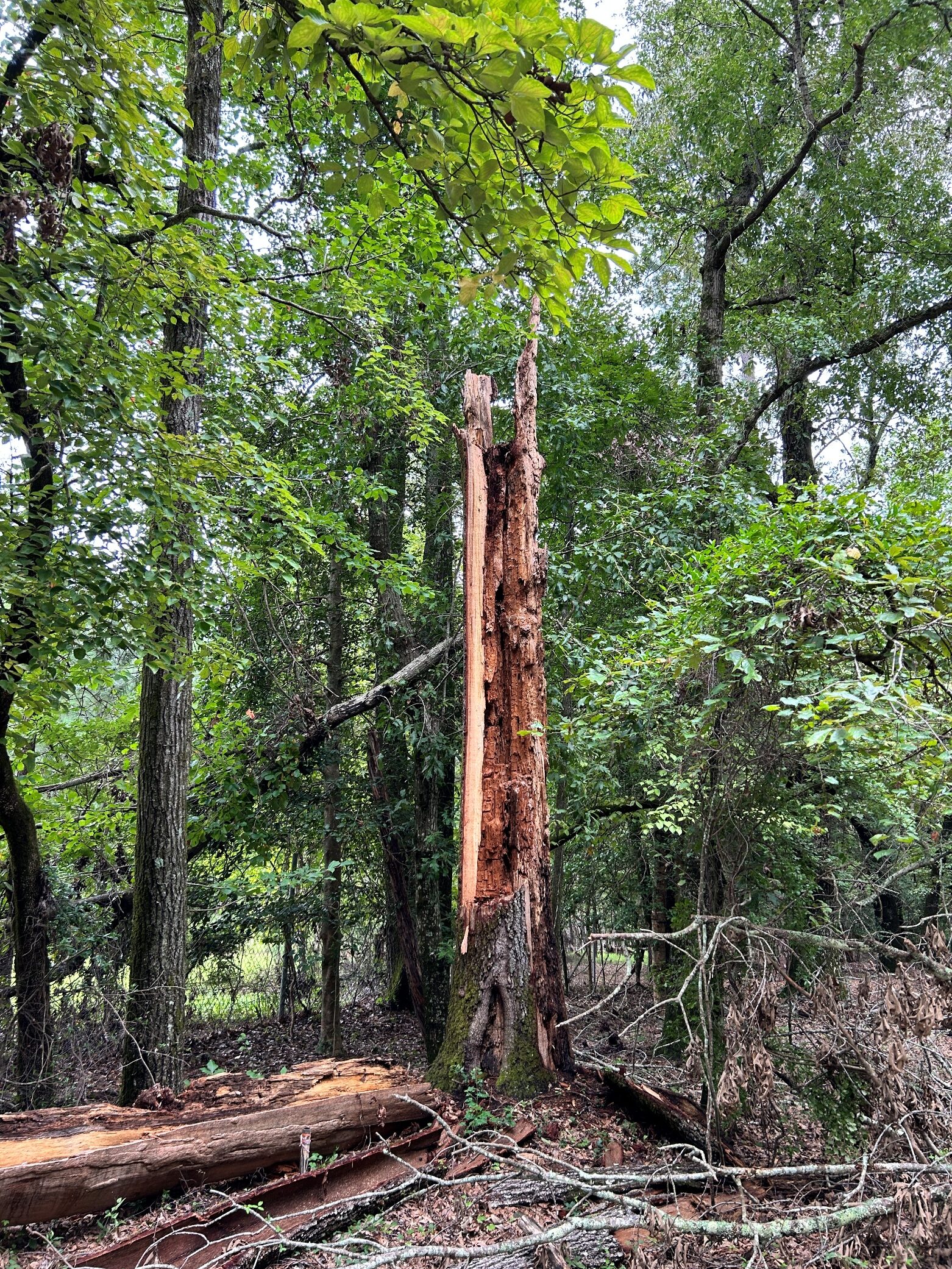
Internal decay is not always evident until a stem is split and a tree loses all or part of its crown.
Janet Steele, ©2025, Clemson Extension
Southern Pine Species and Hurricane Resistance in South Carolina
Southern pine species are common yard trees, especially loblolly pine (Pinus taeda) and longleaf pine (Pinus palustris), but they are rated medium-low for hurricane resistance.
Even trees with healthy root systems and deep taproots can fail under hurricane conditions.
Common contributing factors include:
- The crown structure that can catch high winds and bend or twist, leading to stem breakage
- Large crowns combined with isolation or wide spacing in urban landscapes
- Saturated soils that allow uprooting and overthrowing even well-rooted trees by wind following heavy rainfall
How Tree Condition Impacts Hurricane Resistance
Additional factors to consider in the hurricane resistance of landscape trees include their age, overall health, and structure.
Age and Health of Trees in Hurricane-Prone Landscapes
Trees have a natural life span. Older trees are more prone to disease and decline as they age.
Common warning signs of decay include:
- Cavities in main stems and large branches
- Cracks or fissures in the bark or bark sloughing off
- Insect activity, such as bore holes
- Pruning wounds that appear rotten instead of healed
Decay can impact tree roots, main stems, and large limbs, increasing the risk of significant property damage during a hurricane.
Correctly identifying the tree species in the landscape, estimating their current age, and researching their average lifespan help determine which stems may be overmature and require monitoring for further decline.
Tree Structure and Hurricane Failure
Trees with co-dominant stems of equal size that join at the same point on a tree can develop included bark, creating a weak spot prone to breakage.
Without early structural pruning, many species may develop co-dominant stems.
Importance of Pruning for Hurricane Resistance
Species such as oaks and maples, which are prone to co-dominant stems, may require proper structural pruning from planting through maturity.
Studies have found that properly pruned trees survive hurricanes better than unpruned or improperly pruned trees.
For more information, see HGIC 1003, Principles & Practices for Pruning Trees.
Salt Tolerance and Hurricane-Resistant Trees in Coastal South Carolina
Prolonged exposure to salt spray and salt from storm surge can permanently damage or kill tree species with low salt tolerance. This is only a concern for homeowners in coastal counties.
Highly Salt-Tolerant Native Trees
- Yaupon Holly (Ilex vomitoria) — 15 to 25 feet
- Southern Magnolia (Magnolia grandiflora) — 60 to 80 feet
- Live Oak (Quercus virginiana) — 40 to 80 feet
- Sabal/Cabbage Palmetto (Sabal palmetto) — 40 to 50 feet
Moderately Salt-Tolerant Native Trees
- Mockernut Hickory (Carya tomentosa) — 50 to 80 feet
- American Holly (Ilex opaca) — 40 to 60 feet
- Eastern Redcedar (Juniperus virginiana) — 60 to 80 feet
- Sweetgum (Liquidambar styraciflua) — 60 to 80 feet
- Bald Cypress (Taxodium distichum) — 50 to 120 feet


