
Quick Guide: Viburnum Diseases and Insect Pests
Affected Plants: Viburnum species (Viburnum spp.)
Primary Disease Types:
- Fungal leaf spots (Cercospora spp., Phoma spp., Phyllosticta spp.)
- Anthracnose (Colletotrichum spp.)
- Powdery mildew (Erysiphe viburni)
- Downy mildew (Plasmopara viburni)
- Algal leaf spot (Cephaleuros virescens)
- Root rot (Armillaria mellea)
- Canker (Botryosphaeria spp.)
Primary Insect Pests:
- Aphids (Neoceruraphis viburnicola)
- Thrips (Frankliniella spp.)
- Spider mites (Oligonychus illicis)
- Scale (Lepidosaphes ulmi)
- Root weevils (Otiorhynchus sulcatus)
Primary Causes:
- High humidity
- Leaf wetness
- Poor air circulation
- Plant stress
- Drought stress
- Overwintering pathogens
Most Important Prevention Strategy: Reduce leaf wetness and plant stress through proper spacing, pruning, and sanitation
Chemical Control: Fungicides (chlorothalonil, myclobutanil, mancozeb) and insecticides (horticultural oil, insecticidal soap, systemic products) when necessary
In general, most viburnums are relatively pest-free landscape shrubs in South Carolina. Occasionally, disease or insect pest problems occur, and usually during those times the plants are under stress or growing in less-than-ideal conditions.
Viburnum Diseases: Fungal Leaf Spots on Viburnum
Fungal leaf spots are common foliar diseases that affect viburnum species, especially during warm and humid conditions.
Cause
A variety of leaf spots are caused by the fungi Cercospora, Phoma, and Phyllosticta.
Fungal leaf spots typically occur during warm, moist summer months
Symptoms
Fungal leaf spots on viburnum typically exhibit the following characteristics:
- Angular to irregular-shaped spots
- Sunken and dry leaf tissue within spots
- Spots that begin small but enlarge or merge
- Reddish to grayish brown discoloration
- Initially occurs on older foliage
- Black, sunken lesions associated with anthracnose (caused by Colletotrichum species)
Leaf spots and anthracnose are fairly common on viburnum foliage, but these foliar diseases are not usually serious.
Prevention & Treatment
Cultural Controls
Many foliar problems can be prevented by keeping leaves as dry as possible.
- Avoid overhead irrigation
- Improve air circulation with adequate plant spacing
- Perform selective branch pruning
- Prune overhanging trees to reduce humidity levels and speed foliage drying
- Hand-remove spotted leaves on lightly diseased plants
- Rake up and destroy infected fallen leaves
- Apply a fresh layer of mulch beneath plants
Removing this leaf material and applying mulch will minimize the risk of the disease recurring the next season.
Chemical Control
If chemical control is needed, most fungal leaf spots and anthracnose can be controlled with fungicides containing:
- Chlorothalonil
- Mancozeb
- Myclobutanil
- Thiophanate-methyl
Apply when symptoms first appear and repeat every 10 to 14 days as needed.
Viburnum Diseases: Algal Leaf Spot on Viburnum
Algal leaf spot is a foliar disease that can affect viburnum species, particularly under cool, moist conditions.
Cause
Algal leaf spot is caused by Cephaleuros virescens. This disease may occur especially during cool, moist conditions.
This pathogen will overwinter in leaf spots and spreads to adjacent foliage by wind and splashing rain.
Symptoms
- Algal leaf spot on viburnum is characterized by the following:
- Small, pale green circular spots develop on leaves
- Spots that enlarge and become light brown or reddish-brown with age
- Raised, velvety spots with feathered edges
- Reddish-brown spots producing reproductive structures called sporangia
Prevention & Treatment
Cultural Controls
Algal leaf spots are common on several ornamental shrubs and trees, including camellias, magnolias, azaleas, aucubas, gardenias, and rhododendrons.
- Monitor plants regularly for disease symptoms
- Practice sanitation as described for fungal leaf spot control
- Remove and destroy infected fallen leaves
- Apply a fresh layer of mulch beneath plants
- Improve air circulation and reduce moisture on foliage
Treat any nearby landscape plants that also exhibit algal leaf spot symptoms to reduce reinfection pressure.
Chemical Control
Algal leaf spot can be controlled with copper fungicide sprays.
- Apply when symptoms first appear
- Repeat every 10 to 14 days as needed
See Table 1 for specific products.
Viburnum Diseases: Powdery Mildew on Viburnum
Powdery mildew is a common fungal disease that affects viburnum species, particularly during high-humidity, moderate-temperature conditions.
Cause
Powdery mildew of viburnum is caused by the fungus Erysiphe viburni. The occurrence and spread of this disease are favored by warm days, cool nights, and humid conditions, but are inhibited by rain.
Powdery mildew is worse on plants in the shade.
Symptoms
Powdery mildew of viburnum primarily affects young leaves and shoots and is characterized by:
- Powdery white to light gray fungal growth (mycelia)
- Growth primarily on the upper leaf surface, but also possible on the lower leaf surface
- Disease development begins in summer and peaks in late summer
- Distortion or deformation of developing leaves under severe infections
Prevention & Treatment
Cultural Controls
Since high relative humidity is an important factor favoring disease development, certain cultural practices can help prevent the disease or decrease its severity.
- Follow the sanitation practices described for fungal leaf spot control
- Improve air circulation through proper spacing and pruning
- Reduce shade where possible
Some cultivars exhibiting resistance to powdery mildew include:
- Viburnum burkwoodii ‘Mohawk’
- V. carlecephalum ‘Cayuga’
Chemical Control
Powdery mildew can be controlled with fungicides containing:
- Myclobutanil
- Propiconazole
- Thiophanate-methyl
- Horticultural oil
To prevent foliar injury:
- Apply 2% horticultural oils only if temperatures are below 85°F
- Apply late in the day
- Do not apply if rainfall is expected within 24 hours
- Do not apply to drought-stressed plants
Note: Although sulfur is sometimes used for powdery mildew control, it is not recommended for sulfur-sensitive plants, such as viburnums.
Viburnum Diseases: Downy Mildew on Viburnum
Downy mildew is a foliar disease that affects viburnum species and develops rapidly under conditions of leaf wetness and moderate temperatures.
Cause
The fungus Plasmopara viburni causes downy mildew on viburnums. This disease occurs and spreads rapidly during cool to warm weather conditions, coupled with periods of leaf wetness.
Infections of the foliage in the spring can result from splashing spores produced by the diseased foliage remaining on the ground from the previous year.
Downy mildew may most commonly occur on Viburnum ‘Awabuki’.
Symptoms
- Downy mildew on viburnum can be identified by the following symptoms:
- Light green spots on the upper leaf surfaces
- Spots enlarge into angular patches between leaf veins
- Downy, grayish-white fungal growth on the lower leaf surfaces
- Infected areas redden and then turn brown as the leaf tissue dies
- Defoliation may occur if the disease is severe
Downy mildew disease differs from powdery mildew in that the fungal growth is primarily observed on the lower leaf surface.
Prevention & Treatment
Cultural Controls
As with other foliar diseases, reducing leaf wetness is critical to managing downy mildew.
- Avoid overhead irrigation
- Allow adequate plant spacing when planting
- Prune adjacent shrubs or overhanging tree limbs
- Improve air circulation to promote faster drying of foliage
- Rake up and destroy infected fallen leaves
- Apply a fresh layer of mulch beneath shrubs
Chemical Control
If fungicides are necessary, sprays should adequately cover both the upper and lower leaf surfaces.
Fungicides labeled to control downy mildew include:
- Chlorothalonil
- Mancozeb
Apply when symptoms first appear and repeat as needed according to label directions.
See Table 1 for specific products.
Viburnum Diseases: Botryosphaeria Dieback & Canker on Viburnum
Botryosphaeria dieback and canker is a stress-related fungal disease that affects viburnum branches and stems, often leading to dieback or plant decline.
Cause
Botryosphaeria dieback and canker is caused by Botryosphaeria species. This disease kills cambium and sapwood tissue and is most likely to occur on plants under drought stress, with bark injuries, pruning wounds, or other environmental stresses.
Healthy plants are much more resistant to infection by Botryosphaeria, as they can wall off the fungus and prevent its spread through the branch.
Symptoms
Botryosphaeria dieback and canker on viburnum is characterized by:
- Sunken, dead areas (cankers) on branches and stems
- Cankers that enlarge or merge and may girdle branches or trunks
- Rapid wilting or browning of foliage beyond the canker
- Branches that fail to leaf out in the spring
- Progressive dieback of affected branches
Prevention & Treatment
Cultural Controls
Maintaining plant health is critical for preventing infection and limiting disease progression.
Water shrubs weekly during the growing season if rainfall is insufficient (see Watering Shrubs & Trees (HGIC 1056))
Mulch shrubs with a 2- to 4-inch layer of bark, pine needles, or ground leaves
Avoid piling mulch against the trunk
Prevent mechanical injury by weed trimmers and lawnmowers
Remove infected plant material promptly:
- Prune branches with cankers back to green, healthy wood
- Cut limbs just outside the swollen branch collar (not flush with the trunk)
- Disinfect pruners between cuts with 70% alcohol or a 10% bleach solution
- Burn or dispose of all prunings
Chemical Control
No fungicides are recommended for the control of fungal cankers.
Pruning wounds may be immediately treated for protection with a benzimidazole fungicide, such as:
- Thiophanate methyl
See Table 1 for specific products.
Viburnum Diseases: Armillaria Root Rot on Viburnum
Armillaria root rot is a serious soilborne fungal disease that affects the roots and lower trunk of viburnum and can lead to gradual decline or sudden plant death.
Cause
Armillaria root rot is caused by the fungus Armillaria mellea, which is common in landscape and garden settings. It is also known as shoestring root rot, mushroom root rot, and oak root rot. This fungus can rot the roots of many plant species, including viburnums.
Most often, this disease is found on trees and shrubs such as oak, pine, rhododendron, and dogwood, but hundreds of plant species are susceptible.
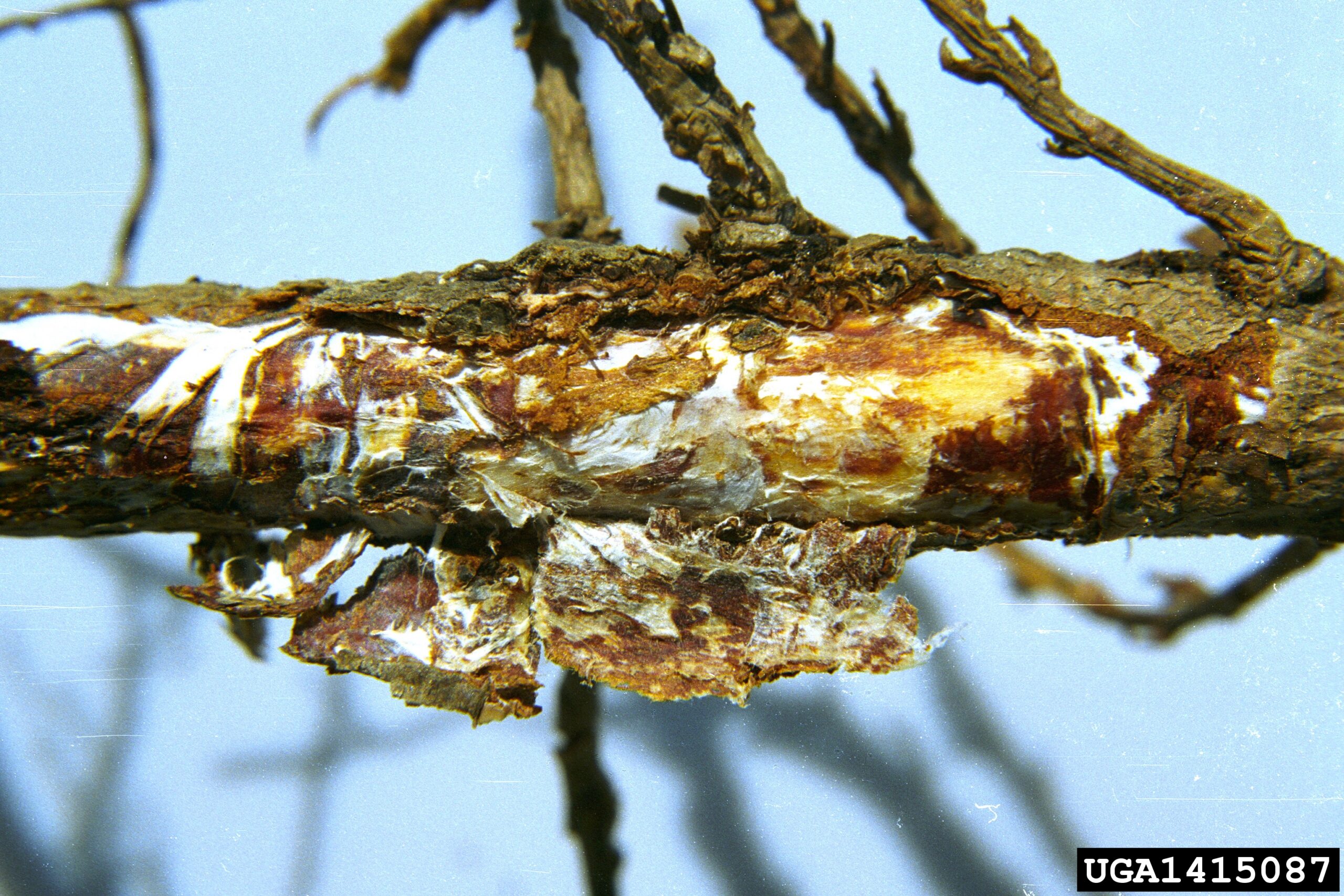
White, felt-like fungal growth beneath bark caused by Armillaria root rot (Armillaria spp.).
Andrej Kunca, National Forest Centre – Slovakia, Bugwood.org
Symptoms
Symptoms of Armillaria root rot on viburnum often affect the entire plant and may include:
- Stunted growth and overall decline
- Yellowing foliage
- Progressive thinning of foliage over several years
- Premature leaf drop
- Sudden plant death without prior visible symptoms
Armillaria root rot can be distinguished from other root problems or environmental stress by examining the crown (lower trunk) and upper roots:
- White, felt-like fungal growth beneath bark
- Fan-shaped fungal growth under peeled bark
- Black, string-like fungal strands shoestrings (1/16-inch in diameter or less) on roots, under, or in surrounding soil
Prevention & Treatment
Providing optimal growing conditions is essential for reducing susceptibility to Armillaria root rot.
- Provide additional water during drought conditions
- Ensure good soil drainage
- Maintain proper fertilization
When infection is confirmed:
- Remove and destroy the entire shrub if the root system or trunk is affected
- Remove large roots and the trunk from the surrounding soil
- Remove soil in the immediate vicinity of the affected plant
Avoid replanting the same species in the affected area.
Chemical Control
No chemical controls are effective for Armillaria root rot.
In addition to diseases, several insect and mite pests may damage viburnum foliage, stems, roots, and flowers.
Viburnum Insect Pests: Aphids on Viburnum
Aphids are common sap-feeding insect pests that affect viburnum species, particularly on new growth, where they can cause leaf distortion.
Cause
Snowball aphids (Neoceruraphis viburnicola) most often occur on European cranberry bush and snowball viburnums.
They feed in clusters on the tips of the branches by piercing plant tissue and sucking plant sap.
Symptoms
Aphid feeding on viburnum results in:
- Twisting and curling of young growth
- Cluster of gray to dark green insects on shoot tips
- Distorted leaves due to sap removal
They usually cause little or no appreciable damage.
Prevention & Treatment
Cultural Controls
Aphid populations are often naturally regulated and may not require intervention.
- Monitor plants regularly, especially new growth
- Encourage natural predators when possible
Chemical Control
If control is needed, aphids can be managed with low-toxicity options:
- Insecticidal soap
- Horticultural oil
Application guidelines:
- Spray thoroughly to contact aphids directly
- Cover both upper and lower leaf surfaces
- Repeat applications three times at 5- to 7-day intervals
- Apply only when temperatures are below 85°F
If higher toxicity insecticides are deemed necessary, products containing the following active ingredients will control aphids:
- Acephate
- Bifenthrin
- Cyfluthrin
- Cyhalothrin
- Malathion
- Neem oil
- Permethrin
- Pyrethrin
Systemic options:
- Soil drenches or granular applications of imidacloprid or dinotefuran will provide longer-lasting control and help prevent future infestations
See Table 1 for specific products.
Viburnum Insect Pests: Flower Thrips on Viburnum
Flower thrips are small, sap-feeding insects that damage viburnum leaves and flowers by scraping plant tissues and extracting cell contents.
Cause
Flower thrips (Frankliniella species) are slender, dark-colored insects with fringed wings. Adults are less than 1/16-inch in length.
Both adults and nymphs (small, immature insect stage resembling the adult) feed on leaves and between flower petals by scraping surface cells and sucking plant sap.
Flower thrips (Frankliniella species) larva (left) and adult (right).
Jack T. Reed, Mississippi State University, Bugwood.org
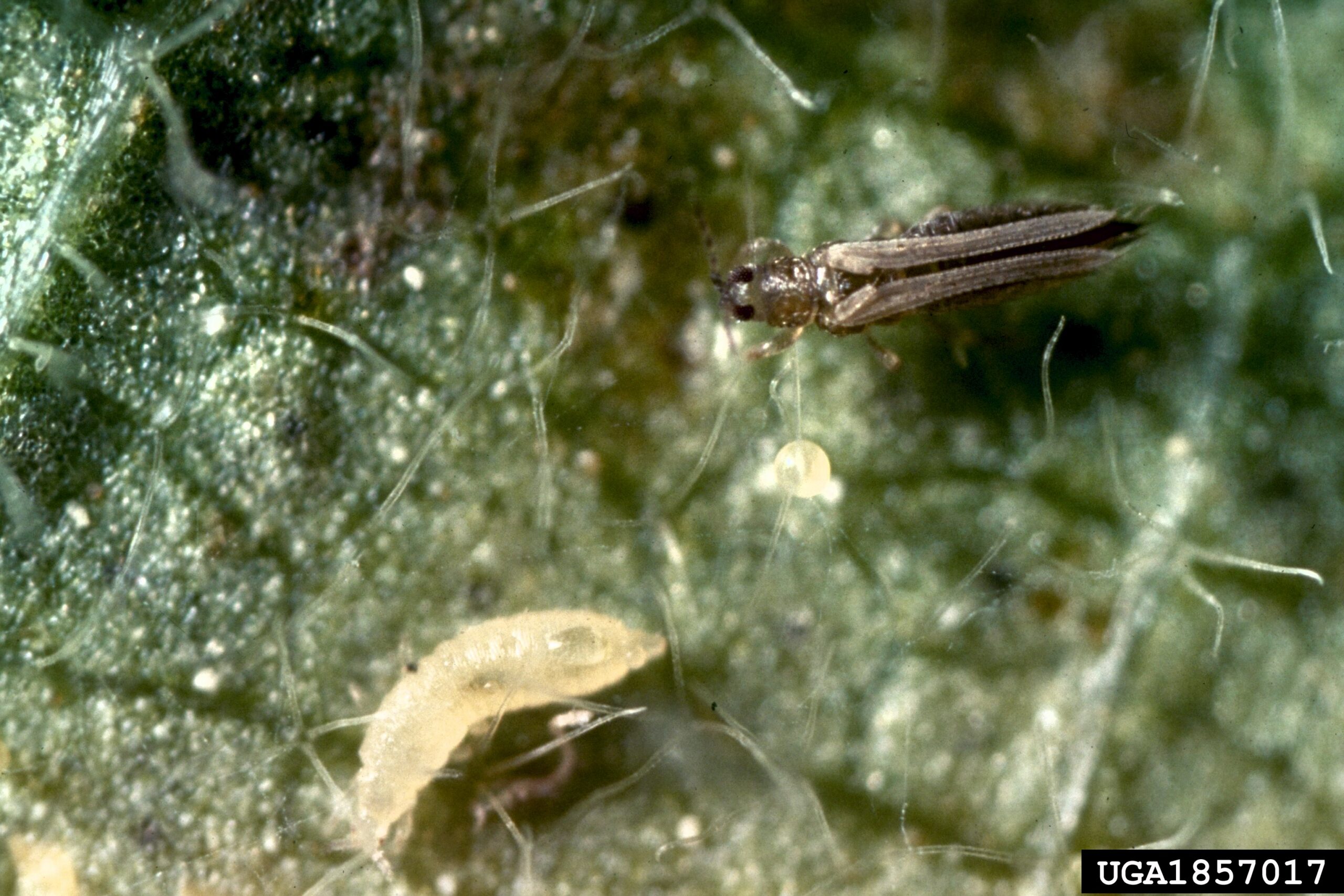
Flower thrips (Frankliniella species) larva (left) and adult (right).
Jack T. Reed, Mississippi State University, Bugwood.org
Symptoms
Thrips feeding on viburnum results in:
- Purplish-red spots on the undersides of leaves
- Severely curled or rolled foliage
- Premature leaf drop
- Silvery speckles or streaks on leaves under a light infestation
- Stunted and distorted leaves and flowers under heavy infestations
- Flower buds that may die without opening
Because of their small size, thrips are difficult to detect before damage is obvious.
Prevention & Treatment
Cultural Controls
Several naturally occurring enemies feed on thrips.
- Avoid unnecessary use of contact insecticides to preserve beneficial insects
- Keep grass and weeds in the area mowed or removed
- Monitor plants by tapping branches over white paper to detect thrips
- Magnification may be necessary to see these small, fast-moving insects
Chemical Control
If insecticide applications are necessary, the following active ingredients are available in homeowner-size packaging:
- Spinosad
- Acephate
- Bifenthrin
- Cyfluthrin
- Lambda cyhalothrin
- Permethrin
Spinosad and acephate are contact and foliar systemic insecticides. All other active ingredients are contact insecticides.
Application guidelines:
- Spray when thrips are present
- Repeat application in 7 to 10 days
- Avoid spraying when plants are in bloom to protect pollinators
Additional options:
- Insecticidal soaps (requires thorough coverage and repeated applications every 5 to 7 days when temperatures are below 85°F)
- Soil drenches or granular applications of dinotefuran or imidacloprid for suppression
See Table 1 for specific products.
Viburnum Insect Pests: Spider Mites on Viburnum
Spider mites are tiny sap-feeding pests that damage viburnum foliage, particularly during cooler seasons, and can cause leaf discoloration and drop.
Cause
The southern red mite (Oligonychus illicis) is a dark reddish or brown-colored mite that is a common pest in the Eastern United States.
Azaleas, camellias, and hollies are the primary hosts for this mite, but it occasionally infests many other species, including viburnums.
The southern red mite is active in the cool weather of spring and fall and overwinters as eggs.
Mites have needle-like piercing-sucking mouthparts.
Symptoms
Spider mite feeding on viburnum results in:
- Initial feeding damage on the lower leaf surface
- Feeding on upper leaf surfaces as populations increase
- Grayish-brown discoloration of foliage
- Premature leaf drop
Prevention & Treatment
Cultural Controls
Early intervention and physical removal can help reduce spider mite populations.
- Use strong sprays of water to dislodge mites regularly
- Monitor populations by shaking branches over a sheet of white paper and observing moving reddish-brown specks
- Encourage beneficial predatory mites by minimizing broad-spectrum insecticide use
Chemical Control
Low-toxicity options are preferred for spider mite management:
- Insecticidal soap
- Horticultural oil
Application guidelines:
- Thoroughly spray both lower and upper leaf surfaces
- Apply before populations become too high
- Repeat applications two to three times at 7- to 14-day intervals
- Use a 2% horticultural oil spray (5 tablespoons per gallon of water)
If additional control is needed:
Tau-fluvalenate is labeled for homeowner use against spider mites.
Important note:
Do not use soil drenches of products containing imidacloprid, as this may kill predator mites and increase spider mite populations.
See Table 1 for specific products.
Viburnum Insect Pests: Scale on Viburnum
Scale insects are sap-feeding pests that attach to viburnum stems and branches, where heavy infestations can cause dieback or plant death.
Cause
Armored scales, such as the oystershell scale (Lepidosaphes ulmi), can infest viburnum.
The oystershell scale can overwinter as full-grown females attached to the bark or as eggs beneath the adult scale covering. Adult females are 1/8-inch long.
Crawler (immature stage) activity often coincides with the flush of new plant growth in the spring. Crawlers are pale, smaller than a pinhead, and are the only mobile stage of the scale life cycle.
Within a few hours, the crawlers will settle in a suitable spot to begin feeding and excreting a waxy covering for protection.
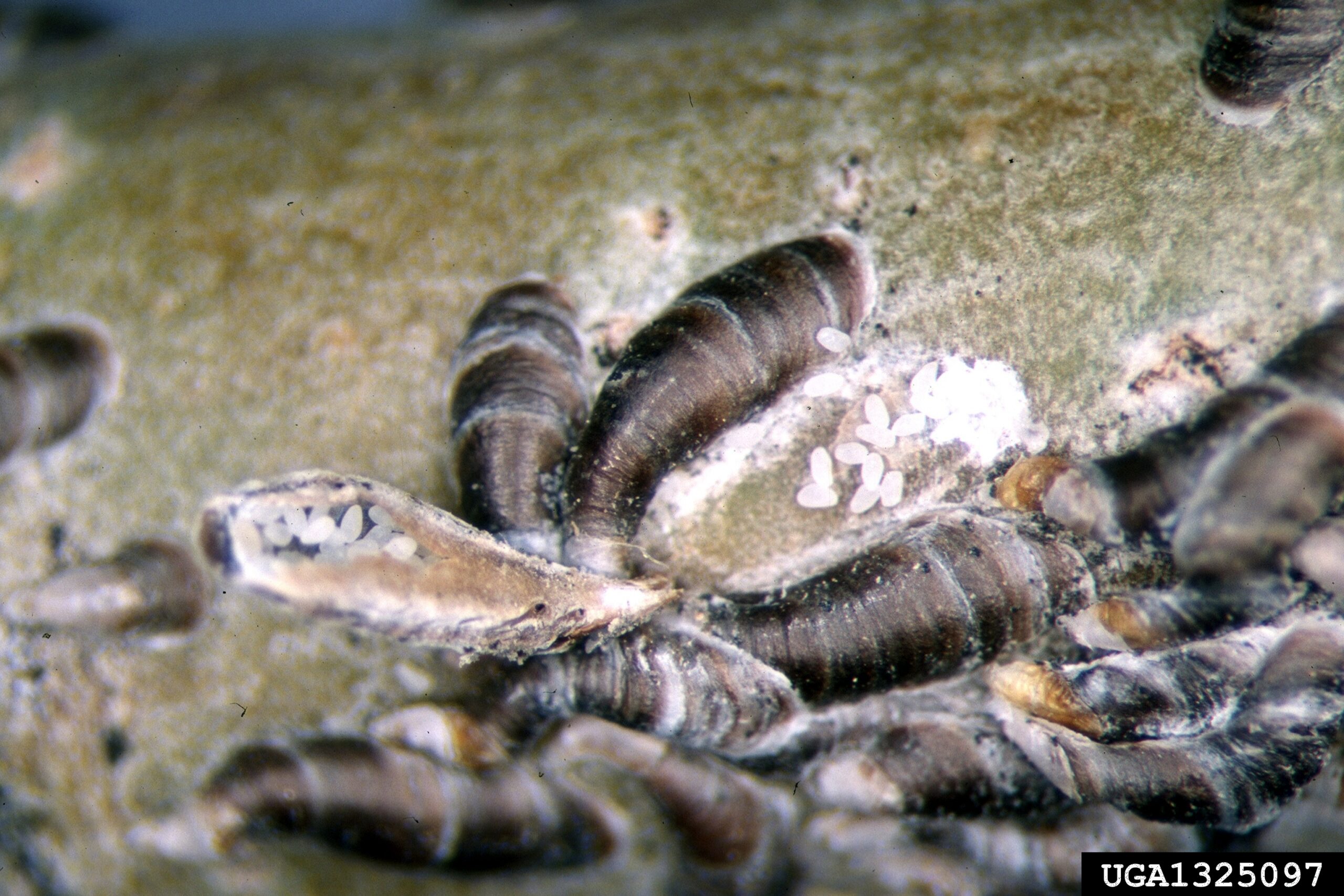
Oystershell scale (Lepidosaphes ulmi)
Whitney Crabshaw, Colorado State University, Bugwood.org
Symptoms
Scale infestations on viburnum may result in:
- Dieback of branches
- Reduced plant vigor
- Severe infestations leading to plant death
- Presence of small, oyster shell-shaped coverings on bark
Prevention & Treatment
Cultural Controls
Early detection and physical removal can help manage light infestations.
- Scrape off scale by hand when infestations are light
- Prune out and dispose of any heavily infested branches
Chemical Control
Dormant and growing-season treatments are effective when properly timed.
Dormant/early spring treatment:
- Apply a 2% horticultural oil spray (5 tablespoons per gallon of water) before new growth begins to kill overwintering adults and eggs
- Apply when temperatures are between 40°F and 85°F and no rainfall expected for 24 hours
Crawler-stage treatment (most critical timing):
Monitor the crawler emergence using:
- Sticky cards
- Double-faced tape wrapped around a branch
- Bagging infested plant material to observe crawler movement
Apply horticultural oil after plant growth begins and crawler activity is detected.
Repeat application after 10 days for improved control.
If additional control is necessary:
Contact insecticides labeled for include:
- Acephate
- Bifenthrin
- Cyfluthrin
- Cyhalothrin
- Malathion
Systemic option:
- Soil application of dinotefuran in spring
Important note:
- Avoid using more toxic insecticides, as they may kill natural predators of scale
See Table 1 for specific products.
Viburnum Insect Pests: Root Weevils on Viburnum
Root weevils are chewing insects that damage the foliage and roots of viburnum, with larvae causing the most serious injury.
Cause
Root weevil adults, such as the black vine weevil (Otiorhynchus sulcatus), feed on foliage, while larvae feed on roots.
Adult weevils are black, wingless insects about ⅜-inch long and are nocturnal feeders that move onto plants at night. During the day, they are found in the leaf litter beneath the viburnum canopy.
Larvae are white, legless grubs with brown heads and a C-shaped appearance and are found in the soil around the roots.
Symptoms
Root weevil damage on viburnum includes:
- Ragged notches along leaf edges caused by adult feeding
- Stunted plant growth
- Pale green or yellow foliage
- Root and crown damage caused by grubs
- Severe infestations leading to plant death
Root weevil larvae cause damage by chewing and girdling roots, with damage appearing in spring to early summer and continuing through the growing season.
The larvae cause more significant damage than the adults.
Prevention & Treatment
Cultural Controls
Monitoring and targeting the correct life stage is important for effective management.
- Inspect foliage for notching damage as an early indicator
- Check soil around roots for the presence of larvae
Chemical Control
Direct control efforts primarily at adult weevils.
- Apply insecticidal sprays when foliar damage is first observed
- Repeat applications at 2- to 3-week intervals (typically three applications)
Treat both foliage and the surrounding soil surface:
- Spray foliage thoroughly
- Spray the soil or mulch beneath the plants (do not apply as a drench for this purpose)
Insecticides labeled for adult weevil control include:
- Acephate
- Bifenthrin
- Cyfluthrin
- Cyhalothrin
- Permethrin
Systemic option:
- Soil drench around the base of the shrub using imidacloprid or dinotefuran
See Table 1 for specific products.
The following fungicides and insecticides are labeled for managing common viburnum diseases and insect pests in South Carolina.
Fungicides and Insecticides for Viburnum Disease and Insect Pest Control (Table 1)
The following fungicides and insecticides are labeled for managing viburnum diseases and insect pests. Always follow label directions for safe and effective use.
Fungicides for Viburnum Disease Control
Active Ingredient |
Example Product Names |
| Chlorothalonil | Bonide Fung-onil Multi-purpose Fungicide Concentrate Bonide Fung-onil Multi-purpose Fungicide Ready to Use Ferti-lome Broad Spectrum Landscape & Garden Fungicide GardenTech Daconil Fungicide Concentrate GardenTech Daconil Fungicide Ready-to-Use Hi-Yield Vegetable, Flower, Fruit And Ornamental Fungicide Ortho MAX Garden Disease Control Concentrate Southern Ag Liquid Ornamental and Vegetable Flowable Fungicide Tiger Brand Daconil |
| Copper | Bonide Captain Jack’s Liquid Copper Fungicide Bonide Captain Jack’s Liquid Copper Fungicide Bonide Copper Fungicide Spray or Dust Ready to Use Camelot O Fungicide/Bactericide Monterey Copper Fungicide Garden Spray Liqui-Cop Natural Guard by ferti-lome Copper Soap Fungicide Concentrate Natural Guard by ferti-lome Copper Soap Fungicide Ready to Use Southern Ag Liquid Copper Fungicide |
| Mancozeb | Bonide Mancozeb Flowable with Zinc Concentrate Southern Ag Dithane M-45 |
| Myclobutanil | Ferti-lome F-Stop Lawn & Garden Fungicide Monterey Fungi-Max Spectracide Immunox Multi-Purpose Fungicide Spray Concentrate For Gardens |
| Neem oil5 | Bonide Captain Jack’s Neem Oil Concentrate Bonide Captain Jack’s Neem Oil Ready to Use Bonide Rose Rx 3-in-1 Concentrate Bonide Rose Rx 3-in-1 Ready to Use Garden Safe Fungicide 3 Garden Safe Fungicide 3 Concentrate Garden Safe Neem Oil Extract Concentrate Monterey 70% Neem Oil Fungicide/Insecticide/Miticide Natria Neem Oil Concentrate Natria Neem Oil Ready-to-Use Natural Guard Brand by ferti-lome Neem Safer Brand Neem Oil Concentrate Fungicide/Miticide/Insecticide Safer Brand Neem Oil RTU Fungicide/Miticide/Insecticide Southern Ag Triple Action Neem Oil |
| Propiconazole | Banner Maxx II Fungicide Bonide Infuse Systemic Disease Control Bonide Infuse Systemic Disease Control Lawn & Landscape Ready to Spray Ferti-lome Liquid Systemic Fungicide II Quali-Pro Propiconazole 14.3 Fungicide |
| Tau-fluvalinate | BioAdvanced Science-Based Solutions All-in-One Rose and Flower Spray BioAdvanced Science-Based Solutions 3-in-1 Insect, Disease & Mite Control BioAdvanced Science-Based Solutions 3-in-1 Insect, Disease & Mite Control Ready-To-Use BioAdvanced Science-Based Solutions 3-in-1 Insect, Disease & Mite Control I |
| Thiophanate-methyl | Southern Ag Thiomyl Systemic Fungicide |
Insecticides for Viburnum Insect Pest Control
Active Ingredient |
Example Product Names |
| Acephate | BioAdvanced Science-Based Solutions 2-in-1 Systemic Rose & Flower Care Granules with 6-9-6 Fertilizer Bonide Systemic Insect Control II |
| Bifenthrin | Hi-Yield Bug Blaster Bifenthrin 2.4 Ready to Spray Hi-Yield Bug Blaster II Bifenthrin 2.4 Ready to Spray Monterey Mite & Insect Control Monterey Mosquito Control Martin’s FLEE Ready to Use Yard Spray Ortho Outdoor Insect Killer Concentrate Ortho Bug B Gon Insect Killer for Lawns & Gardens1 Ortho BugClear Insect Killer for Lawns & Landscapes Bifen I/T Talstar P Professional Insecticide Up-Star Gold Insecticide Hi-Yield Vegetable & Ornamental Insect Control Granules Bonide Eight Insect Control Flower & Vegetable Above & Below Soil Insect Granules |
| Cyfluthrin | BioAdvanced Science-Based Solutions 24 Hour Lawn Insect Killer Ready-to-Spray BioAdvanced Science-Based Solutions Complete Brand Insect Killer for Soil & Turf Ready-to-Spray I BioAdvanced Science-Based Solutions Insect Killer for Lawns Ready-to-Spray BioAdvanced Science-Based Solutions Rose & Flower Insect Killer Ready-to-Use |
| Cyhalothrin | Bonide Eight Insect Control Garden & Home II Ready to Use Cutter Backyard Bug Control Spray Concentrate Cyzmic CS Controlled Release Insecticide Martin’s Cyonara Lawn & Garden Insect Control Martin’s Cyonara Lawn & Garden Insect Control Ready-to-Spray Spectracide Triazicide Insect Killer for Lawns & Landscapes |
| Dinotefuran | Gordon’s Zylam Liquid Systemic Insecticide5 Valent Safari 20 SG Insecticide5 |
| Insecticidal soap4 | Bonide Insecticidal Soap Multi-purpose Insect Control Ready to Use Garden Safe Brand Insecticidal Soap Insect Killer Miracle-Gro Nature’s Care Insecticidal Soap Natria Insecticidal Soap Ready-to-Use Natural Guard by ferti-lome Insecticidal Soap Concentrate Safer Brand Insect Killing Soap Concentrate II Whitney Farms Insecticidal Soap 1 |
| Malathion | Bonide Malathion 50% Insect Control Gordon’s Malathion 50% Spray Hi-Yield 55% Malathion Insect Spray Martin’s Malathion 57% Ortho Max Malathion Insect Spray Concentrate Southern Ag Malathion 50% EC Spectracide Malathion Insect Spray Concentrate Tiger Brand 50% Malathion |
| Neem oil5 | Bonide Captain Jack’s Neem Oil Concentrate Bonide Captain Jack’s Neem Oil Ready to Use Bonide Rose Rx 3-in-1 Concentrate Bonide Rose Rx 3-in-1 Ready to Use Garden Safe Fungicide 3 Garden Safe Fungicide 3 Concentrate Garden Safe Neem Oil Extract Concentrate Monterey 70% Neem Oil Fungicide/Insecticide/Miticide Natria Neem Oil Concentrate Natria Neem Oil Ready-to-Use Natural Guard Brand by ferti-lome Neem Safer Brand Neem Oil Concentrate Fungicide/Miticide/Insecticide Safer Brand Neem Oil RTU Fungicide/Miticide/Insecticide Southern Ag Triple Action Neem Oil |
| Permethrin | Bonide Eight Insect Control Vegetable, Fruit, & Flower Concentrate Bonide Eight Yard & Garden Ready to Spray Hi-Yield 38 Plus Turf, Termite & Ornamental Insect Control Hi-Yield Lawn Garden Pet & Farm Insect Control Southern Ag Permetrol Lawn & Garden Insecticide Tiger Brand Super 10 Brand |
| Pyrethrin | Monterey Bug Buster–O PyGanic Crop Protection EC 1.4 II PyGanic Crop Protection EC 5.0 II |
| Spinosad | Bonide Captain Jack’s Deadbug Brew Concentrate Bonide Captain Jack’s Deadbug Brew Ready to Spray Bonide Captain Jack’s Deadbug Brew Ready to Use Bonide Colorado Potato Beetle Beater Concentrate Conserve SC Turf & Ornamental Monterey Garden Insect Spray Monterey Garden Insect Spray RTU2 Natural Guard by ferti-lome Spinosad Bagworm, Tent Caterpillar & Chewing Insect Control Natural Guard by ferti-lome Spinosad Soap Ortho Insect Killer Tree & Shrub Concentrate Southern Ag Conserve Naturalyte Insect Control |
Application Notes
- RTS (Ready-to-Spray): Hose-end applicator
- RTU (Ready-to-Use): Pre-mixed spray bottle
- Drench: Add to water and apply around the base of the plant
- Do not apply oil sprays when the temperature is above 85 °F or to drought-stressed plants. Spray late in the day when no rainfall is forecast.
- Do not apply soap sprays when the temperature is above 90 °F or to drought-stressed plants. Spray late in the day.
Note: Always read and follow all label instructions and precautions for mixing and use. Apply pesticides only as directed on the label. Improper use may result in plant injury, environmental damage, or reduced effectiveness.
Pesticides are updated annually. The last updates were made on 5/26 by N. Jordan Franklin.
Originally published 12/07


