Sunday (1/25) brought a mixture of rain, snow, and ice to a large portion of the state. Cold weather is in store for the entirety of this week. Lots of strawberries are covered, and blueberry growers are running overhead frost protection on early varieties. See details below.
Keep an eye on the Upcoming Events tab periodically so you don’t miss any of our winter/spring meetings. Also, check out the latest episode of the SC Grower Exchange Podcast.
Don’t forget to look at our Resources tab for links to crop handbooks, helpful websites, and related blogs.
Coastal Region
Zack Snipes
- It seems that we have some cold weather coming our way this week. My forecast is calling for 19°F low tomorrow morning and 5 nights in the 20’s.
- For the folks growing strawberries on the Sea Islands, I think we will be ok, but folks more inland might want to use row covers to protect the crowns of their plants. I think we have had plenty of cold, so the plants should be acclimated, but temperatures in the mid to upper teens could cause damage to our crowns.
- The weather coming in will be a good test for our citrus to see what survives and what doesn’t. I don’t plan to use any frost protection in the experimental orchard. Many varieties survived 16.5 °F for several nights during the Christmas of 2022.
- Highbush blueberry growers have had very little sleep as they have been running overhead irrigation to protect blossoms for the past several weeks. This week will be another long, stressful week for them.
Midlands Region
Rob Last
- I hope you are all doing well after the winter storm this past weekend. With that in mind, inspecting structures and the farm for any damage will be advantageous to prioritize any needed repairs.
- Strawberries are covered and will remain so for the foreseeable future, given the forecast for this week. Once temperatures begin to rise and covers come off, inspection for spider mites and any foliar pathogens will be critical. Having a multi-site fungicide, such as Captan or Thiram, on hand and a miticide will be advantageous.
- As we look forward to warmer weather, pruning operations will be vital for many of our fruit crops. Dormancy is a good time to prune our fruit crops.
- These cold winter days can be a good opportunity to update and revise any records, taking note of what worked or didn’t and the possible reasons for reduced performance. Reviewing 2025 now could save a few headaches in 2026.
- It’s also a good time to register and attend meetings to obtain continuing education hours for this current recertification block.
Sarah Scott
- Although the weather was mild last week, over the weekend, temperatures got downright cold. Luckily, most of our area made it through the “winter storm” with no significant ice. This week will remain cold, but as things warm up, we will assess how crops handled the freeze.
- Pruning on peaches continues, as well as mowing/grinding limbs in row middles. We will delay any sprays through this week as temperatures will remain too cold.
- If you’re staying inside and keeping warm this week, make sure to check out the first podcast of 2026! We’re introducing 2 new agents to the vegetable crops team. Tune in to get to know Brad and Daniel.
Upstate Region
Samantha Brown
- The upstate received a wintry mix over the weekend that resulted in a layer of ice that ranges from 0.25” to 1” in some places. With the current forecast, it looks as if it will continue to be a cold week, not giving the ice much of a chance to melt without refreezing.
- Cold injury symptoms on crops may show later with leaf burn resulting in purple or red discoloration or tissue-damaged lesions. This is an invitation for some diseases as we warm up later. Keep an eye on the temperature rising in the weeks to come.
- As insect pressure is not a major issue right now, keep scouting as the temperature is a key factor in their activity.
- Monitor fields for uneven growth patterns, as this can be an indicator of root or crown damage. On strawberries, cold-damaged crops increase the risk of crown and root rots in poorly drained areas. Avoid early nitrogen applications until you can rule out damaged crops, as it will push soft growth and increase the risk of disease.
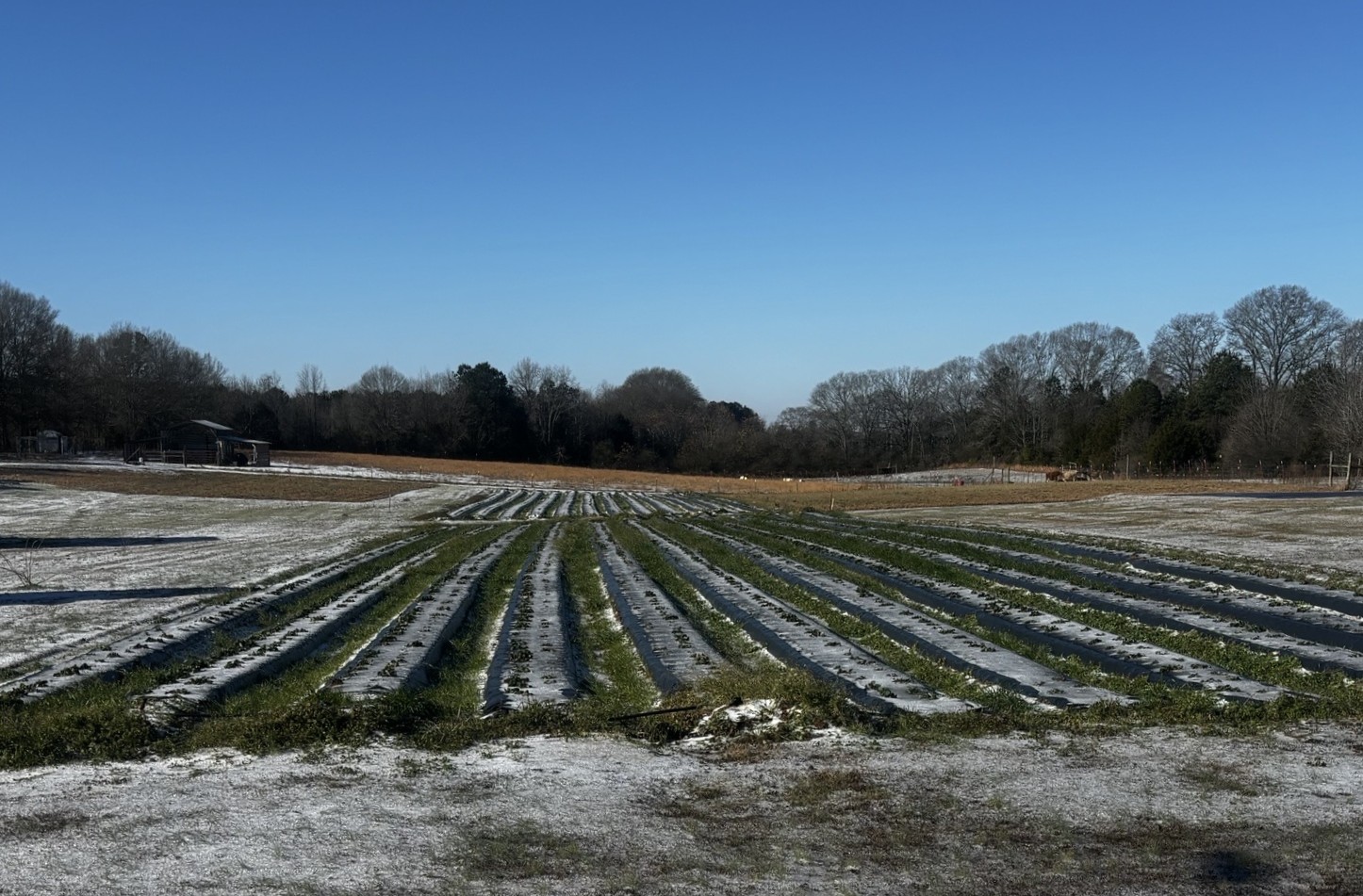
Just a little bit of ice in some fields in Anderson County. (Golden Acres Strawberry Patch).
Samantha Brown, ©2026, Clemson Extension

.75 inches of ice. That ruler didn’t last long, by the way.
Samantha Brown, ©2026, Clemson Extension