
Quick Guide (At-a-Glance)
Affected Plants: Flowering dogwood (Cornus florida), kousa dogwood (Cornus kousa), and hybrids
Primary Disease Types: Powdery mildew, spot anthracnose, dogwood anthracnose, Cercospora leaf spot, Septoria leaf spot
Primary Insect Pests: Dogwood borer, dogwood club-gall midge, scale insects
Primary Causes: Fungal pathogens, insect feeding, environmental stress and unfavorable growing conditions
Most Important Prevention Strategy: Maintain vigorous trees through proper planting, sanitation, pruning, irrigation, and using resistant cultivars when available.
Chemical Control: Fungicides and insecticides may be recommended when cultural controls are insufficient and disease or insect damage warrants treatment.
Flowering dogwood (Cornus florida) is a small, deciduous ornamental tree native throughout the eastern United States. Although it is well adapted to South Carolina landscapes, dogwoods can be affected by a variety of diseases and insect pests.
Maintaining healthy trees through recommended cultural practices is the first and most effective step for preventing many dogwood problems.
For information on selecting, planting, and maintaining healthy dogwood trees, see Dogwood (HGIC 1010).
Dogwood Diseases: Powdery Mildew on Dogwood
Powdery mildew is one of the most common fungal diseases affecting flowering dogwood (Cornus florida) and primarily infects leaves and tender new shoots.
Cause
Powdery mildew is caused by the fungus Erysiphe pulchra (formerly Microsphaera pulchra). The fungus infects leaf surfaces and tender shoots, and its spores are spread by wind to nearby dogwood trees.
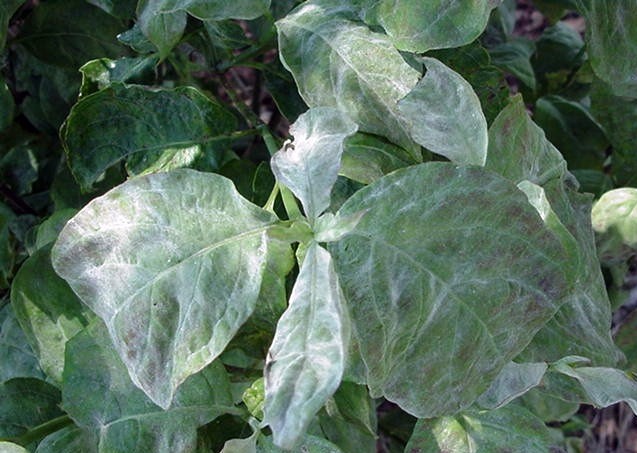
Powdery mildew on dogwood (Cornus florida) leaves.
James Blake, ©2007 HGIC, Clemson Extension
Symptoms
Symptoms may include:
- White, powdery fungal growth on the upper leaf surface
- Infection of tender new shoots
- Marginal leaf scorch
- Dead patches on leaves
- Reddish leaf discoloration
- Yellowing foliage
- Premature leaf drop (defoliation)
Prevention & Treatment
Cultural Controls
Powdery mildew is most common in dense, shaded locations with poor air circulation. Warm, dry days followed by cool, damp nights favor disease development.
To reduce disease pressure:
- Rake and destroy fallen leaves.
- Prune dead and infected twigs and branches.
- Increase air circulation by thinning surrounding vegetation.
- Improve sunlight penetration by removing overhanging branches.
When planting new dogwoods, consider disease-resistant species and cultivars.
Resistant Varieties
Highly resistant flowering dogwood (Cornus florida) cultivars
- ‘Appalachian Blush’
- ‘Appalachian Joy’
- ‘Appalachian Mist’
- ‘Appalachian Snow’
Partially resistant flowering dogwood cultivars
- ‘Cherokee Brave’
- ‘Springtime’
- ‘Pygmy’
Generally resistant kousa dogwood (Cornus kousa) cultivars
- ‘Milky Way’
- ‘Milky Way Select’
- ‘National’
Generally resistant Cornus florida × Cornus kousa hybrids
- ‘Aurora’
- ‘Constellation’
- ‘Celestial’
- ‘Stellar Pink’
Highly susceptible
- Red-twig dogwood (Cornus sericea)
Chemical Control
Most powdery mildew infections on landscape trees develop late in the summer and usually cause little long-term damage. However, infections that begin early in the growing season can be severe and may warrant fungicide treatment.
Before applying a fungicide, determine whether the affected dogwood is a valuable landscape specimen and whether spray equipment can provide thorough coverage of the foliage. Fungicides are most effective when applications begin as soon as symptoms are detected.
Recommended active ingredients include:
Highly effective:
- Myclobutanil
- Propiconazole
Provides control:
- Triadimefon
- Thiophanate-methyl
- Sulfur
- Copper-based fungicides
Myclobutanil, propiconazole, triadimefon, and thiophanate-methyl are foliar systemic fungicides and may require fewer applications than sulfur- or copper-based fungicides. To help reduce the risk of fungicide resistance, alternate fungicides with different modes of action whenever possible.
See Table 1 for example products.
Follow all label directions, including application intervals.
Dogwood Diseases: Spot Anthracnose on Dogwood
Spot anthracnose is a common fungal disease of flowering dogwood (Cornus florida) that primarily affects flower bracts, leaves, young shoots, and fruit during wet spring weather.
Cause
Spot anthracnose is caused by the fungus Elsinoe corni. The disease commonly infects flower bracts first, followed by leaves, young shoots, and fruit. The fungus survives from year to year on infected twigs, fruit, and other plant tissues. Disease development is favored by wet spring weather, frequent rainfall, or extended periods of high humidity. If dry weather follows bud swell and bloom, flower bracts may show few or no symptoms, and leaf infections are often less severe.
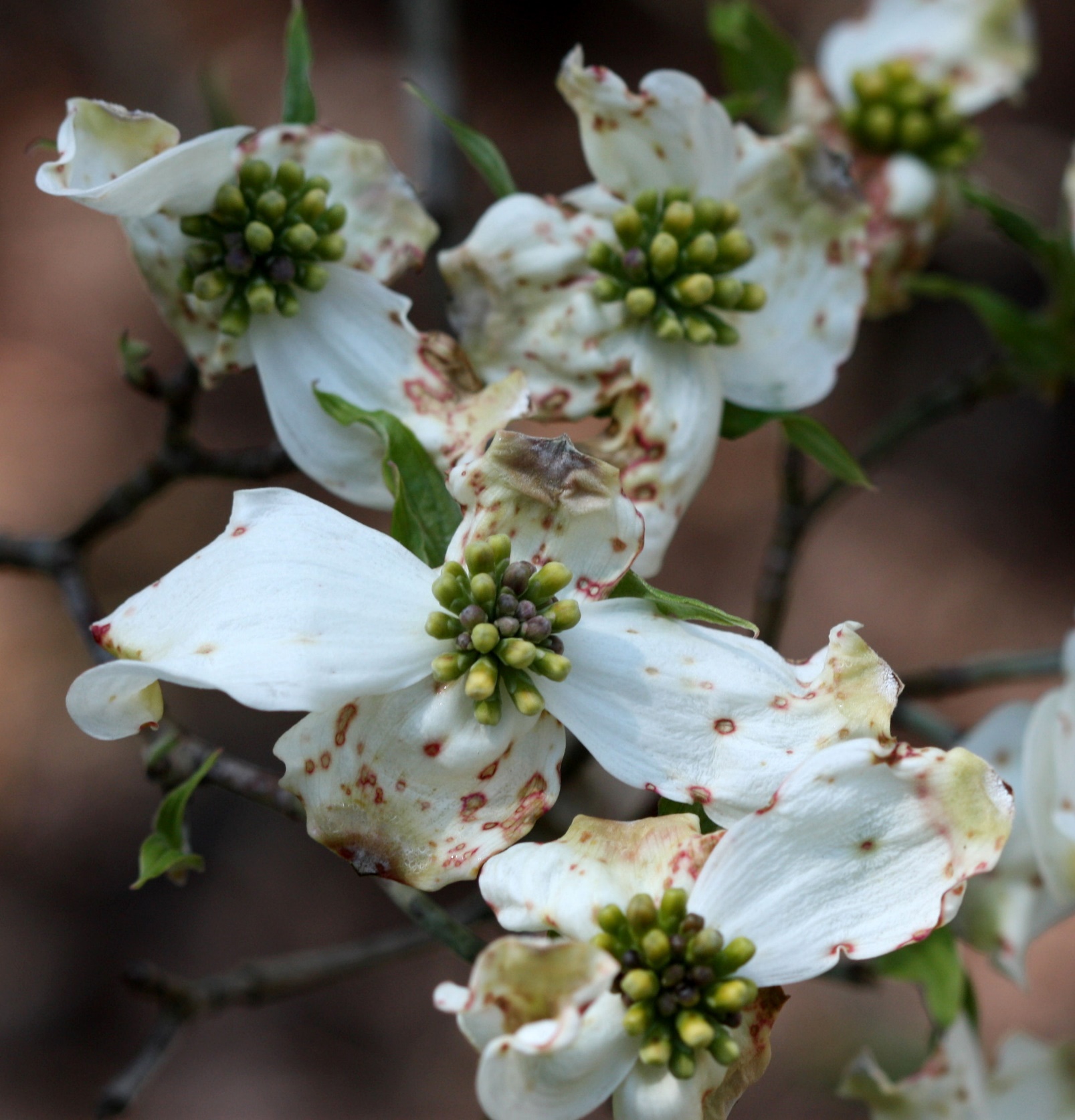
Spot anthracnose on dogwood (Cornus florida) petals.
Joey Williamson, ©2009 HGIC, Clemson Extension
Symptoms
Symptoms may include:
- Small tan spots (about ⅛ inch) with reddish-purple borders
- Spots appearing first on flower bracts
- Wrinkled or distorted flower bracts and leaves
- Individual spots that merge into larger lesions
- Centers of older lesions that may drop out, creating a shot-hole appearance
Prevention & Treatment
Cultural Controls
Although spot anthracnose often causes little lasting damage, severe or repeated infections can weaken a tree over time.
To reduce disease pressure:
- Thin the canopy to improve air circulation.
- Promote faster drying of foliage.
- Plant disease-tolerant or resistant cultivars when establishing new landscapes.
Resistant Varieties
Kousa dogwood (Cornus kousa)
- ‘National’
- ‘Milky Way Select’
Flowering dogwood (C. florida)
- ‘Cherokee Brave’
- ‘Cherokee Chief’
- ‘Cherokee Princess’
- ‘Springtime’
- ‘Welch’s Bay Beauty’
Rutgers Hybrid
- ‘Stellar Pink’
Highly susceptible cultivars
- Cornus florida ‘Rainbow’
- Cornus florida ‘Cherokee Daybreak’
Chemical Control
If spotting becomes severe, fungicides may be applied beginning at bud break and repeated every 10 to 14 days until leaves are fully expanded. Early-season applications provide the greatest protection for newly developing foliage.
Recommended active ingredients include:
- Chlorothalonil
- Copper-based fungicides
- Mancozeb
- Propiconazole
- Thiophanate-methyl
These fungicides are also labeled for control of dogwood anthracnose (Discula anthracnose or canker anthracnose). See Table 1 for example products and always follow all label directions.
Dogwood Diseases: Dogwood Anthracnose on Dogwood
Dogwood anthracnose, also called Discula anthracnose, is a serious fungal disease of dogwood that can cause branch dieback and tree death.
Cause
Dogwood anthracnose is caused by the fungus Discula destructiva. In South Carolina, the disease is most severe at elevations above 2,000 feet, although cases have occurred at lower elevations where dogwoods grow in very cool, moist, shady locations.
Most Cornus species can become infected.
Symptoms
The first symptoms appear in the spring as spots on leaves and flower bracts. Leaf symptoms typically begin in the lower canopy and progress upward through the tree.
Symptoms may include:
- Tan leaf spots with purple edges
- Dry brown leaf margins
- Large leaf blotches
- Blighted, gray, or drooping leaves that remain attached to twigs
- Sunken brown areas (cankers) on the shoots, branches, and trunk
- Branch or twig death when cankers girdle affected tissue
- Numerous epicormic shoots, or “water sprouts,” on the lower trunk and limbs
Multiple cankers can girdle the main trunk and eventually kill the tree. Water sprouts that develop on affected trees can also become infected.
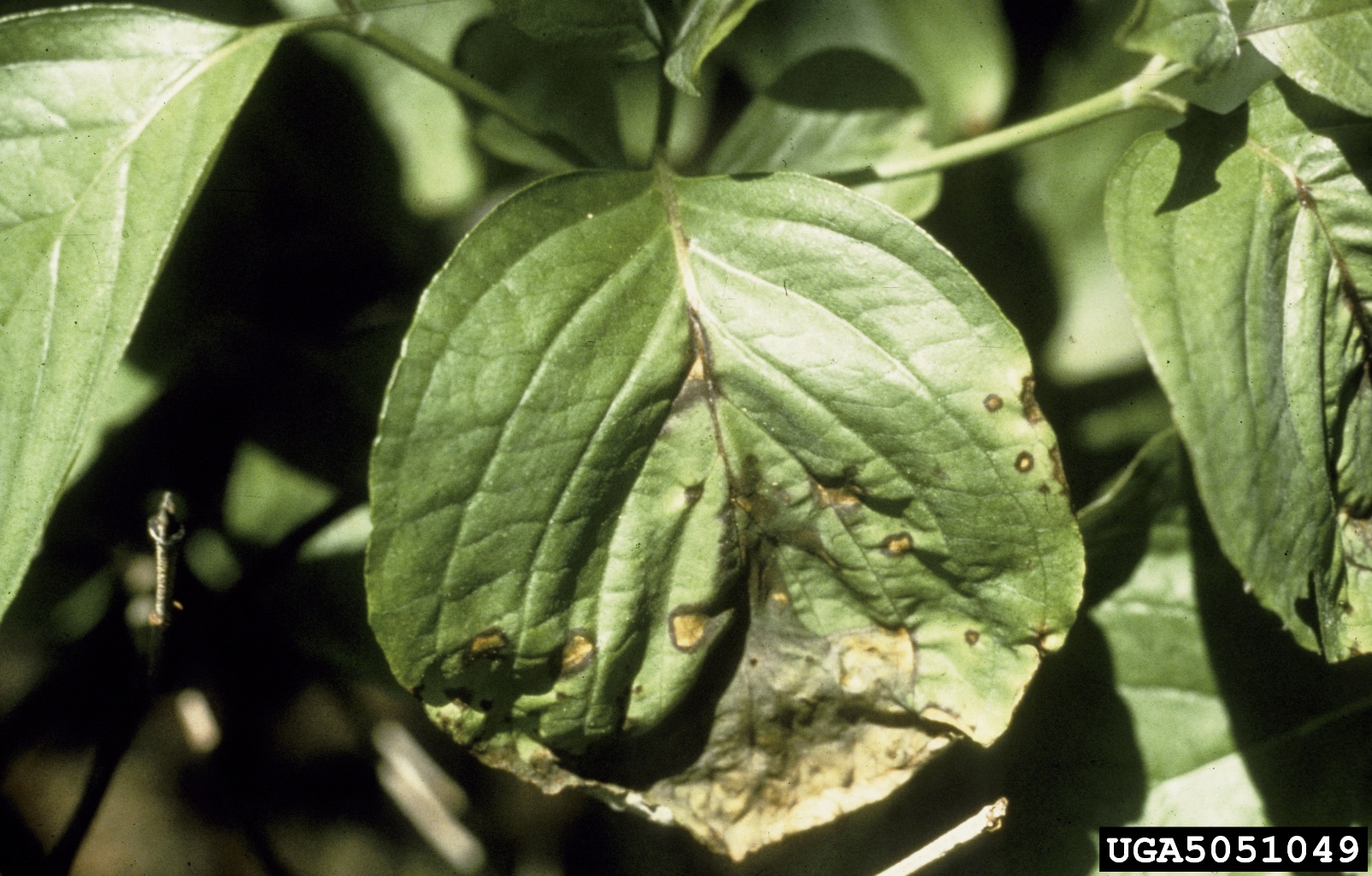
Spot anthracnose on dogwood (Cornus florida) petals.
Joey Williamson, ©2009 HGIC, Clemson Extension
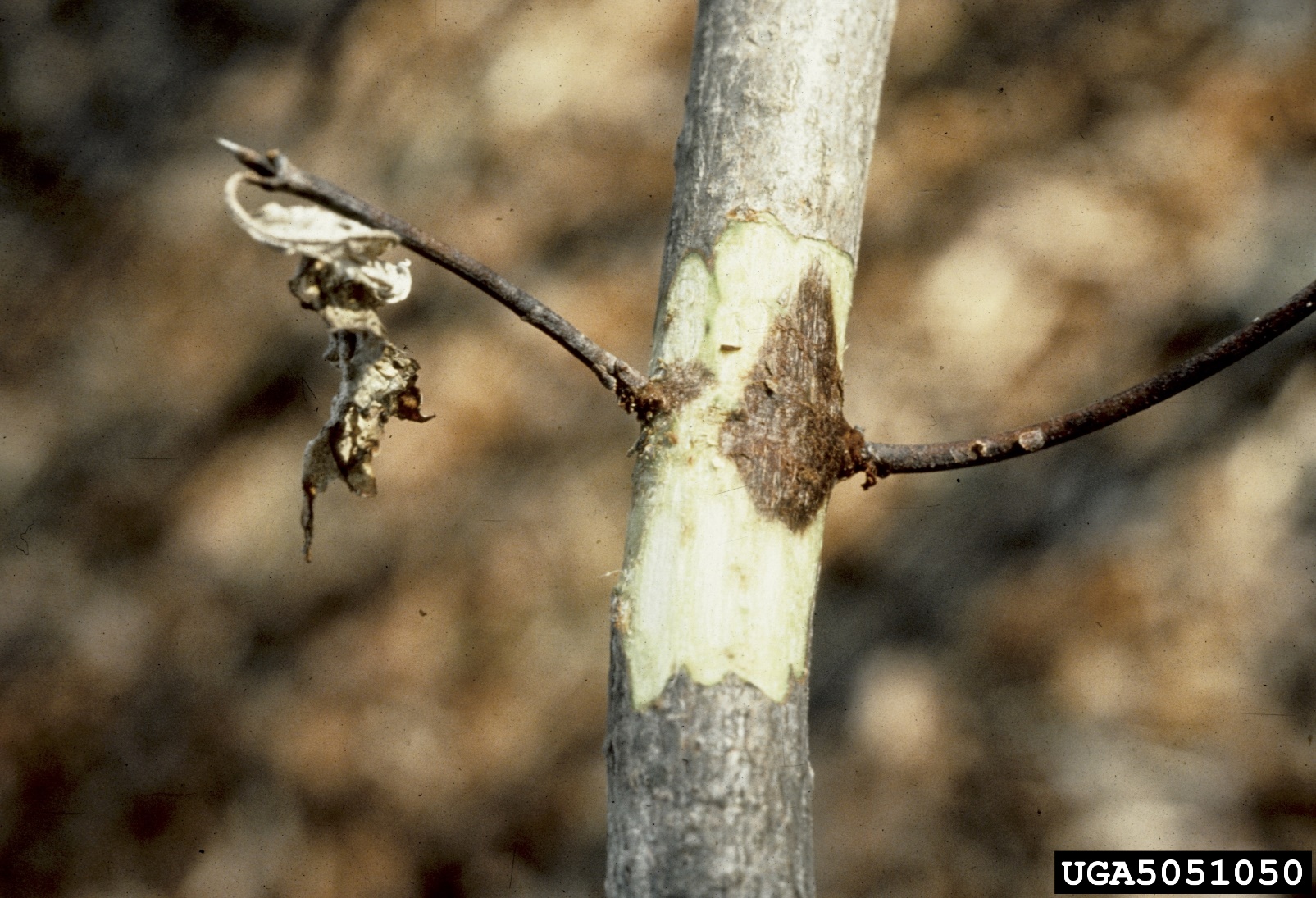
Canker on dogwood (Cornus florida) caused by Discula anthracnose (bark removed).
Joseph O’Brien, USDA Forest Service, www.ipmimages.org
Prevention & Treatment
A combination of cultural and chemical measures is necessary to control this dogwood anthracnose. Effective control may be possible when the disease is detected before branch dieback begins.
Cultural Controls
During hot, dry summer weather:
- Prune and dispose of dead or cankered twigs and limbs.
- Remove all “water sprouts.”
- Rake and remove fallen leaves.
- Remove dead leaves that remain attached to the tree.
- Improve air circulation and light penetration by removing understory plants and crowding vegetation.
Avoid excessive applications of nitrogen fertilizer, as they can encourage succulent new shoots that are susceptible to infection. Maintain healthy dogwoods by following recommended cultural practices.
Do not transplant dogwood seedlings from the wooded areas because these plants may harbor the fungus.
Resistant Varieties
Planting resistant species and cultivars is an excellent option for managing this disease in the landscape.
Kousa dogwood (Cornus kousa)
Kousa dogwood (Cornus kousa) is generally resistant to dogwood anthracnose and is a better choice for replanting where dogwoods have died from the disease.
Rutgers Hybrids (Cornus kousa × Cornus florida hybrids)
- ‘Aurora’
- ‘Celestial’
- ‘Constellation’
- ‘Galaxy’
- ‘Ruth Ellen’
- ‘Star Dust’
- ‘Stellar Pink’
Flowering dogwood (Cornus florida)
- ‘Appalachian Spring’
Chemical Control
Fungicide applications to protect the new leaves and shoots should begin at bud break in early spring. Maintain a protective fungicide covering while new growth is present.
The fungicides recommended for spot anthracnose can also help control dogwood anthracnose.
Recommended active ingredients include:
- Chlorothalonil
- Copper-based fungicides
- Mancozeb
- Propiconazole
- Thiophanate-methyl
See Table 1 for example products. Always apply pesticides according to label directions.
Dogwood Diseases: Cercospora & Septoria Leaf Spots on Dogwood
Cercospora and Septoria leaf spots are fungal diseases of dogwood that occur most commonly during wet summer months and can cause premature leaf drop when infections are severe.
Cause
Cercospora leaf spot is caused by the fungi Cercospora cornicola, while Septoria species cause Septoria leaf spot. These diseases most commonly occur during the wet summer weather.
The fungi survive the winter in infected leaves.
Symptoms
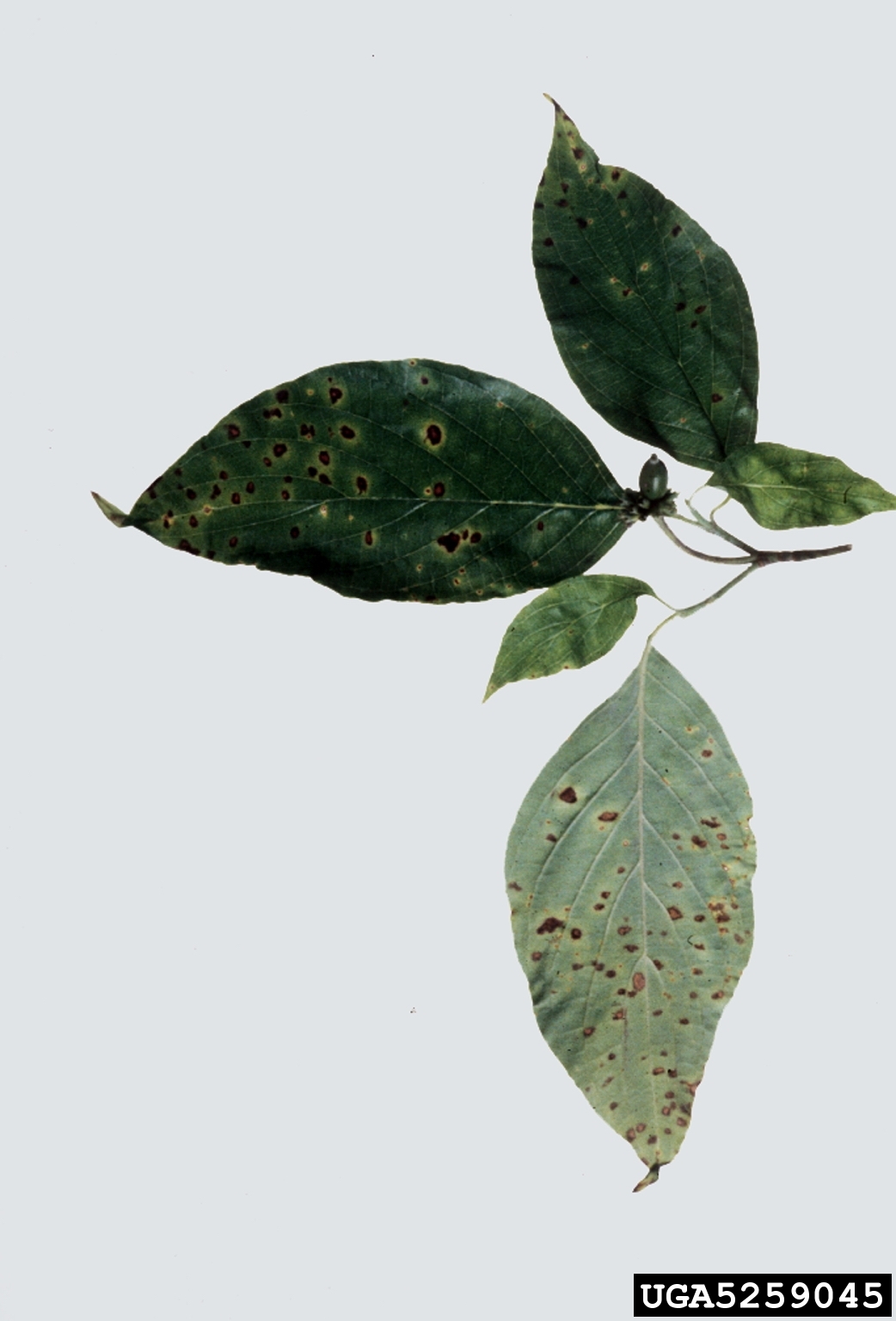
Septoria leaf spots on dogwood (Cornus florida).
Division of Plant Industry Archive, Florida Department of Agriculture and Consumer Services, www.ipmimages.org
Cercospora and Septoria leaf spots are similar in size and appearance. Both produce small spots, approximately ⅛ to ¼ inch, that are angular to irregularly shaped and usually bordered by leaf veins.
Cercospora leaf spot symptoms include:
- Tan-brown spots
- Diffuse borders around affected areas
Septoria leaf spot symptoms include:
- Dark brown-purple spots
- Light brown or gray centers that develop as spots mature
- Dark borders surrounding the centers
Leaf spots may become so numerous that they cover much of the foliage by late summer. Heavily spotted leaves may drop prematurely.
Light leaf spotting usually has little effect on tree health. However, repeated years of early leaf drop can weaken the tree.
Prevention & Treatment
Cultural Controls
Sanitation helps reduce sources of the fungi that can survive from one growing season to the next.
- Clean up infected leaves on the ground.
- Remove infected leaves remaining on the tree when possible.
- Dispose of infected leaves.
Chemical Control
Fungicide treatment may be used for severe infections of Cercospora or Septoria leaf spots.
Recommended active ingredients include:
- Chlorothalonil
- Mancozeb
- Thiophanate-methyl
See Table 1 for example products. Always follow pesticide label directions.
Dogwood Insect Pests
Although insects often damage dogwood trees, the damage is usually minor. If the tree is planted in full sun with limited water or under other stress, the damage can be serious. Most insect damage occurs on the trunk and branches of dogwoods. Commonly occurring insect pests of dogwood include the dogwood borer, dogwood club-gall midge, and scales.
Dogwood Insect Pests: Dogwood Borer on Dogwood
Dogwood borer (Synanthedon scitula) is an insect pest of dogwood that feeds beneath the bark and can seriously damage young or stressed trees.
Identification & Damage
The dogwood borer (Synanthedon scitula) is the larva (immature form) of a clearwing moth that resembles a wasp. The borer is off-white with a reddish-brown head and about 5/8 inch long at maturity.
The female moth lays eggs on the bark. Borers can become established only when they find a wound or opening in the bark. Once inside the tree, they feed just beneath the bark, consuming the inner bark and cambium. If the cambium is destroyed, individual branches or the entire tree will die.
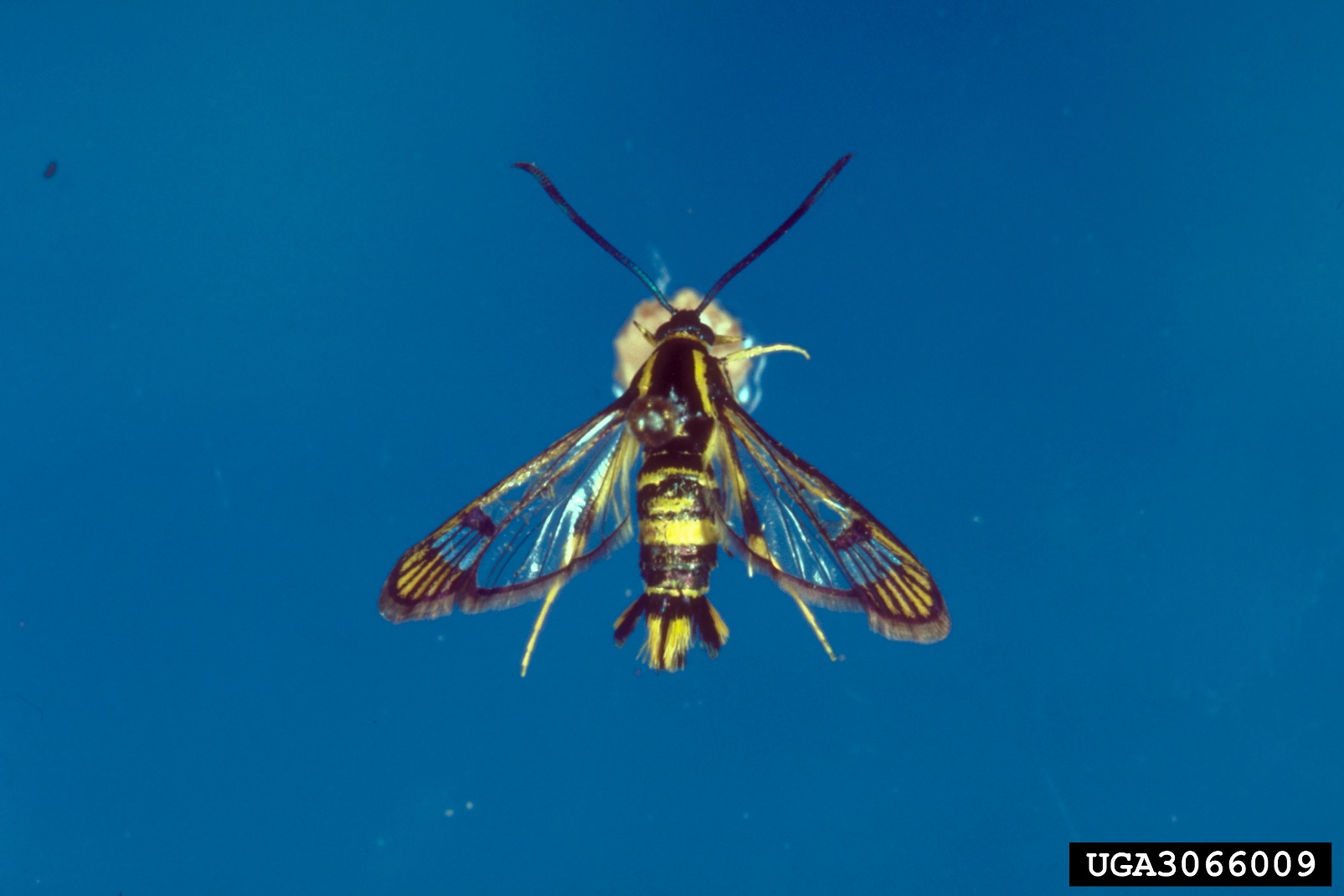
Dogwood borer adult.
James Solomon, USDA Forest Service, www.ipmimages.org
Signs of dogwood borer infestation include:
- Leaves that turn red and drop early
- Bark that sloughs off around holes in the trunk or branches
- Brown sawdust-like borer frass (insect waste) near or below the holes in late summer
- Reduced vigor in established trees
- Rough, knotty areas on the trunk and large branches
Infested young trees can be killed in one to two seasons.
Prevention & Control
Cultural Controls
Keeping dogwoods healthy and preventing bark injuries are the best ways to reduce dogwood borer problems.
- Fertilize, water, and mulch trees appropriately.
- Protect trunks and branches from unnecessary wounding.
- Prevent injury from lawnmowers and string trimmers.
Chemical Control
Permethrin is labeled for homeowner use against dogwood borer. Because adults may be present from late April through July, several applications may be needed for good control.
- Begin treatment in early May.
- Repeat four times at three-week intervals.
- Thoroughly spray the trunk and major branches.
- Thoroughly spray wounds in the bark.
See Table 1 for example products containing permethrin. Read and follow all pesticide label instructions and precautions.
Dogwood Insect Pests: Dogwood Club-Gall Midge on Dogwood
Dogwood club-gall midge (Resseliella clavula) is a small fly whose larvae feed within dogwood shoots, causing distinctive club- or spindle-shaped galls.
Identification & Damage
The dogwood club-gall midge (Resseliella clavula) is a small fly, about 1/16-inch long. Females lay eggs in tiny terminal leaves of dogwood. After hatching, the larvae enter the shoots and begin feeding.
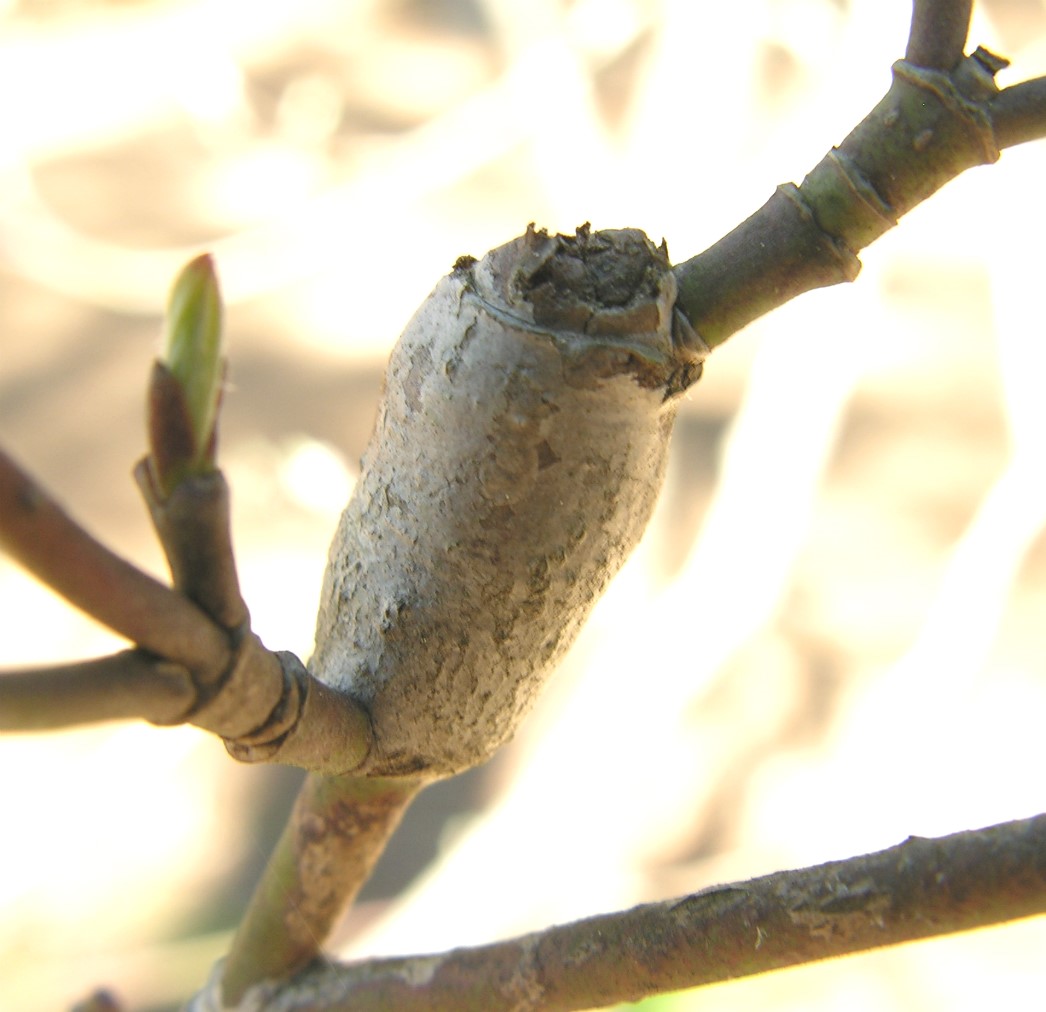
Damage to dogwood (Cornus florida) caused by dogwood club-gall midge.
Joey Williamson, ©2013 HGIC, Clemson Extension
In response to the feeding and growth of the larva, a ½- to 1-inch-long club- or spindle-shaped tubular swelling (gall) develops at the shoot tip or along the stem.
Signs and symptoms of dogwood club-gall midge include:
- Wilted, deformed leaves
- Club- or spindle-shaped galls on shoots
- Twig dieback beyond the gall
- Exit holes in galls after larvae emerge in early fall
After leaving the galls, larvae drop to the ground, where they survive the winter. Light infestations are not serious, but heavy infestations can stunt a tree.
Prevention & Control
Cultural Controls
- Inspect dogwoods for shoots with characteristic galls.
- Prune twigs containing galls.
- Burn the removed twigs before larvae make exit holes and leave the galls.
Dogwood Insect Pests: Scale Insects on Dogwood
Several species of scale insects can infest dogwood, feeding on plant sap and potentially causing yellowing, stunted growth, or branch dieback when infestations are heavy.
Identification & Damage
Scales insects are unusual in appearance. They are small and immobile, with no visible legs, and may occur on dogwood leaves or stems. Their appearance varies depending on species, age, and sex.
Scale insects typically look like small brownish, grayish, or blackish bumps. They feed by piercing leaves or stems with their mouthparts and sucking plant sap.
Heavy infestations may cause:
- Leaf yellowing
- Stunted growth
- Branch dieback
Adult scales are relatively protected from insecticides by their waxy covering. However, the immature stages, called crawlers, are susceptible to insecticide treatments.
Prevention & Control
Cultural & Monitoring Controls
Avoid using insecticides unless the plant is very valuable and in danger from the scale. Insecticides can kill the naturally occurring enemies of scale insects.
If insecticide treatment is being considered, monitor for crawler emergence using:
- Sticky cards
- Double-faced tape wrapped around a branch
- An infested shoot or leaf placed in a plastic bag to observe crawler movement
Crawler activity often coincides with the flush of new plant growth in the spring. However, some scale species may have overlapping generations with an extended crawler emergence period, particularly along the coast.
Chemical Control
Horticultural Oil
For heavy infestations, apply horticultural oil in spring to smother adults and eggs.
- Apply horticultural oil before new growth begins.
- Apply again after flowering.
- Thoroughly coat the branches.
Horticultural oil is a safer alternative to insecticides when spraying upward into a large tree. See Table 1 for example horticultural oil products.
Insecticides
If insecticides are necessary, apply them when crawlers are observed. Active ingredients labeled for homeowner control of scale crawlers on dogwood include:
- Bifenthrin
- Cyfluthrin
- Cyhalothrin
- Malathion
- Permethrin
Repeat treatments in 10 days. See Table 1 for example products, and read and follow all pesticide label instructions and precautions.
Other Dogwood Problems
Poor leaf color, unhealthy plant growth, twig dieback, and even tree death are typical symptoms of distressed dogwoods. A number of factors other than insects or diseases can contribute to the decline of dogwoods in the landscape, especially mower injury, over-fertilization, and poor growing conditions.
Other Dogwood Problems: Leaf Scorch on Dogwood
Leaf scorch is an environmental problem of dogwood caused by excessively dry conditions and is especially common on drought-stressed trees.
Cause
Leaf scorch develops when environmental conditions are too dry. Dogwoods have a very shallow root system and are very susceptible to drought stress, especially newly planted trees in full sun.
Although leaf scorch can resemble a disease, it is not caused by a plant pathogen.
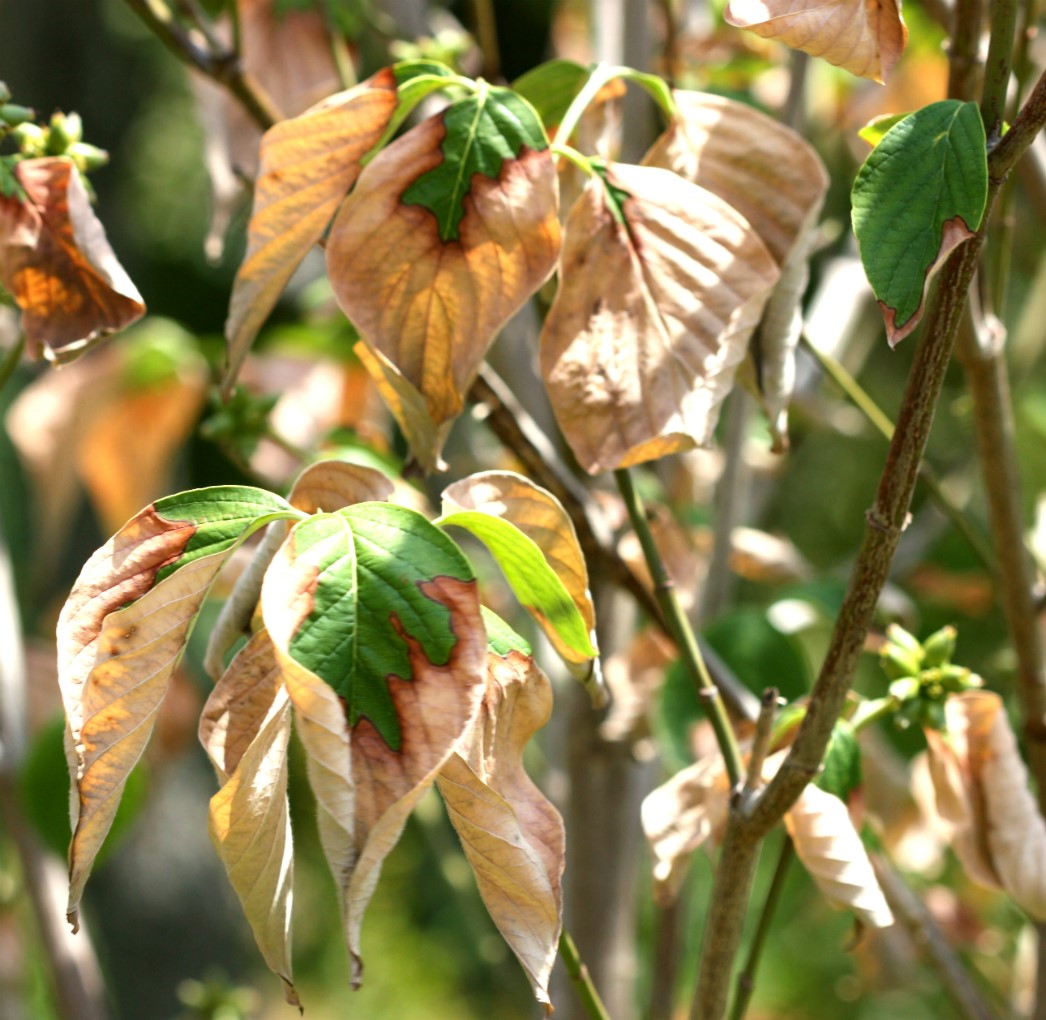
Leaf scorch caused by drought stress on dogwood (Cornus florida).
Joey Williamson, ©2014 HGIC, Clemson Extension
Symptoms
Symptoms of leaf scorch include:
- Dry, browning leaf edges
- Browning and drying of tissue between leaf veins on severely stressed trees
- Premature leaf drop when drought stress is severe
Prevention & Treatment
Cultural Controls
Providing adequate water during dry periods is the key to preventing leaf scorch.
- Water dogwoods as needed during dry spells.
- Provide adequate water during the first summer and fall after transplanting.
- Apply a 3- to 4-inch layer of mulch extending beyond the tree canopy.
- Do not grow grass over the dogwood root system.
Fungicides and Insecticides for Dogwood Diseases and Insect Pests (Table 1)
Fungicides
Active Ingredient |
Example Product Names |
| Chlorothalonil | Bonide Fung-onil Multi-purpose Fungicide Concentrate |
| Bonide Fung-onil Multi-purpose Fungicide Ready to Use | |
| Ferti-lome Broad Spectrum Landscape & Garden Fungicide | |
| GardenTech Daconil Fungicide Concentrate | |
| GardenTech Daconil Fungicide Ready-to-Use | |
| Hi-Yield Vegetable, Flower, Fruit And Ornamental Fungicide | |
| Ortho MAX Garden Disease Control Concentrate | |
| Southern Ag Liquid Ornamental and Vegetable Flowable Fungicide | |
| Tiger Brand Daconil | |
| Copper-based Fungicides | Bonide Captain Jack’s Liquid Copper Fungicide |
| Bonide Copper Fungicide Spray or Dust Ready to Use | |
| Camelot O Fungicide/ Bactericide | |
| Monterey Copper Fungicide Garden Spray Liqui-Cop | |
| Natural Guard by ferti-lome Copper Soap Fungicide Concentrate | |
| Natural Guard by ferti-lome Copper Soap Fungicide Ready to Use | |
| Southern Ag Liquid Copper Fungicide | |
| Mancozeb | Bonide Mancozeb Flowable with Zinc Concentrate |
| Southern Ag Dithane M-45 | |
| Myclobutanil | Ferti-lome F-Stop Lawn & Garden Fungicide |
| Monterey Fungi-Max | |
| Spectracide Immunox Multi-Purpose Fungicide Spray Concentrate For Gardens | |
| Propiconazole | Banner Maxx II Fungicide |
| Bonide Infuse Systemic Disease Control | |
| Bonide Infuse Systemic Disease Control Lawn & Landscape Ready to Spray | |
| Ferti-lome Liquid Systemic Fungicide II | |
| Quali-Pro Propiconazole 14.3 Fungicide | |
| Thiophanate-methyl | Southern Ag Thiomyl Systemic Fungicide |
Insecticides
Active Ingredient |
Example Product Names |
| Bifenthrin | Bifen I/T |
| Bonide Eight Insect Control Flower & Vegetable Above & Below Soil Insect Granules | |
| Hi-Yield Bug Blaster Bifenthrin 2.4 Ready to Spray | |
| Hi-Yield Bug Blaster II Bifenthrin 2.4 Ready to Spray | |
| Hi-Yield Vegetable & Ornamental Insect Control Granules | |
| Martin’s FLEE Ready to Use Yard Spray | |
| Monterey Mite & Insect Control | |
| Monterey Mosquito Control | |
| Ortho Bug B Gon Insect Killer for Lawns & Gardens1 | |
| Ortho BugClear Insect Killer for Lawns & Landscapes | |
| Ortho Outdoor Insect Killer Concentrate | |
| Talstar P Professional Insecticide | |
| Up-Star Gold Insecticide | |
| Cyfluthrin | BioAdvanced Science-Based Solutions 24 Hour Lawn Insect Killer Ready-to-Spray |
| BioAdvanced Science-Based Solutions Complete Brand Insect Killer for Soil & Turf Ready-to-Spray I | |
| BioAdvanced Science-Based Solutions Insect Killer for Lawns Ready-to-Spray | |
| BioAdvanced Science-Based Solutions Rose & Flower Insect Killer Ready-to-Use | |
| Cyhalothrin | Bonide Eight Insect Control Garden & Home II Ready to Use |
| Cutter Backyard Bug Control Spray Concentrate | |
| Cyzmic CS Controlled Release Insecticide | |
| Martin’s Cyonara Lawn & Garden Insect Control | |
| Martin’s Cyonara Lawn & Garden Insect Control Ready-to-Spray | |
| Spectracide Triazicide Insect Killer for Lawns & Landscapes | |
| Horticultural Oil | Bonide All Seasons Horticulture Spray Oil Ready-to-Use |
| Bonide All Seasons Horticulture & Dormant Spray Oil Ready-to-Spray | |
| Ferti-lome Horticultural Oil Spray | |
| Monterey Horticultural Oil Concentrate | |
| Monterey Horticultural Oil RTU | |
| Safer Brand Horticultural & Dormant Spray Oil Concentrate | |
| Southern Ag Parafine Horticultural Oil | |
| Summit Year-Round Spray Oil | |
| Malathion | Bonide Malathion 50% Insect Control |
| Gordon’s Malathion 50% Spray | |
| Hi-Yield 55% Malathion Insect Spray | |
| Martin’s Malathion 57% | |
| Ortho Max Malathion Insect Spray Concentrate | |
| Southern Ag Malathion 50% EC | |
| Spectracide Malathion Insect Spray Concentrate | |
| Tiger Brand 50% Malathion | |
| Permethrin | Bonide Eight Insect Control Vegetable, Fruit, & Flower Concentrate |
| Bonide Eight Yard & Garden Ready to Spray | |
| Hi-Yield 38 Plus Turf, Termite & Ornamental Insect Control | |
| Hi-Yield Lawn Garden Pet & Farm Insect Control | |
| Southern Ag Permetrol Lawn & Garden Insecticide | |
| Tiger Brand Super 10 Brand |
Abbreviations
RTS = Ready to Spray
RTU = Ready to Use
Pesticide Disclaimer
Pesticide products and registrations may change over time. Always read and follow the pesticide label, and confirm that the product is currently registered and labeled for the intended plant and target pest or disease before use.
Pollinator and Pesticide Safety
Pollinating insects, including honey bees and bumblebees, can be adversely affected by pesticide use. Avoid spray pesticides, including both insecticides and fungicides, as well as soil-applied systemic insecticides, unless they are necessary.
When pesticide treatment is necessary, apply sprays late in the evening to reduce the direct exposure to pollinating insects. When appropriate, try less-toxic alternatives first for managing insect pests and diseases.
Less-Toxic Options for Insect Pests
Depending on the pest, less-toxic products that may help control small insect pests and mites on garden and landscape plants include:
- Bacillus thuringiensis (Bt)
- Botanical oils
- Horticultural oil
- Insecticidal soap
- Neem oil extract
- Spinosad
Neem oil extract or botanical oil sprays may also reduce plant damage by repelling many insect pests.
Cultural Practices for Disease Management
Cultural practices can help prevent or reduce plant diseases. Recommended practices include:
- Pre-plant soil improvement
- Proper plant spacing
- Crop rotation
- Applying mulch
- Applying lime and fertilizer based on soil test results
- Avoiding overhead irrigation
- Avoiding frequent watering of established plants
Less-Toxic Options for Plant Diseases
Less-toxic fungicide options include products containing
- Sulfur
- Copper soap
- Biological controls containing Bacillus subtilis
Always read and follow the label directions for every pesticide product.
Pesticides are updated annually. The last updates were made on 8/26 by N. Jordan Franklin.
Originally published 09/99


