
Quick Guide (At-a-Glance)
Affected Plants:
- Many annual and perennial flowers, including:
- African violet
- Amaryllis
- Begonia
- Calendula
- Camellia
- Dahlias
- Delphinium
- Geranium
- Hyacinth
- Impatiens
- Iris
- Larkspur
- Peony
- Snapdragon
- Fruits and berries, including:
- Apples
- Blackberries
- Blueberries
- Grapes
- Peaches
- Pears
- Plums
- Raspberries
- Strawberries
- Vegetables, including:
- Beans
- Tomatoes
Primary Disease Types: Gray mold (Botrytis blight) caused by the fungus Botrytis cinerea.
Primary Causes:
- Cool, damp weather
- Infection of aging or weakened plant tissues
- Spent flowers
- Leaves
- Overripe fruit
- Spread through wind and splashing water
Most Important Prevention Strategy:
- Good sanitation and cultural practices, including:
- Removing infected plant debris
- Avoiding overhead watering
- Improving air circulation
Chemical Control:
- Fungicides: chlorothalonil, captan, copper fungicides, thiophanate-methyl, or neem oil
Gray Mold (Botrytis Blight) on Flowers, Fruits, and Vegetables
Cause
Botrytis blight or “gray mold” is a widely distributed disease caused by the fungus Botrytis cinerea. It can infect some vegetables, soft fruits, flowers, trees, and shrubs, especially when conditions are cool and damp.
The fungus usually occurs on plant debris or weak plant tissue, such as old flowers, leaves, and overripe fruit. It can be very destructive, as it spreads quickly and rots healthy plant tissue.
Cool, damp weather favors the development of gray mold infections. The fungus commonly infects stressed, aging, or inactive plant tissues.
Symptoms
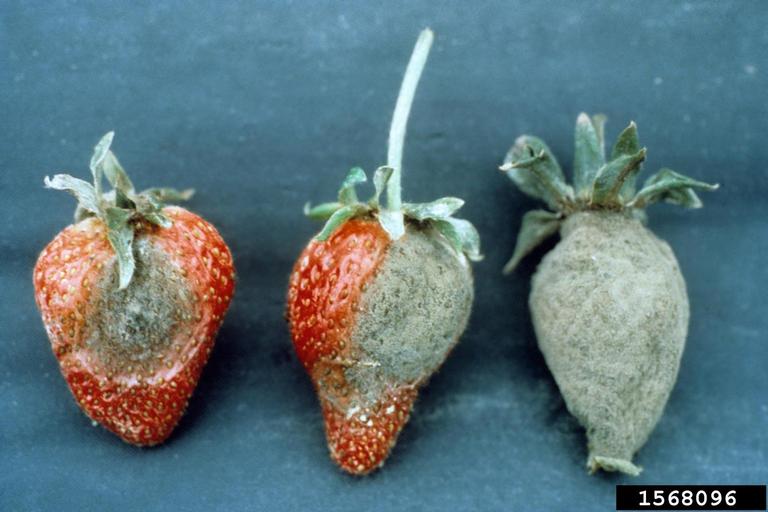
Gray mold (Botrytis cinerea) on harvested strawberries.
Edward Sikora, Auburn University, Bugwood.org
Gray mold can cause different symptoms in different plant species. Typically, as its name suggests, gray mold causes a gray, fuzzy coating on aging flower blossoms and soft, ripe fruits.
A cloud of grayish-white spores may be noticed when infected leaves or flowers are picked.
Infection usually begins as brown to gray circular spots that later become fuzzy when the fungus produces gray masses of spores.
Ripe strawberries or raspberries left too long in the refrigerator often develop gray mold on their surfaces.
The disease can cause spotting and decay of flowers, leaves, fruits, and berries.
On some plants, such as roses, it can cause slightly sunken areas called cankers on the stems.
Corms and bulbs of perennials and annuals may rot when infected with gray mold.
Plants Commonly Affected by Gray Mold (Botrytis Blight)
Gray mold (Botrytis blight) can infect a wide range of ornamental plants, fruits, and vegetables, particularly when weather conditions are cool and damp.
Gray mold affects a wide range of annual and perennial plants. Flowers with thick succulent petals, such as begonias, peonies, and geraniums, are particularly susceptible.
Ornamental Plants Commonly Affected by Gray Mold
The disease also commonly affects:
- African violet
- Amaryllis
- Bulbous iris
- Calendula
- Camellia
- Dahlias
- Delphinium
- Hyacinth
- Impatiens
- Larkspur
- Snapdragon
Fruits Commonly Affected by Gray Mold
Many fruits, vegetables, and berries are also easily infected by gray mold, especially after harvest and transport to cool storage. Commonly infected fruits include:
- Apples
- Blackberries
- Blueberries
- Grapes
- Peaches
- Pears
- Plums
- Raspberries
- Strawberries
Vegetables Affected by Gray Mold
In the vegetable garden, gray mold is most commonly observed on:
- Beans
- Tomatoes
Prevention & Treatment of Gray Mold
Cultural Controls
Remember, cool, damp weather favors the development and spread of this disease. Gray mold is not difficult to control using the following cultural methods.
Sanitation
Following good sanitation practices is one of the best ways to reduce the risk of this disease.
- Collect and discard faded flower blossoms and fallen petals.
- In the vegetable garden, remove infected plants immediately after harvest.
Stressed, aging, or inactive plant tissues are easily infected by gray mold, allowing it to become established.
Keep Leaves Dry
Avoid overhead watering and wetting plants, as this fungus is easily spread by splashing water and wind.
Provide Good Air Circulation
- Do not overcrowd plants.
- Use a wide spacing between plants to promote drying.
Gray mold thrives in shaded, crowded plantings and in areas with poor air circulation.
Plant in sites with adequate sunlight.
Maintain Healthy Plants
Follow recommended cultural practices, especially proper fertilization, irrigation, and pruning practices.
Chemical Controls
Chemical control of gray mold using fungicides is rarely needed on most plants.
Fungicides can be applied as a preventive measure before disease develops, especially during periods of high humidity and cool temperatures.
Several fungicides are approved for homeowner use to control gray mold on specific vegetables and flowers.
Always check the label of the fungicide product to determine:
- If it will control gray mold
- If it is labeled for use on the specific plants
- How often the plants should be sprayed
For fruit and vegetable crops, the label will state the pre-harvest interval (the time that must elapse between spraying and harvesting).
The label will also specify the spray interval required before reapplying.
Bedding Plants & Ornamentals
Annual and perennial bedding plants, flowering and foliage plants, and seedlings in beds, flats, or pots may be sprayed with fungicides containing:
- Chlorothalonil
- Copper fungicides
- Neem oil (clarified hydrophobic extract)
- Thiophanate-methyl
However, neem oil is a rather weak fungicide.
Caution is recommended, however, especially with the new bedding plants developed in the past 10 years.
It is best to test the fungicide on a few plants first before treating all of them.
Check the label on the fungicide product for when and how often it should be used for specific plants.
Beans
Snap and green beans infected with gray mold can be sprayed with chlorothalonil-containing fungicides.
In problem areas:
- Start spraying at early bloom
- Continue to apply once a week
Wait at least seven days between the last fungicide application and harvest.
Tomatoes
Tomato plants infected by the gray mold fungus have light tan or gray spots that are covered with a brown mold on the upper leaf surface.
Fungicides for home gardens containing chlorothalonil can be used on most vegetable crops to control gray mold.
Check the product label for the pre-harvest interval.
Fruits & Small Fruits
Gray mold on grapes, blueberries, peaches, nectarines, and plums can be controlled with sprays of captan.
Brambles (blackberries, raspberries, etc.), strawberries, and cherries can be sprayed with either:
- Captan
- Copper fungicides
Important Pesticide Label Guidance
Always check fungicide product labels for:
- The plants that can be sprayed
- The rate of application
It is always best to spray in the late evening to reduce the impact on pollinating insects.
See Table 1 for a listing of brands and products for gray mold control.
Postharvest Treatment
Postharvest rots can be a problem for many fruits and vegetables grown in home gardens.
Mix 1 tablespoon of fresh bleach (sodium hypochlorite 5.25%) in one gallon of water.
- Dip the fruit into the bleach solution
- Rinse the fruit in clean water
- Dry fruit
Change the bleach solution frequently when it gets dirty.
Fungicides for Gray Mold (Botrytis Blight) Control (Table 1)
The following fungicides are labeled for homeowner use to help control gray mold (Botrytis blight) on various plants. Always read and follow all label directions to determine if a product is labeled for the specific plant being treated.
Active Ingredient |
Examples of Brands & Products |
| Captan | Arysta LifeScience Captan 50 Wettable Powder Fungicide Drexel Captan 50W Fungicide Hi-Yield Captan 50W Fungicide Southern Ag Captan Fungicide |
| Chlorothalonil | Bonide Fung-onil Multi-purpose Fungicide Concentrate Bonide Fung-onil Multi-purpose Fungicide Ready to Use Ferti-lome Broad Spectrum Landscape & Garden Fungicide GardenTech Daconil Fungicide Concentrate GardenTech Daconil Fungicide Ready-to-Use Hi-Yield Vegetable, Flower, Fruit And Ornamental Fungicide Ortho MAX Garden Disease Control Concentrate Southern Ag Liquid Ornamental and Vegetable Flowable Fungicide Tiger Brand Daconil |
| Copper Fungicides | Bonide Captain Jack’s Liquid Copper Fungicide Bonide Copper Fungicide Spray or Dust Ready to Use Camelot O Fungicide/Bactericide Espoma Organic Copper Soap Ready-to-Use Fungicide Monterey Copper Fungicide Garden Spray Liqui-Cop Natural Guard by ferti-lome Copper Soap Fungicide Concentrate Natural Guard by ferti-lome Copper Soap Fungicide Ready to Use Southern Ag Liquid Copper Fungicide |
| Neem Oil | Bonide Captain Jack’s Neem Oil Concentrate Bonide Captain Jack’s Neem Oil Ready to Use Bonide Rose Rx 3-in-1 Concentrate Bonide Rose Rx 3-in-1 Ready to Use Espoma Organic Neem Oil 3n1 Fungicide/Miticide/Insecticide Garden Safe Fungicide 3 Garden Safe Fungicide 3 Concentrate Garden Safe Neem Oil Extract Concentrate Monterey 70% Neem Oil Fungicide/Insecticide/Miticide Natria Neem Oil Concentrate Natria Neem Oil Ready-to-Use Natural Guard Brand by ferti-lome Neem Safer Brand Neem Oil Concentrate Fungicide/Miticide/Insecticide Safer Brand Neem Oil RTU Fungicide/Miticide/Insecticide Southern Ag Triple Action Neem Oil |
| Thiophanate-methyl | Southern Ag Thiomyl Systemic Fungicide |
| RTU = Ready to Use (a pre-mixed spray bottle) RTS = Ready to Spray (a hose-end sprayer bottle) |
|
Pesticides are updated annually. The last updates were made on 3/26 by N. Jordan Franklin.
Originally published 05/99


