Quick Guide: Spongy Moth Identification and Impact
Common name: Spongy moth (formerly gypsy moth)
Scientific name: Lymantria dispar
Origin: Europe and Asia
Status: Invasive defoliating insect
Host range: Over 300 species of North American trees and shrubs
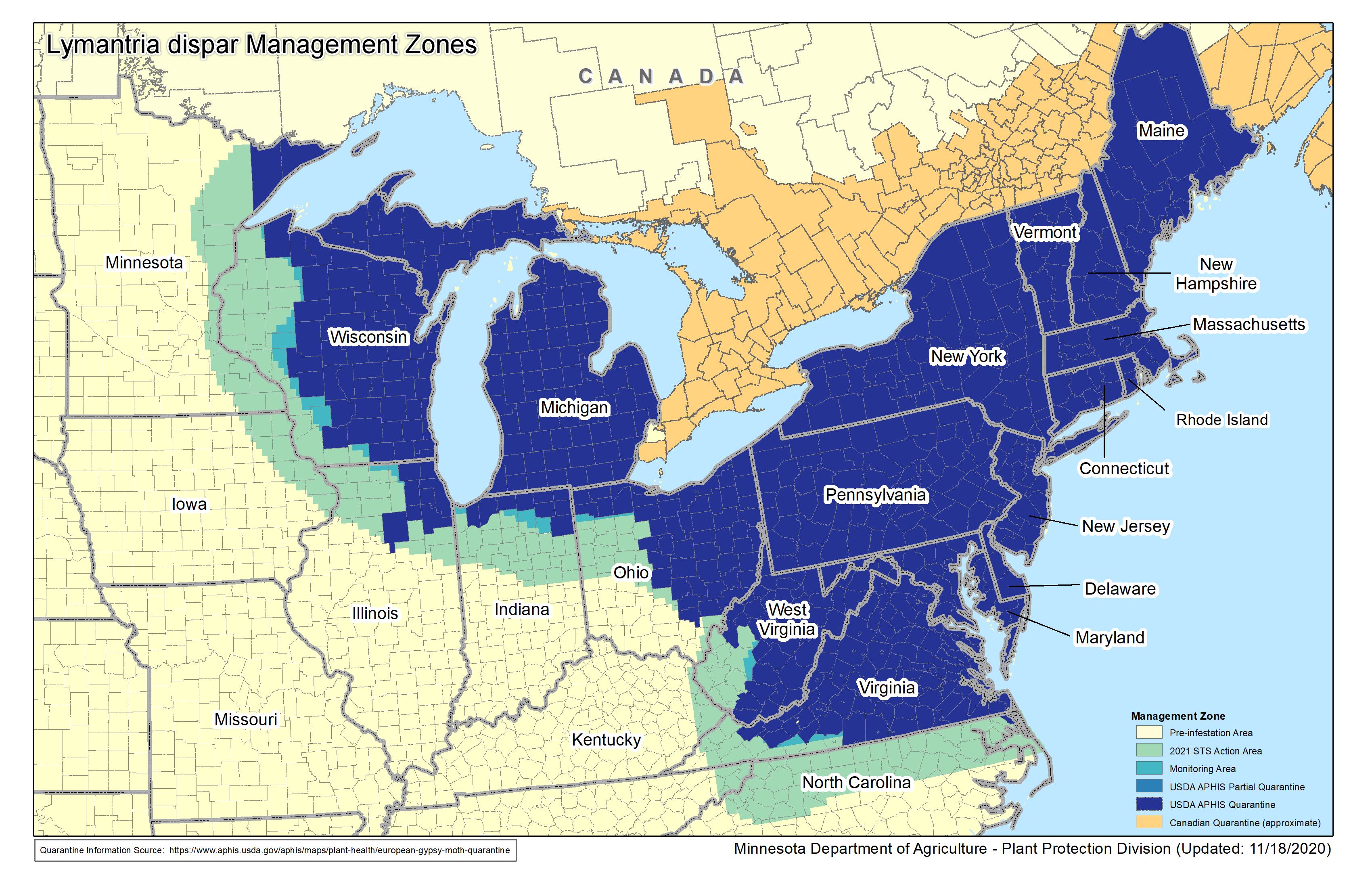
U.S. distribution: Northeastern and Midwestern U.S.; rare in South Carolina but common in parts of North Carolina and Tennessee
Primary damage: Leaf defoliation
Human concern: Caterpillar hairs (setae) may cause skin, nose, throat, and eye irritation
What is the Spongy Moth?
The spongy moth, formerly known as the gypsy moth, is an invasive, defoliating insect native to parts of Europe and Asia that can feed on over 300 species of North American trees and shrubs.
How Did Spongy Moth Get to the United States?
First brought to the US in the late 1860s by an amateur entomologist with an interest in using the silk from spongy moth caterpillars for silk production, it escaped captivity near his home in Massachusetts.
Spongy Moth Distribution
Since then, it has spread throughout the northeastern and midwestern U.S. and parts of Canada. While rarely captured in South Carolina, it is frequently captured in traps or established in parts of North Carolina and Tennessee.
Spongy Moth Life Cycle
Spongy moths have one generation per year.
Egg stage (summer through winter): Egg masses, which typically contain 100 to 600 eggs, are laid by females in the summer and are present throughout the fall and winter.
Caterpillar stage (spring): In the spring, eggs hatch into caterpillars, which feed on leaves for 6 to 8 weeks and grow up to 2½ inches long.
Pupal stage (early summer): Caterpillars pupate in early summer.
Adult stage (mid-summer): Adults appear in mid-summer; they do not have mouthparts, nor do they feed.
Although the female moths have wings, they are flightless and produce pheromones (airborne chemical odors) to attract males.
Males fly to the females, and after mating, females lay eggs, and the life cycle repeats.
How to Identify Spongy Moth Life Stages
Spongy Moth Egg Masses
The tannish colored egg masses are covered in a somewhat hairy coating, giving the egg masses a “spongy” appearance.
Though often found on trees, these masses can also be found on the sides of buildings, cars, or almost any outdoor surface.

These spongy moth eggs were laid on the bark of a tree.
Image by Ferenc Lakatos, University of Sopron, Bugwood.org

Larvae hatching from an egg mass. These will mature into caterpillars before pupating and becoming adult moths.
Image by Milan Zubrik, Forest Research Institute – Slovakia, Bugwood.org
Spongy Moth Caterpillars
The caterpillars are very hairy with five pairs of blue dots and six pairs of red dots along their back.
Pupae are about 2 inches long and dark brown.
Adult Spongy Moths
Male spongy moths are brown in color with feathery antennae. Females are beige to white in color and do not have the same feathery antennae as their male counterparts.

Caterpillars have 5 pairs of blue dots and 6 pairs of red dots on their backs. They have spiky setae and feed on the leaves of various trees.
Image by Ferenc Lakatos, University of Sopron, Bugwood.org.

Brown male spongy moth next to a female spongy moth.
Image by John Ghent, Bugwood.org

Adult moths can lay eggs on almost anything. This picture is of adult moths on egg masses on a metal/wood structure.
Image by Rusty Haskell, University of Florida, Bugwood.org
Spongy Moth Damage and Impacts
Spongy moth damage affects plants, ecosystems, and people.
Tree and Plant Damage from Spongy Moth
Spongy moth caterpillars can feed on many common trees in South Carolina, including oaks, willows, crabapples, apple trees, and sometimes even pines.
Defoliation by spongy moth can weaken the plant and make it more susceptible to secondary pests or diseases.
Heavy or repeated defoliation can lead to host plant dieback or contribute to plant death.
However, healthy trees can often survive short-term or partial defoliation.
Environmental and Economic Impacts
Defoliation and tree health issues can impact:
- Tourism
- Property values
- Timber production
Spongy moth defoliation can alter:
- Habitats for wildlife
- Carbon sequestration
- Forest health and diversity
- Overall ecosystem function
Human Health Concerns
Spongy moth poses a health risk to humans because its setae (hairs on the caterpillar’s body) can become airborne and cause irritation to the skin, nose, throat, and eyes.
Spongy Moth Host Trees
Spongy moths prefer these trees:
- Apple/Crabapple (Malus spp.)
- Mountain ash (Sorbus spp.)
- Oaks (Quercus spp.)
- Pine (Pinus spp.) – older caterpillars
- Willow (Salix spp.)
Spongy moths will feed on:
- Beech (Fagus spp.)
- Elm (Ulmus spp.)
- Hemlock (Tsuga spp.)
- Hickory (Carya spp.)
- Maple (Acer spp.)
Spongy moths rarely feed on:
- Arborvitae (Thuja spp.)
- Catalpa (Catalpa spp.)
- Green, white, black Ash (Fraxinus spp.)
- Locust (Robinia spp.)
- Tulip poplar (Liriodendron tulipifera)
Spongy Moth Prevention and Spread
How Spongy Moth Spreads
Spongy moth lays eggs on many different surfaces, and can be accidentally spread after attaching to vehicles, firewood, or other inanimate objects.
How to Prevent Spongy Moth Spread
The first step in prevention is to know where spongy moths are regulated.
If in a regulated area:
- Inspect vehicles and other outdoor surfaces
- Destroy egg masses, caterpillars, and moths found
- Report them to regulatory officials.
Note: Failure to comply with federal regulations could result in penalties.
Public Education and Firewood Transport
Programs like the Don’t Move Firewood program have helped educate the public about proper firewood use and have helped stop spongy moth and other harmful pests from spreading.
Spongy Moth Management and the Slow the Spread Program
National Slow the Spread Program
Many effective management techniques can help control spongy moth populations. The national Slow The Spread program has helped reduce the historic spread rate by 60% by monitoring populations through trapping and performing treatments (aimed towards both larvae and mating adults) to prevent higher moth spread rates.
Larvae are killed through a naturally occurring fungus called Entomophaga maimaiga, while pheromones are used to confuse mating adults and prevent mating.
Spongy Moth Control and Management for Homeowners
Homeowners and property owners can:
- Survey property for egg masses, caterpillars, and moths
- Destroy them to keep populations in check and protect desired plants
- Do not aid the spread of spongy moths
- Inspect cars, trailers, boats, and anything else that spongy moths may hide
Report Spongy Moth in South Carolina
If spongy moth is found, please contact:
Clemson University Regulatory Services – Department of Plant Industry
- Website: https://www.clemson.edu/public/regulatory/plant-industry/
- Phone: 864-646-2140
South Carolina Forestry Commission Forest Health Program
- Website: https://www.scfc.gov/protection/forest-health/
- Phone: 803-667-1002
References
- USDA – Spongy Moth
- Cornell Integrated Pest Management – Spongy Moth
- USDA – The spongy moth, Lymantria dispar
- Minnesota Department of Agriculture – Plant Protection Division – Lymantri dispar Management Zones
- University of Wisconsin-Madison Division of Extension – Spongy Moth in Wisconsin
- National Slow The Spread Program