Coastal Region – Christiana Huss
- Insects are waking up from their winter sleep. Many bees, moths, and beetles pupate in fallen leaves, plant stems, and holes in the soil. To protect them, delay yard clean-up just a little longer until the end of the month.
- Early Spring flowers are beginning to bloom. Keep an eye out for violets, clovers, and purple henbit. These flowers are the first food for many of these emerging pollinators.
- Now is the time to start seeds for your spring garden. Vegetables that take a while to mature, like tomatoes, peppers, and summer squash, are especially important to start early. Keep these seedlings warm indoors, in a greenhouse, or covered under a clear container.
- Planting vegetables earlier will help you to avoid our worst insect and disease pests that peak in late summer.
- Finally, the ideal window to prune trees and shrubs is quickly closing as plants begin to break dormancy.

Violets are beginning to bloom.
Christiana Huss, ©2026, Clemson Extension
Midlands Region – Jennifer Weaver
- Look for these early spring bloomers at your local nursery. Strive to add something of interest to your landscape for every season of the year.
- Moss phlox is a mat-forming, evergreen ground cover with trailing stems spreading from a central stem, which blooms from February to early April.
- Native to the United States, and many are native to South Carolina.
- Many have a color difference in the flower center, which guides pollinators to the nectar source.

Moss phlox cascading over rock wall.
Jennifer Weaver, ©2026, Clemson Extension
- Rusty Blackhaw viburnum is a native, large shrub reaching 10-20 feet, which provides wonderful four seasons of interest. Bonus – resistant to deer browsing and is very drought-tolerant once established.
- Purple to dark blue berries provide fruit for birds and small animals.
- Creamy-white flower clusters provide nectar for pollinators.
- Waxy, green foliage.
- Brilliant maroon to deep purple fall color.
- Consider adding edibles into your landscape, such as the herb rosemary, creeping or upright. This fragrant, drought-tolerant perennial can be used as an informal hedge or cascading in pots.
- Another idea is to incorporate native fruiting species in the landscape, such as elderberry, serviceberry, pawpaw or the non-native fig tree. Figs fit well into the landscape due to its shrub-like habit and attractive lobe-shaped leaves.

For fruit set to occur, pawpaw flowers (Asimina triloba) require the pollen from another unrelated pawpaw.
Bob Polomski, ©2023, Clemson Extension

Cultivars such as Prolific typically bear pawpaws (Asimina triloba) that are much larger than the fruit from wild types.
Bob Polomski, ©2023, Clemson Extension
- Looking for a spring-flowering shrub for your shaded woodland garden? Try Japanese Kerria. Unlike many flowering shrubs, kerria thrives and blooms prolifically in partial shade.
- Single, yellow rose-like flowers are produced on finely textured arching stems.
- Great in naturalized areas where plants may be allowed to sucker and spread.
- In the winter, you will see a delicate haze of green stems typical of all Kerria.

Unlike many flowering shrubs, Kerria japonica ‘Pleniflora’ thrives and blooms prolifically in partial shade.
Barbara Smith, ©2026, Clemson Extension
- Be careful when moving houseplants or transplants from indoor to outdoor environments without gradually acclimating them to increased light conditions. Without proper conditioning, plants can easily suffer from “sunburn”.
- Time to prune roses? Identify the type of rose you have before pruning. The class of rose and the time of year it blooms influence the type and amount of pruning.
- Wait until your lawn is fully greened up and actively growing before fertilizing. Make sure you fertilize according to soil test results to better guide the fertilizer needs of your lawn.
- Weeds in lawns are a good indicator that your lawn is struggling. Poor maintenance practices such as improper mowing, watering or fertilization can weaken your lawn and make it more prone to weed invasion. Work on improving the health/vigor of your lawn instead of relying on herbicides.
- Bradford Pear bounty will take place in Columbia, SC, on Saturday, March 14, 2026. Pre-registration is required, and certain criteria must be met for the exchange.
Upstate Region – Ginger Long
Drought
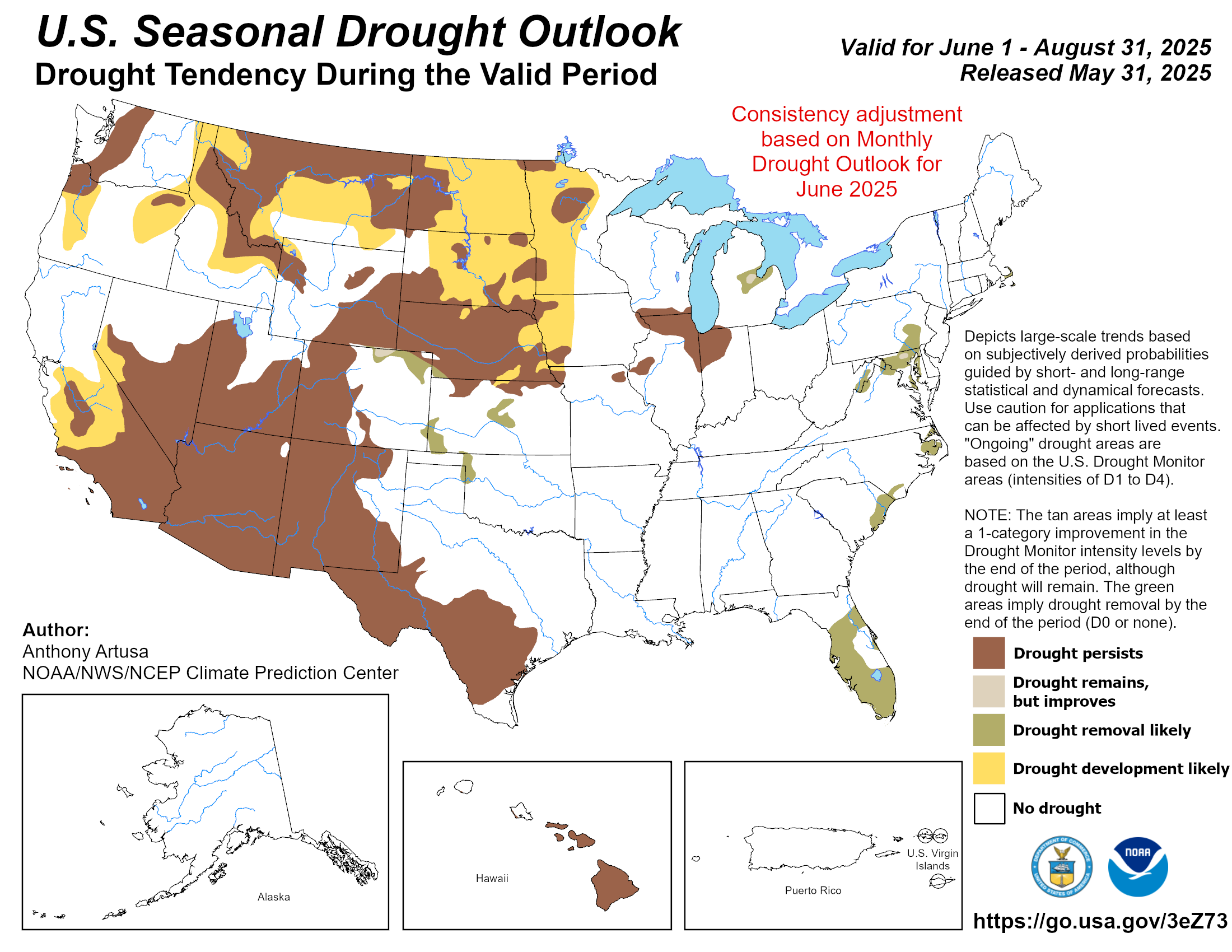
The Upstate, as well as the rest of the state, is in a drought, according to the US Drought Monitor. The months of November, December, January, and February had below-average rainfall. The Seasonal Drought Outlook from the National Weather Service predicts the drought will persist through April. Keep this in mind as plants come out of dormancy and water accordingly.
Lawn Care
- Water tall fescue lawns one inch per week to prevent drought damage.
- Do not fertilize tall fescue lawns after March 15.
- Post-emergent weed killers may be applied before warm-season lawns start to green up. If lawns have already started growing, it is not advisable to apply most post-emergent products until the lawn has fully greened up in May.
- Apply pre-emergent weed products to prevent summer weeds on warm-season lawns when there are 4 consecutive days of temperatures 65⁰ to 70⁰, typically in March. Make a second application 8 to 10 weeks later.
- Combination weed-and-feed products are not recommended in March. Lawns should not be fertilized until they have fully greened up in May.
Vegetable Garden
- Have your soil tested this month to prepare your garden. Instructions for collecting samples are in our HGIC 1652, Soil Testing factsheet. Take samples to your county Extension office for testing by the Clemson Agricultural Service Laboratory.
- Transplant broccoli, cabbage, chard, and kale into the garden starting mid-March.
- Sow cool-season vegetable seeds such as lettuce, radishes, carrots, peas, parsley, beets, and spinach.

Radishes can be sown in succession in spring.
Julia Nichols, © 2024 HGIC, Clemson Extension
- Plant seed potatoes (white- and red-skinned) starting March 15.
- Start seeds for summer crops such as cucumbers, squash, and melons indoors.
- Wait to transplant tomatoes and peppers after the last frost date in mid-to-late April.
- If the drought persists into spring and summer, consider adding drip irrigation to your vegetable garden.

Squash (Curcurbita pepo) is a warm-season vegetable that can be started from seed indoors a few weeks before the last frost date.
Julia Nichols, ©HGIC 2025, Clemson Extension
Flower Garden
- Perennial plants such as black-eyed Susans (Rudbeckia sp.), daylilies (Hemerocallis sp.), hostas (Hosta sp.), mums (Chrysanthemum sp.), and many more can be divided in March.

Black-eyed Susans (Rudbeckia fulgida var. deamii ‘American Gold Rush’) and other perennials can be divided in March.
Ginger E. Long, ©HGIC 2024, Clemson Extension
- Cool-season (half-hardy) annuals can be transplanted into the garden in March. Check local garden centers for sweet alyssum (Lobularia maritima), annual lobelia (Lobelia erinus), Johnny jump-ups (Viola tricolor), nasturtium (Tropaeolum majus), and snapdragons (Antirrhinum majus). These will bloom throughout the spring until the weather gets hot.

Sweet alyssum (Lobularia maritima), blue lobelia (Lobelia erinus), and Johnny jump-ups (Viola cornuta) bloom in a container in spring.
Ginger E. Long, ©HGIC 2024, Clemson Extension
- Prune summer-flowering shrubs such as Limelight hydrangeas (Hydrangea paniculata ‘Limelight’), butterfly bush (Buddleia sp.), rose of Sharon (Hibiscus syriacus) and beautyberry (Callicarpa americana) in early March for blooms this summer.
- Prune repeat-blooming roses like Knock Out® (Rosa ‘Radrazz’) in early spring, just as the buds swell. This includes floribundas, hybrid teas, and shrub roses. Do not prune old-fashioned roses and climbers until after they bloom.
- Fertilize established spring-blooming bulbs like daffodils, hyacinths, crocus, etc., with a bulb fertilizer.
Mulch
- Apply mulch if needed in early spring to landscape beds to prevent weed seeds from germinating.
- The vegetable garden needs mulch to prevent weeds from competing with plants for water and nutrients.